Showing posts sorted by relevance for query task force. Sort by date Show all posts

Sunday, January 28, 2018

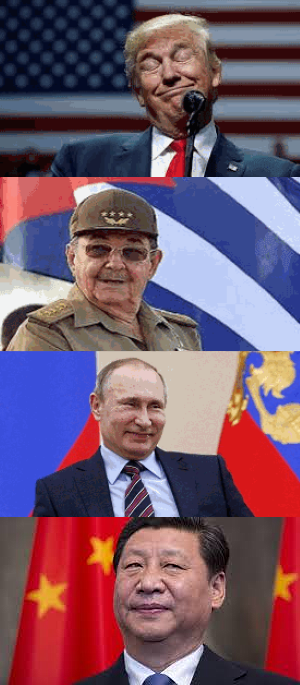
The Cuba Internet Task Force -- a win for Trump, Castro, Putin and Xi

President Obama began working on Cuban rapprochement during his 2009 presidential campaign. After over five years of thought and negotiation, the Whitehouse announced a major shift in Cuba policy, which included allowing telecommunications providers "to establish the necessary mechanisms, including infrastructure, in Cuba to provide commercial telecommunications and Internet services, which will improve telecommunications between the United States and Cuba."

When President Obama's trip to Cuba was announced, I speculated on possible Internet-related advances but was disappointed by the results. While in Cuba, the President held optimistic public meetings and several Internet-related projects were announced, but, as far as I know, none of them materialized. Can we expect more from Trump?

Last summer, Trump said he would be changing our Cuba policy and I speculated on how it might affect the Internet, but could not think of anything reasonable. When he published his Cuba policy memorandum, one of its purposes was to restore Cuban's "right to speak freely, including through access to the Internet" and one of its goals was to "amplify efforts to support the Cuban people through the expansion of internet services."

Trump said he was "canceling the last administration’s completely one-sided deal with Cuba," but his Internet policy sounded a lot like Obama's. The only concrete difference I saw was that Trump had ordered the State Department to convene a task force "to examine the technological challenges and opportunities for expanding internet access in Cuba."

Last week, the State Department issued a public invitation to attend the first meeting of that Cuba Internet Task Force on February 7th.

I called the State Department to ask whether the meeting would be streamed or archived and was told that it would not. I asked if they had any information on the meeting agenda, the charge of the task force and who the members were. They referred my questions to the Press office, but they did not answer.

We will hopefully learn more after the meeting, but what might Trump do? Will we see the laissez-faire Trump who promised Saudi Arabia that "America will not seek to impose our way of life on others" or some sort of digital Bay of Pigs like the failed smuggling of satellite equipment into Cuba, Zunzuneo or the Alan Gross affair?

My guess is that not much will happen -- that this task force and the rest of Trump's Cuba policy is for domestic political consumption by anti-Castro politicians and voters. The Cuban government is also using the task force for domestic political consumption. Their reaction to its formation was predictable -- saying that Cuba is being attacked by a powerful, hostile nation. Within a few days of the formation of the task force, many articles like this one were published by the Cuban government and allied publications like China's Xinhua and Russia's RT. (Perhaps rekindling the Cold War is part of making America great again).

Ironically, this task force is a political win for both Castro and Trump -- autocracy thrives on fear and mistrust.

=====
Update 2/2/2018

Last night I saw The Final Year, a documentary on the final year of the Obama administration. In it, former Whitehouse staff member Ben Rhodes says it took them time to realize that Putin was not motivated by the interests of Russia, but by self-interest. That may be true to some extent for nearly all politicians, but it seems to fit Castro and Trump well in this case.

(As an aside -- Rhodes was one of the two White House staff members handling the negotiations leading up to our opening with Cuba).

=====
Update 2/3/2018

Following up on Ben Rhodes' comment on Putin -- establishing this task force or any other act that drives a wedge between Cuba and the US benefits Putin as well as Trump and Castro.

While Castro and Trump use the rift between their nations for domestic political advantage, Putin uses it for international political advantage and commerce.

The dissolution of the Soviet Union caused an economic crisis in Cuba, sharply cutting trade and cooperation with Russia and other Soviet republics, but in the last few years, trade and cooperation have picked up. In 2014, Russia forgave 90 percent of the $35 billion debt Cuba incurred during the economically difficult "special period" of the 1990s, with the remaining $3.5 billion to be settled by giving preferential treatment to Russian investments on the island.

Cuba and Russia are also cooperating on oil exploration, extraction and refining and Cuba is importing oil, cars, trucks, and railway infrastructure and equipment. Trade between Russia and Cuba rose 73 percent in the first half of 2017 to $176 million. There has even been talk of Russia reopening it's cold war Signals Intelligence base, which once had a staff of 1,500 in Cuba.

While Russia is building commercial and political ties with Cuba, China remains their largest trading partner and a major supplier of Internet and computer equipment. (For more on Cuba-China trades, click here). Even Iran is allying with Cuba.

Russia is also on the "right side" of public opinion of the Cuban embargo. The embargo is unpopular in Latin America and the rest of the world. (The US and Israel support the embargo in the UN and the remaining 191 UN member states oppose it).

Evidently making America great again entails having a hostile ally of Russia and China 90 miles from Florida -- sound familiar? Putin and Ji may be the biggest winners from our Cuban policy shift and the Cuban and American people the biggest losers.

Castro and Putin meeting at the UN (source)

=====
Update 2/7/2018

Reuters reports that Cuban independent media outlets oppose Trump's Cuba Internet policy.

Elaine Diaz, founder of Periodismo de Barrio, José Jasán Nieves, director of El Toque and Miguel Alejandro Hayes who writes for La Joven Cuba are all quoted as opposing the Trump initiative.

Nieves said civil society initiatives had "flourished" after the Obama-Castro detente and Diaz said she would refuse any money the Trump program might award and stressed that they are independent media "independent of Cuban authorities as well as any other government." Hayes does not agree with Trump's goal of toppling the Cuban government.

Of course, these are only three of many independent journalists in Cuba and they are not extremists.

I suspect that this Task Force will be given a budget and, if independent journalists are not interested in assistance from the US, they may end up funding secret projects like those mentioned above. That will allow Trump to claim to be tougher than Obama and the Cubans will discover the projects and overstate their significance -- propaganda wins for Trump and Castro while Putin and Ji smile quietly.

Friday, January 10, 2020

Cuban fake news about some fake news

Four CITF winners (source)
When the Cuba Internet Task Force (CITF) was established, it was touted as being formed for the benefit of the Cuban people, but that was fake news.

Granma recently posted a Trump-worthy article charging that the U. S. finances mercenary groups and gives scholarships to train young Cubans as fake leaders in a dirty Internet war on Cuba. The article also alleges that activists who live in Florida, Texas, Tennessee and Georgia have tried to manipulate Cuban opinion on the constitutional referendum using the hashtag #YoVotoNo on Twitter and it claims we do similar things in Iran and Bolivia.

I am not sufficiently naive to think that the US has never meddled with the Internet in Cuba and have blogged extensively about the Alan Gross case, Zunzuneo and the attempted smuggling of satellite receivers disguised as surfing equipment, but the claims made in this article are bogus. It is telling that there there are no links in the story -- nothing to substantiate any of the claims -- and I have first-hand knowledge of the central claim that:
In February of 2018, the so-called Cuba Internet Task Force was created, following instructions outlined in a Presidential memorandum on national security, released June 16, 2017. The website Razones de Cuba has documented that the CIA’s Political Action Group and institutions on the task force have highly qualified specialists who, based on models previously developed through Big Data, sent sector-specific messages to Cubans.
The CITF established two subcommittees, one to explore and develop recommendations on the role of the media and the free, unregulated flow of information through independent media in Cuba and the other to explore and develop recommendations for expanding Internet access in Cuba. I attended the first meeting of the Internet-access subcommittee, participated in the online discussions of both and reviewed and commented on their draft recommendations.

The Task Force Final Report is short -- only 1,904 words on 6 double-spaced pages. (This post is 631 words). It consists of a summary of the state of the Cuban Internet and regulatory policy followed by nine fairly obvious, tersely stated recommendations. I am unaware of any impact it has had on U. S. or Cuban action or policy.

The CIA and its Political Action Group (PAG) are not mentioned in the report and were never mentioned during the discussion leading up to it. No form of cyberattack or propaganda was discussed by the Task Force or called for in the final report. In short, this was a bland report and the Task Force was a show for Florida voters.

The quote regarding the CIA and PAG are taken from the English language version of the story. It is noteworthy that it has been edited out of the Spanish, French, German, Italian, and Portuguese versions. Each version credits the same author and I reached out to him asking about this but did not receive a reply. Furthermore, the article credits the Razones de Cuba Web site with having documented this CIA PAG meddling. I searched their Web site for terms like Grupo de trabajo, grupo de tarea and and 1984, but got no hits.

You get the picture -- the CITF did not work with the CIA and this Granma article does not document any of the charges it makes. In fact, it includes no links or quotes -- just assertions. When the CITF was established, it was touted as being formed for the benefit of the Cuban people, but that was fake news. It was a political move, intended to give Trump a boost in Florida. It also provided Cuba with propaganda fodder for articles like this one and strengthened the economic and political ties between Cuba and Russia and China.

Saturday, July 1, 2017

What does Trump's Cuba policy memorandum say about the Internet?

Trump orders the Secretary of State to create a Cuban Internet task force.

Last week I reviewed Trump's Cuban policy speech and its implications for the Internet. The speech was accompanied by a national security memorandum on strengthening US Cuba policy, which was sent to the Vice President, Cabinet Secretaries, and heads of various departments.

The first thing that struck me about the memorandum was that it was a "national security" memorandum. Does Trump think Cuba poses a threat to our national security and how does his policy improve the situation? That is a topic for another discussion, but what does the memorandum say about the Internet?

The memorandum addresses the Internet in its purpose, policy and implementation sections.

The purpose section states that in Cuba "the right to speak freely, including through access to the internet, is denied, and there is no free press." One of the purposes of the memorandum is to restore the right to speak freely on the Internet. The Cuban government censors and sometimes punishes dissent and uses the Internet for propaganda, but it is not clear that Trump's policy and attitude will improve the situation. Furthermore, freedom of speech online is often abused and it is ironic that Trump should lecture anyone on this issue.

In the policy section, Trump says he will "amplify efforts to support the Cuban people through the expansion of Internet services, free press, free enterprise, free association, and lawful travel." This sounds good, but, at best, it is inconsistent with the policy he outlined last month in Saudi Arabia when he promised that "America will not seek to impose our way of life on others but to outstretch our hands in the spirit of cooperation and trust." At worst, he could be considering actions like the failed smuggling of satellite equipment into Cuba, Zunzuneo or the Alan Gross affair.

The implementation section says he will "support the expansion of direct telecommunications and Internet access for the Cuban people" by having the Secretary of State convene
a task force, composed of relevant departments and agencies, including the Office of Cuba Broadcasting, and appropriate non-governmental organizations and private-sector entities, to examine the technological challenges and opportunities for expanding internet access in Cuba, including through Federal Government support of programs and activities that encourage freedom of expression through independent media and internet freedom so that the Cuban people can enjoy the free and unregulated flow of information
I contacted the State Department to see if they could tell me more about the task force, but they offered no details at this time. I'll follow up on this.

I cannot end this post without commenting on the writing style of the memorandum. It is written in the first person, implying that Trump actually wrote it. I am sure it was drafted and revised by staff, but gratuitous adjectives as in "dissidents and peaceful protesters are arbitrarily detained and held in terrible prison conditions," sounded Trumpian to me and the call for the establishment of a task force, quoted above, reminded me of James Joyce. I also found the organization confusing in places. Some policies seemed more like goals and one of them is to "not reinstate the 'Wet Foot, Dry Foot' policy." One wonders why he did not also vow not to reinstate limits on the value of rum and cigars travelers are allowed to bring back from Cuba.


Tuesday, May 29, 2018

The Internet in Cuba -- a Periodismo de Barrio anthology

Periodismo de Barrio has edited a collection of 13 articles on the Cuban Internet in collaboration with the Internet Policy Observatory at the University of Pennsylvania. The articles cover the history of the Cuban Internet, the legal framework, services, communities, and projects. It is a diverse collection -- something for everyone. Here are thumbnail summaries of each article:
¿Puede Estados Unidos conectar a Internet a los cubanos? – Elaine Díaz Rodríguez
A critical look at US efforts to enhance Cuban connectivity, from the Clinton administration through the recent formation of the Cuban Internet Task Force by Trump
La ruta de Internet en Cuba – Anidelys Rodríguez Brito
A survey of Cuban networking from the pre-Internet days through today's 3G, home DSL, and public access points
Internet en Cuba: ¿limitada por la política o la economía? – Eloy Viera Cañive
A survey of the political and economic factors that curb Cuban access and content
¿Quién eres, ETECSA? – Mabel Olalde Azpiri
A history of ETECSA and its role in serving Infomed and other networks as well as the general public
Variaciones sobre la wifi – Lianet Fleites
A portrait of WiFi hotspot users and uses
Te quiero, mi sangre – Geisy Guia Delis
People connecting with expatriate family members
Nauta Hogar: nueva herramienta para emprendedores cubanos – Julio Batista Rodríguez
Nauta Hogar: a new tool for Cuban entrepreneurs
El color verde en la palabra Sígueme – Jesús Jank Curbelo
A look at Sígueme, the SNET "Facebook" application
Se venden héroes a diez pesos – Carlos Melián
Kids playing multiplayer online games
Tecnología y cambio social en Cuba: en busca de hipervínculos – Mónica Baró Sánchez
An interview of Yohana Lezcano Lavandera, who advocates computer literacy education
El Callejón de los Milagros – Rogelio Serrano
An interview with professor and researcher Juan Antonio García Borrero about his project The Alley of the Mircales
Ocho aplicaciones contra la desconexión – Mónica Baró Sánchez
Descriptions of eight mobile phone apps that can be used offline
¿Qué podría hacer el gobierno cubano en el escenario virtual? – Jessica Domínguez Delgado
Potential e-government applicatioins in Cuba
Perhaps the most outstanding feature of this collection is not any one of the articles, but the fact that they were pulled together and edited as an innovative online "dossier" -- an anthology of articles on the Internet in Cuba.

Finally, the editor, Elaine Díaz Rodríguez. asked me for feedback on her opening contribution ¿Puede Estados Unidos conectar a Internet a los cubanos? and I might as well share my comments.

Elaine covered several US efforts to influence the Cuban Internet, most recently Trump's Cuban Internet Task Force. I've written a couple of posts on the Task Force, which I see as a political act. That being said, the Task Force participant's hearts are in the right place for the most part and we can hope that genuine aid and investment might be possible in the future if Trump is defeated and Diaz-Canel adopts Internet-friendly policies.

Elaine also drilled down on the Alan Gross fiasco. I've written many posts about Alan Gross, including several on what he actually did, how little difference he would have made had he succeeded and how much the Cubans overstated the impact it would have had.

I agree with Elaine that nothing happened as a result of President Obama's trip to Cuba. That being said, Google has worked diligently, before and after President Obama's trip, to establish relationships in Cuba. The only concrete result has been their caching server (GCC) in Cuba, but the relationships they have built may pay off in the long run. (GCC has resulted in a noticeable increase in YouTube traffic relative to Facebook).

I've also written posts on La ruta de Internet en Cuba -- including one on the initial Cuban Internet connection over a link provided by Sprint with a subsidy from the US National Science Foundation and several on pre-Internet networking in Cuba.

I've speculated on the question raised in the essay Internet en Cuba: ¿limitada por la política o la economía?. From the early days of the Internet, it has been both the economy and politics, but I would add vested interests and bureaucracy today.

Another post asks ¿Quién eres, Etecsa?, a question I've also asked, but can't answer.

The post Te quiero, mi sangre shows WiFi hotspots being used to communicate emotion and presence, in the tradition of the pioneering Hole in Space performance art project.

I've also looked at Nauta Hogar, and, while I agree that it is useful for some tech and other small businesses, it is a dead end on the road to home connectivity.

The articles include photos and other images as well as original illustrations.

=====
Update 5/31/2018

Periodismo de Barrio is also experimenting with short video documentaries about the Cuban Internet. Here are links to their first five videos:

Sunday, February 11, 2018

Suggestions for the Cuba Internet Task Force

John S. Creamer
The Cuba Internet Task Force (CITF) held their inaugural meeting last week.

Deputy Assistant Secretary for Western Hemisphere Affairs John S. Creamer will chair the CITF and there are government representatives from the Department of State, Office of Cuba Broadcasting, Federal Communications Commission, National Telecommunications and Information Administration and Agency for International Development. Freedom House will represent NGOs and the Information Technology Industry Council will represent the IT industry.

They agreed to form two subcommittees -- one to explore the role of media and freedom of information in Cuba and one to explore Internet access. The subcommittees are to provide preliminary reports of recommendations within six months and the CITF will reconvene in October to review those preliminary reports and prepare a final report with recommendations for the Secretary of State and the President.

They are soliciting public comments, looking for volunteers for service on the subcommittees and have established a Web site.

I may be wrong, but it sounds like the subcommittees will be doing much of the actual work. The subcommittee on technological challenges to Internet access will include US technology firms and industry representatives and the subcommittee on media and freedom of information will include NGOs and program implementers with a focus on activities that encourage freedom of expression in Cuba through independent media and Internet freedom. They aim to maintain balance by including members from industry, academia and legal, labor, or other professionals.

I hope the Task Force resists proposals for clandestine programs. Those that have failed in the past have provided the Cuban government with an excuse for repression and cost the United States money and prestige. Both the Cuban and United States governments have overstated what their impact would have been had they succeeded.

Cuba's current Wi-Fi hotspots, navigation rooms, home DSL and 3G mobile are stopgap efforts based on obsolete technology and they provide inferior Internet access to a limited number of people. (El Paquete Semanal is the most important substitute for a modern Internet in Cuba today).

It would be difficult to devise plans or offer support for activities that the current Cuban government would allow and be able to afford; however, the situation may ease somewhat after Raúl Castro steps down in April. Are there short-run steps Cuba would be willing to take that we could assist them with?

For example, the next Cuban government might be willing to consider legitimizing and assisting some citizen-implemented stopgap measures like building street nets and rural community networks, selling geostationary satellite service and installing LANs in schools and other organizations.

They might also be willing to accept educational material and services like access to online material from Coursera or LAN-based courseware from MIT or The Khan Academy. (At the time of President Obama's visit, Cisco and the Universidad de las Ciencias Informaticas promised to cooperate in bringing the Cisco Network Academy to Cuba, but, as far as I know, that has not happened).

The US requires Coursera and other companies to block Cuban access to their services. We could reverse that policy unilaterally, without the permission of the Cuban government.

Google is the only US Internet company that has established a relationship with and been allowed to install infrastructure in Cuba. The next Cuban administration might be willing to trust them as partners in infrastructure projects like providing wholesale fiber service or establishing a YouTube production space in Havana. Cuba could also serve as a test population for Google services optimized for low-bandwidth networks.

These are short-term, stopgap measures. In the long run, Cuba should investigate opportunities for leapfrogging – planning for technology like 5G wireless and low-Earth orbit satellites that will be available in, say, five years. Our mobile phone companies and nascent satellite ISPs SpaceX and OneWeb may have significant offerings in five years -- might Cuba be willing to work with them?

Long-run steps like these would require Cuba's leapfrogging regulatory and infrastructure-ownership policy. The ITU defines four generations of regulation and Cuba is one of the few remaining first-generation nations -- might the Cuban government be willing to make policy changes in five years?


Tuesday, September 29, 2020

What became of the ARCOS undersea cable connection to Cuba?

Will Trump kill the proposal before the election?


Proposed 56km link between the
ARCOS undersea Cable and Cuba
Cuba's primary connection to the global Internet is through the ALBA-1 undersea cable linking landing points on the south-east shore of the island to Venezuela and Jamaica; however, the bulk of Cuban traffic originates in Havana which is on the north-west coast. Traffic from Havana and other cities in the west travels over a backbone to reach the cable landing points. A landing point near Havana would reduce the load on the backbone, speeding connections, providing redundancy, and saving capital investment.

At one time, there seemed to be bipartisan support in the US for improving Cuban Internet access. During his second term, President Obama pursued detente with Cuba and much of that effort was focused on the role of the Internet and undersea cable connectivity was part of the plan. Daniel Sepulveda, Deputy Assistant Secretary of State and U.S. Coordinator for International Communications and Information Policy, who led two US government delegations to Cuba during the Obama administration, said there were at least a half-dozen proposals — from US and non-US companies — to construct a north-south undersea cable between the US and Cuba. There had even been discussion of one day allowing Cuban access to the US cable at Guantanamo, GTMO-1.

At first, Trump seemed to agree -- consider the following timeline:

  • October 20, 2017, The State Department issued National Security Presidential Memorandum, NSPM-5, stating that it was our policy to "Amplify efforts to support the Cuban people through the expansion of internet services" and directing government departments and agencies "to examine the technological challenges and opportunities for expanding internet access in Cuba."
  • January 22, 2018, The State Department established a Cuba Internet Task Force "to examine technological challenges and opportunities for expanding internet access in Cuba." (Disclosure -- The Task Force formed two sub-committees and I was a member of both).
  • July 23, 2018, The consortium that owns the ARCOS cable applied to construct a branch from the cable to an ETECSA supplied cable landing spot in Cojimar, Cuba.
  • August 10, 2018, The FCC found the application "to be acceptable for filing and subject to the streamlined processing procedures" obligating them to take action "within forty-five (45) days" unless upon "further examination" the application is "deemed ineligible for streamlined processing."
Well, it seems the application must have been deemed ineligible since as far as I know nothing happened until earlier this month when The Committee for the Assessment of Foreign Participation in the United States Telecommunications Services Sector (CAFPUSTSS), which Trump established in an executive order on April 4, 2020, notified the FCC that it is planning to conduct 120-day security reviews of the ARCOS application.

I reached out to the FCC and the attorney who filed the request for the cable branch to ask why the application had not been acted upon but got no reply. I can think of two possible explanations:
  • Trump changed his policy with respect to Cuban Internet connectivity without, as far as I know, telling anyone.
  • Trump held this application up in order to grab a Florida headline between now and the election when the CAFPUSTSS rejects the application showing how tough he is on Cuba in an effort to win Cuban and Venezuelan votes.
I'm unfamiliar with FCC procedures and workflow -- is there another explanation?

Finally, note that on March 15, 2018, Deep Blue Cable Inc. applied for a Caribbean cable with 19 landing points. While none of those were in Cuba, they planned a second phase with two Cuban landing points, but the Deep Blue application was withdrawn on November 11, 2019.

Update 11/30/2020

Denise Coca, FCC Division Chief, informed me that the ARCOS-1 application had been withdrawn on October 20, 2020, about two weeks before the election. When asked why the FCC had taken so long to process the application, she did not answer.

I wonder whether this might be re-submitted to the Biden FCC. Since the administration sought Cuban rapprochement during his time as Vice President, I imagine Biden would favor the link. One can argue that doing so would be a net political win among Florida voters. Would Cuban president Díaz-Canel approve it? It would reduce traffic on the Cuban backbone and improve international connectivity, but might be construed as a security threat and neutralize one of his complaints against the US.

Tuesday, February 23, 2021

A simple suggestion for President Biden regarding the Cuban Internet

President Biden has a lot on his plate, but having someone pursue a Cuban undersea cable would be simple and benefit both Cuba and the US.

The Cuban backbone (source)
Last September I asked what had happened to the proposal for a branch connecting the ARCOS undersea cable, which has a landing point in North Miami Beach, to Cojimar, Cuba. The consortium that operates the cable had applied for permission to connect Cuba in July 2018 and the FCC granted a request for streamlined processing, which should have taken less than 45 days, but nothing happened until September 2020 when the application was referred to a Justice Department committee for the assessment of foreign participation in the telecommunication services sector, that Trump had established in an executive order on April 4, 2020.

On October 26, 2020 -- shortly before the election -- the application was withdrawn without explanation. I asked the FCC officials involved why the processing had taken so long and why the application was withdrawn, but received no answer. I also filed Freedom of Information Act Requests with the FCC and Justice Department, but my questions were not answered. (Justice did not even reply).

But that is history -- spilled milk. During the campaign, President Biden said he would "try to reverse the failed Trump policies that inflicted harm on Cubans and their families" and he has taken steps to liberalize travel and remittances. He has a lot on his plate beside Cuba, but having someone pursue a Cuban undersea cable would be simple and benefit both Cuba and the US.

The first step would be to contact the operators of the ARCOS cable to see if they are still interested in the Cuban branch. If not, other options should be pursued. Daniel Sepulveda, who was Deputy Assistant Secretary of State and U.S. Coordinator for International Communications and Information Policy, in the Obama administration said there were at least a half-dozen proposals — from US and non-US companies — to construct a north-south undersea cable between the US and Cuba. There had also been discussion of one day allowing Cuban access to the US cable at Guantanamo, GTMO-1.

An undersea cable to the US would be a boost to the Cuban Internet. Nearly all Cuban international traffic is carried over the ALBA-1 cable, which lands at the south-east end of the island so traffic from heavily populated areas like Havana must traverse the national backbone. An undersea cable from Cojimar, which is near Havana, would reduce latency, free backbone capacity, save capital investment and provide a backup path in case of an outage.

Note that even Trump would agree with this proposal. His policy was to "amplify efforts to support the Cuban people through the expansion of internet services" and he directed government departments and agencies "to examine the technological challenges and opportunities for expanding internet access in Cuba." He also established a task force "to examine technological challenges and opportunities for expanding internet access in Cuba" and did nothing to reverse any of President Obama's Cuba telecommunication policies.

President Biden might be concerned that such a move might be politically damaging since Cuban-American voters in Florida favored Trump in the last election, but that is not a sure thing. The 2020 Florida International University Cuba Poll showed that among south Florida Cubans, young people are most liberal on issues like the embargo and all except those over 75 consider Cuba policy less important than the economy, health care, race, immigration, and China policy. Demographics and Trump's impeachments may have shifted Cuban voting patterns by 2022 or 2024.

Supporting an undersea cable between the US and Cuba would also enhance our reputaion in the region and encroach upon China's near monopoly as a vendor of Cuban Internet infrastructure. It would also strengthen the US's strategic position vis-a-vis China's expansion in the region.

President Obama sought rapproachmont with Cuba and several Internet-related proposals followed, but the result was disappointing. Trump and Raúl Castro are now ex-presidents so the ARCOS cable may stand a chance. (It would not be unprecedented -- Cuba's first connection to the Internet was through the US National Science Foundation International Connections Program for research and university networks in developing nations).

Update 4/5/2021

In March 2019, Google and ETECSA signed a memorandum of understanding committing to cost-free interchange of traffic between their networks once Cuba was able to connect to a new undersea cable that would be laid, presumably to Miami "sometime in the future." That cable has not yet been laid and I got no answer when I asked Google what the project status was last week.

Google has persisted in an effort to improve Cuban Internet connectivity and access for years but the effort has yielded very little. They have installed Google Global Cache servers in Cuba, enabling ETECSA to serve some Google content from within its own network, and established one public WiFi hotspot.

There were hopes for progress when President Obama visited Cuba, but the Cuban government under Raúl Castro was unwilling and Díaz-Canel was met by Trump. President Biden has a lot on his mind these days, but I hope Google is hanging in.

Wednesday, January 1, 2020

Could ETECSA at least talk with SpaceX?

Consider the following:
Could ETECSA at least talk with SpaceX?

Update 1/9/2020

For a Spanish translation of this post, click here.

Monday, July 19, 2021

President Díaz-Canel, The Cuban Internet is more than Facebook on a cell phone -- don't be afraid of it.

The Internet could and should be controlled and used to serve peace and development.
Ramiro Valdés Menéndez, Cuban Minister of Informatics and Communications, 1997

Ramiro Valdés Menéndez
As a result of Internet service interruption during the recent anti-government protests in Cuba, Florida Senator Rubio and Governor DeSantis and President Biden have called for measures to strengthen and guarantee Cuban Internet connectivity, but that won't happen until the Cuban government recognizes that doing so is in its long-run interest.

I have seen several suggestions that we smuggle end-user satellite terminals from services like SpaceX Starlink into Cuba, but attempts to smuggle in end-user terminals by Alan Gross and others disguised as surfing equipment have failed spectacularly. Furthermore, they would have been inconsequential drops-in-the bucket had they succeeded.

However, if the Cuban government would permit it, SpaceX service in Cuba would benefit the Cuban people and, in doing so, strengthen the position of the Cuban government.

There have also been several proposals to provide undersea cable connectivity to Cuba. The most recent one was killed in the US, but I'm confident that President Biden would support it (or another one) if the Cuban government would permit it.

I served on the advisory subcommittees to the Cuban Internet Task Force, and made a number of recommendations for facilitating Cuban Internet connectivity. Again, none of these proposals would work without the support of the Cuban government.

The Cuban government was frightened by the role mobile phones, running communication and social media applications, played in the protests, but mobile apps are one small part of the full Internet. Widespread fixed broadband connectivity via satellite and improved cable capacity would have positive effects on the economy, education, healthcare, entertainment, etc., thereby enhancing the government’s standing with the people.

Fidel Castro opens the Youth Computer Clubs.
When the Internet first came to Cuba, there was a high-level debate on its risks and rewards. Ramiro Valdés Menéndez, then Minister of Informatics and Communications, is often quoted as calling the Internet "the wild stallion of the new technologies" and a potential tool for "global extermination," but he went on to say it "could and should be controlled and used to serve peace and development." Fidel Castro also recognized the potential upside of the Internet and supported the establishment of Youth Computer Clubs throughout the nation. (They were networked using pre-Internet technology.)

The same debate took place in China around that time, and they decided on a robust but controlled Internet. It would be great if the US could convince the Cubans that the Chinese and Valdés were right. If we cannot, the Chinese, with their own satellite and cable projects, may.

Tuesday, February 20, 2018

SpaceX Starlink and Cuba -- a match made in low-Earth orbit?

I've suggested that Cuba could use geostationary-orbit (GSO) satellite Internet service as a stopgap measure until they could afford to leapfrog over today's technology to next-generation infrastructure. They did not pick up on that stopgap suggestion, but how about low-Earth orbit (LEO) satellite Internet service as a next-generation solution?

SpaceX, OneWeb, Boeing and others are working on LEO satellite Internet projects. There is no guarantee that any of them will succeed -- these projects require new technology and face logistical, financial and regulatory obstacles -- but, if successful, they could provide Cuba with affordable, ubiquitous, next-generation Internet service.

Cuba should follow and consider each potential system, but let's focus on SpaceX since their plan is ambitious and they might have the best marketing/political fit with Cuba.

LEO satellite service will hopefully reach a milestone this week when SpaceX launches two test satellites. If the tests go well, SpaceX plans to begin launching operational satellites in 2019 and begin offering commercial service in the 2020-21 time frame. They will complete their first constellation of 4,425 satellites by 2024. (To put that in context, there are fewer than 2,000 operational satellites in orbit today).

SpaceX has named their future service "Starlink," and, if Starlink succeeds, they could offer Cuba service as early as 2020 and no later than 2024 depending upon which areas they plan to service first.

What has stopped the Cuban Internet and why might LEO satellites look good to Cuba?

Cuba blames their lack of connectivity on the US embargo, but President Obama cleared the way for the export of telecommunication equipment and services to Cuba and Trump has not reversed that decision.

I suspect that fear of losing political control -- the inability to filter and surveil traffic -- stopped Cuba from allowing GSO satellite service. Raúl Castro and others feared loss of control of information when Cuba first connected to the Internet in 1996, but Castro is about to step down and perhaps the next government will be more aware of the benefits of Internet connectivity and more confident in their ability to use it to their advantage.

A lack of funds has also constrained the Cuban Internet -- they cannot afford a large terrestrial infrastructure buildout and are reluctant (for good and bad reasons) to accept foreign investment. SpaceX is building global infrastructure so the marginal cost of serving Cuba would be near zero.

They say that the capital equipment for providing high-speed, low-latency service to a Cuban home, school, clinic, etc. would be a low-cost, user-installed ground-station. I've not seen ground-station price estimates from SpaceX, but their rival OneWeb says their $250 ground-station will handle a 50 Mbps, 30 ms latency Internet link and serve as a hot-spot for WiFi, LTE, 3G or 2G connectivity.

Since the marginal cost of serving a nation would be small and they hope to provide affordable global connectivity, I expect their service price will vary among nations. Prices would be relatively high in wealthy and low in poor nations -- there would be no point in having idle satellites flying over Cuba or any other place.

Expansion of the Cuban Internet is also constrained by bureaucracy and vested financial interest in ETECSA and established vendors. While I do not endorse Cuba's current monopoly service and infrastructure ownership policy, it could remain unchanged if ETECSA were to become a reseller of SpaceX Internet connectivity.

In summary, if Starlink succeeds, they could offer affordable, ubiquitous high-speed Internet, saving Cuba the cost of investing in expensive terrestrial infrastructure and allowing ETECSA to maintain its monopoly. The only intangible roadblock would be a loss of control of traffic. (But Cuban propagandists and trolls would be able to reach a wider audience :-).

That is the rosy picture from the Cuban point of view, what about SpaceX?

OneWeb plans to offer LEO satellite Internet service in Alaska in 2019 and hopes to cover all of Alaska by the end of 2020.

How about SpaceX starting by serving Cuba?

I don't know the SpaceX constellation rollout plan, but satellites that serve Cuba would also be capable of serving the eastern US and FCC licenses are conditional upon providing US service in a timely manner.

Since Cuba is an island nation, portions of the footprint of satellites serving Cuba would fall on the uninhabited ocean. That would reduce population destiny in the satellite footprint area, freeing capacity for use by customers in relatively urban areas.

Selecting Cuba as its initial service market would be an audacious move, but Elon Musk is not a conventional, conservative businessman. SpaceX would get a lot of publicity from a Cuba opening and, like the roadster they just launched into orbit, first offering Starlink service in Cuba would have symbolic value -- marking an opening to Cuba.

There is pent-up demand for Internet access in Cuba since they have very poor Internet access given their level of education and development.

Cuba is 166th among the 176 nations the International Telecommunication Union (ITU) ranks on access to telecommunications. Haiti, ranked 167th, is the only nation in Latin America and the Caribbean (LA&C) that ranks below Cuba, yet Cuba ranks 9th in the region on the ITU telecommunication-skills index. Cuba ranks tenth in LA&C on the United Nations Development Programme's human-development index and their mean years of schooling is the highest in the region.

Cuba's relatively high human-development and IT-skill indices reflect its emphasis on free public education at all levels. This is exemplified by the curriculum at Cuba's Information Science University, where students pay no tuition but are required to work on useful applications in education, health, sport, and online government.

But, perhaps the biggest contributor to pent-up demand is El Paquete Semanal, a weekly distribution of current, pirated Internet content that is distributed throughout the nation. I've heard the claim that 95% of Cubans see El Paquete content each week. That sounds high, but it is very popular and has been alleged to be Cuba's largest private employer.

The political situation is the elephant in the room. The US has formed a Cuba Internet Task Force and Trump is following President Obama's lead in seeking to strengthen the Cuban Internet, so it unlikely that the US government would object to SpaceX offering Starlink service to Cubans.

That being said, such a move would be unpopular among some members of Trump's Cuban "base." While there might be some domestic political cost to SpaceX, an opening to Cuba would be seen as extremely positive in Latin America and the rest of the world and SpaceX and Tesla are global companies. (Only Israel supports the US embargo of Cuba).

If you guys want to talk about this, DM @RaulCastroR and @elonmusk.

Update 2/27/2018

Two years ago, Google invested $900 million in SpaceX, stating that they expected the acquisition would be used “to keep Google Maps accurate with up-to-date imagery and, over time, improve Internet access and disaster relief.”

In the aftermath of Hurricane Maria, Google began providing mobile phone and Internet connectivity in Puerto Rico using their Project Loon balloons and today they are serving 200,000 Puerto Rican users. They have learned from this effort and demonstrated the ability to provide Project Loon connectivity. How about using Starlink when it is available?

Starlink envisions low-cost, user-installed terminals at homes and other end-user sites, but their satellites will also have to connect to ground-stations and it turns out that Google has a lot of terrestrial points of presence on the Internet. Some of them are shown on the following map:

Google Global Cache locations(source)

Note that one of those points of presence is in Havana and two others are in Puerto Rico.

SpaceX rocketry, Starlink satellites and service plus Google's terrestrial infrastructure sounds like a formidable combination -- perhaps too formidable. A part of me would love to see such a combination succeed and eventually provide a truly global Internet, but I am also afraid of the market and political power that enterprise would have. Would this or any other global Internet service provider require unique regulation and, if so, what should it be and who has the power to do it?

If a global ISP monopoly (or even an oligopoly) doesn't worry you, what about adding strong AI -- is the Earth beginning to grow a nervous system -- with us as biological components (for the time being)?

Update 3/20/2019

SpaceX sister company, SpaceX Services, filed an FCC application for "a blanket license authorizing operation of up to 1,000,000 earth stations that end-user customers will utilize to communicate with SpaceX’s LEO constellation." Those end-users will be individuals, libraries, schools, etc. "throughout the contiguous United States, Alaska, Hawaii, Puerto Rico, and the U.S. Virgin Islands." SpaceX will begin launching operational satellites this year, and those that provide connectivity over the US east coast and Puerto Rico will have idle capacity when in sight of Cuba. Cuba isn't politically ready to allow home connectivity, but how about satellite links to Youth Clubs, schools, clinics, libraries, etc.? It would be legal from the US side and the sort of thing Elon Musk might like to do.

Update 12/30/2019

Elon Musk confirms that Starlink Broadband should be available in the Caribbean in 2020 or early 2021. See more here. How about a ground station at Google's data center?

Real Time Analytics