Showing posts sorted by relevance for query obama. Sort by date Show all posts

Thursday, May 25, 2017

Crooked media interviews on Cuba

"We were just trying to get Alan Gross out of prison at first" Ben Rhodes, Obama Administration Cuba negotiator

Crooked Media, which was created by three senior Obama White House staff members, produces several excellent (pro-Democratic) podcasts. One of those is PodSavetheWorld, hosted by Tommy Vietor, who spent nearly a decade as a spokesman for President Obama, specializing in foreign policy and national security issues.

Two episodes of PodSavetheWorld include interviews with high-level Obama staff members who were involved in forming our Cuba policy. The following describe and link to exceprts from those interviews.

The first excerpt is from an interview of Dan Restrepo, who served as a top Latin America advisor to President Obama. Restrepo had written a Cuban-rapprochement roadmap for candidate Obama during his first campaign and he returned to the topic in 2013. He says Obama was playing a "long game," knowing that his executive authority was limited and he could not move faster than US public opinion. Restrepo characterizes Obama's strategy as a bet that by creating a degree of freedom among the Cuban people, for example by expanding reparations and undermining Castro's excuse of blaming all problems on the Evil Empire, the Cuban government would be forced to change. He noted that the blame-US game was a hard sell after the Cuban people saw the Evil Emperor, who looked more like them than the current Cuban leaders, giving a speech on TV or at a baseball game with Raúl Castro.

The excerpt (14:20) is here and the full podcast (48:37) here.

The second excerpt is from an interview of Ben Rhodes, who served as a speechwriter and emissary for President Obama and was one of two White House staff members handling the negotiations leading up to our opening with Cuba. Rhodes and his colleague Ricardo Zuniga traveled to Canada for 12-15 secret meetings with Cuban representatives while working out the rapprochement details. At the start, they were only negotiating for the release of Alan Gross because Obama reasoned that rapprochement would be politically unacceptable if Gross remained in a Cuban prison. Early in the negotiation for Gross, they realized more was possible and the scope of the discussion broadened. Only a few people in the White House knew of these negotiations, but the Vatican was informed early and played a key role. (If you are unfamiliar with the Alan Gross case, click here).

The excerpt (11:30) is here and the full podcast (1:00:48) is here.

Tuesday, June 20, 2017

Trump's Cuba policy and its impact on the Cuban Internet

Overall, I don't see anything in Trump's policy that will directly impact the Cuban Internet, but it will have an indirect impact by delaying the eventual rapprochement between the US and Cuba.

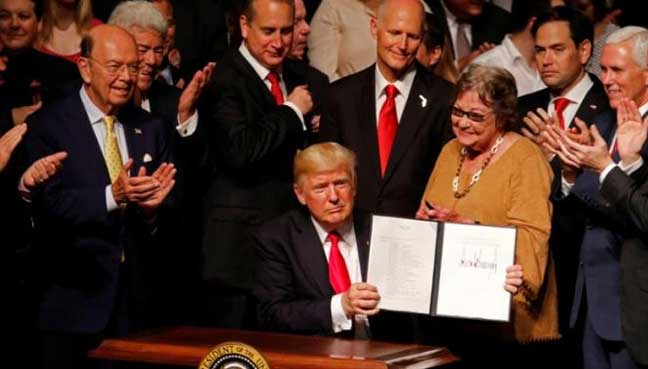
On June 12th, I speculated on Trump's forthcoming Cuba policy and its impact on the Internet. He outlined his policy in a June 16th speech (transcript) and the Treasury Department published a FAQ on forthcoming regulation changes. It looks like my (safe) predictions were accurate.

I predicted he would attack President Obama, brag about what he had done, make relatively minor changes that would not upset businesses like cruise lines, airlines, and telecommunication and hotel companies. I also said he would criticize Cuban human rights, while hypocritically ignoring the issue in other countries.

For example, he slammed President Obama and bragged that "I am canceling the last administration’s completely one-sided deal with Cuba."

This does not come close to passing a fact-check. He said he was going to restrict people-to-people travel and stop people from doing business with companies owned by the Cuban Military, but that is far from canceling President Obama's "deal," which included little things like establishing diplomatic relations, reducing constraints on remittances, dropping the wet-foot-dry-foot policy, allowing US companies to do business with self-employed Cubans, allowing US companies to sell telecommunication equipment and services, agricultural commodities, medicines, and medical devices in Cuba, taking Cuba off the list of state-sponsors of terrorism, etc. You get the idea -- he canceled none of this, not even President Obama's lifting of restrictions on rum and cigar imports for personal use.

His statements on Cuban human rights are either 100% hypocritical or he has changed his mind since his speech in Saudi Arabia last month. At that time, he promised that "America will not seek to impose our way of life on others but to outstretch our hands in the spirit of cooperation and trust."

If he really has changed his live-and-let-live human-rights policy, we can expect a spate of new sanctions, from Manila to Moscow.

I had one surprise -- his singling out hotels and other businesses operated by the military-run conglomerate, Grupo de Administración Empresarial S.A. (GAESA). Officials say existing hotel deals will not be effected, but the detailed regulations have not yet been released. This change will cut Cuban worker's jobs and GAESA's profit, but I guess the ban is good news for AirBnB and any future Trump hotel or resort in Cuba.

How about changes affecting the Cuban Internet?


I read the Fact Sheet on Cuba Policy, looking for changes that would affect the Internet, and did not find much.

The first "key policy change" is "allowing American individuals and entities to develop economic ties to the private, small business sector in Cuba." Someone should let him know that President Obama made such changes some time ago, for example in allowing software imports from the private sector.

In fact, someone should read him President Obama's 2009 Fact Sheet - Reaching out to the Cuban people. That document introduced many changes which enhance the ability of Cuban private, small businesses to "develop ties to the US," for example by authorizing "greater telecommunications links with Cuba to advance people-to-people interaction at no cost to the U.S. government." The fact sheet lists seven concrete telecommunication policy changes, none of which were "canceled" by Trump.

He has canceled none of President Obama's changes to encourage private Cuban business and added nothing new himself.

One change he did make is stopping "self-directed, individual travel" to Cuba. That will force would-be tourists to join fake groups and fake their travel reports or go to Aruba instead of Cuba, but it will not slow the deployment of Chinese telecommunication infrastructure.

I hope Trump's policy will not undo the progress made by Google in establishing a relationship with Cuba and gaining permission to install Google Global Cache servers on the island. The servers are not yet in use, and when they go online they will have a small practical impact, but they indicate that Google has built trust and a relationship with the Cuban government and Internet community. I bet representatives of Google and other companies who have established relationships with Cuba are trying to reassure their counterparts that this is a temporary, unpopular change in US policy.

Overall, I don't see anything in Trump's policy that will directly impact the Cuban Internet, but it will have an indirect impact by delaying the eventual rapprochement between the US and Cuba. The Cuban government will enjoy a few more years of claiming their economic problems are the result of the US embargo, the integration of the Cuban and American people will be slowed and The Chinese, Russians, and Iranians will have more time to establish political and business relationships in Cuba with diminished competition from the US.

Trump's speech did not change much practically -- its intent and impact were symbolic. It let him say he had carried out a campaign pledge, which was music to the ears of the Cuba-hardline audience at the Manuel Artime auditorium, named for a leader of the Bay of Pigs invasion. The talk lasted about 39 minutes with 53 applause breaks (50 for Trump, 3 for others) and a violin rendition of the Star Spangled Banner. Add to that the fact that Trump speaks slowly and repeats a lot of words and phrases, you realize that the speech was 90% political cheerleading and 10% content. You can watch the speech below, but reading the transcript is a lot quicker.


For a more comprehensive critique of Trump's Cuba policy see this article by Ben Rhodes, who was one of two White House staff members handling the negotiations leading up to our opening with Cuba. I also recommend the podcast interviews of Rhodes and Dan Restrepo, who served as a top Latin America advisor to President Obama and wrote a Cuban-rapprochement roadmap for candidate Obama before he was elected President. The interviews reveal President Obama's strategy and describe the negotiation process.

-----
Update 6/22/2017

Airbnb has published a report on their Cuba rentals. The following table summarizes their activity since they began Cuban operations in April, 2015:


Airbnb specializes in people-people rentals and contact so my guess is that the majority of their Cuba business has been "self-directed, individual travel," which Trump has banned. Thus, one of the two major changes he has introduced will work against his "key policy change" of "allowing American individuals and entities to develop economic ties to the private, small business sector in Cuba." It will also cut the goodwill and mutual understanding resulting from home-stay tourism. But, I bet he got a round of applause when he announced it in his speech last Friday.

For further discussion of the Airbnb report in Spanish, click here.

Monday, June 12, 2017

Speculation on Trump's forthcoming Cuba policy speech and its impact on the Cuban Internet

Trump has a dilemma. He has to take some executive action that will allow him to ridicule President Obama and show that he is punishing Cuba for its human rights violations and the confiscation of businesses and property after the revolution, but not harm US telephone companies, hotel chains, airlines and cruise lines.

Trump is expected to announce his Cuba policy next Friday in Miami. There can be little doubt that he will reverse some of President Obama's executive orders in order to brag to his base supporters and try to make the Cuban diaspora hardliners happy. He will say the President was weak and made a terrible "deal," which the world is ridiculing. He may even take yet another shot at Hillary Clinton.

Cuban people trust and like President Obama. He opened diplomatic relations between the US and Cuba and implemented a policy of reaching out to the Cuban people. He is shown here at a baseball game with the wife of Jackie Robinson.
Cubans do not see President Obama as
an "Evil Emperor."
There are some things that I bet he does not say. He will not compare Cuban human rights with those of his friends in Turkey, the Philippines, Saudi Arabia, Russia, et al. and he will not mention that he is lending credence to the tired claim that the US is the Evil Empire that is responsible for Cuban economic problems. He probably won't note the unpopularity of his action in Latin America and I don't expect him to say much about the security implications of alienating Cuba at a time when Russia, China, and Iran are moving closer either. (Someone should tell him about the Cuban missile crisis).

But, I can't imagine that he would do something major like break off diplomatic relations or do anything to harm the tourism and travel industries. That would hurt our economy, cost jobs and be unpopular with the general public which favors lifting the trade embargo.

What about the Internet?


By and large, the Cuban Internet is constrained by political/power considerations, tired political rhetoric and mistrust, the cost of infrastructure, the bureaucracy and economic interests of the ETECSA monopoly and Cuban government bureaucracy, not US policy.

But, what Internet-related changes might Trump reverse?

During his first hundred days, President Obama "reached out to the Cuban people" (emphasis added) by easing restrictions on remittances, family travel and gifts.¹ Increased remittances and gifts meant more Cuban people had laptops, tablets and smartphones to use in public access hotspots and access rooms as well as the money to pay for time online. Reversing these changes would deny ETECSA Interent-access revenue, but it would harm Cuban citizens with family abroad and give the government anti-US talking points. I will be surprised if Trump reverses these changes, but that does not mean he won't do it.

At the same time, the president eased restrictions on telecommunications allowing:
  • Phone companies to offer voice and data roaming
  • People in the US to pay for Internet-access and other telecommunication bills for Cubans
  • US Companies to establish fiber-optic cable and satellite links to Cuba
  • Satellite Internet and TV companies to serve Cuban companies
  • Companies to export personal communication equipment like mobile phones, computers and software and satellite receivers to Cuba
Cutting roaming would hurt US tourism and telephone companies -- it is hard to imagine Trump doing that. He might be willing prohibit Americans from buying phone and data minutes for Cubans -- that would only hurt Cuban people and payment services like Ding.com (an Irish company).

While US companies have permission to sell communication equipment and infrastructure to Cuba, I am not aware of any significant sales. Since China has dominated the Cuban Internet infrastructure market, stopping infrastructure sales would have little or no immediate impact, but it could become significant next year when Miguel Díaz-Canel, who seems to be pro-Internet, replaces Raúl Castro.

The FCC removed Cuba from their exclusion and reversing that might cause Google to remove their Cuban caching servers. If that were to happen, there would be little practical impact, but it would be symbolically significant.

President Obama also moved to allow US citizens and companies to pay self-employed Cuban entrepreneurs for software and services. I don't know the extent to which this occurs, but it is hard to see what would be gained by trying to stop the practice and who would be pleased to see it happen. I doubt that he will roll this one back.

A number of organizations and universities have sponsored conferences, training courses, hackathons, etc. in support of Cuban software entrepreneurs. I am not sure whether Trump could somehow block that sort of activity, but I cannot imagine why he would do so.

How about attacking President Obama's trip to Cuba? During that trip, he addressed Cuban entrepreneurs and announced a couple of concrete commitments, but they have all fizzled. Trump may point that out.

Trump has a dilemma. He has to take some executive action that will allow him to ridicule President Obama and show that he is punishing Cuba for its human rights violations and the confiscation of businesses and property after the revolution, but not harm US telephone companies, hotel chains, airlines and cruise lines. It does not seem that reversing any of President Obama's Internet-related changes will achieve that end.

Steve Bannon may be able to come up with some ideas, but, if he can't, I have a suggestion. One of the properties the Castro government seized after the revolution was the Riviera, a waterfront hotel and casino that is now run by the Cuban government. The hotel was built by the gangster Meyer Lansky and Lansky's grandson, Gary Rapoport, has claimed it. Perhaps he and Trump could work out a deal with the Cuban government, rebranding it the Trump Rivera.

-----
¹ The initial announcement of this was removed from the Whitehouse.gov Web site, but it was captured by the Internet Archive and is also on the Obamawhitehouse.gov Web site.


Tuesday, June 28, 2016

Disappointment after President Obama's trip to Cuba

President Obama meeting with Cuban entrepreneurs last March

Shortly before President Obama went to Cuba last March, I wrote a post on Internet-related announcements that might be made during the trip. It was pure speculation -- things like a Havana-Florida undersea cable or copyright and cyber-security agreements, significant infrastructure deployment -- and none of it happened.

However, The President did make some Internet-related announcements. He said Google would be announcing wireless connectivity during his visit and Stripe would offer their Atlas service to Cuban entrepreneurs -- providing a US tax ID, bank account and Delaware incorporation along with use of their global payment service. Stripe said they would be working with the Merchise Startup Circle in Cuba. The President also announced that Cisco would be offering their Cisco Academy training at Cuba's University of Information Science.

So, what has come of all this? Not much.

Google's wireless connectivity is the biggest disappointment. I've speculated on significant infrastructure and content investments Google could conceivably make in Cuba, but all they announced was a single WiFi hotspot at the studio of Cuban artist Kcho. Google supplied 20 Acer Chromebooks and a number of Nexus 5 phones with Cardboard viewers, and got a lot of publicity in return. Perhaps this is a necessary relationship-building step (Kcho is well connected), but in itself this hotspot is less than a drop in the bucket -- 99% hype and 1% substance, like Kcho's previous hotspot.

How about the deal with Stripe and their Cuban partner Merchise? In March, I contacted Merchise and Stripe to learn more about their business relationship. Merchise had nothing to say about their relationship with Stripe and Stripe said "Merchise is a partner in the the Stripe Atlas Network ... it isn't so much that we expect them to represent or market Stripe in Cuba; rather, if they know any specific entrepreneurs or businesses in Cuba for whom Stripe Atlas would be helpful, as a Network partner they can refer those entrepreneurs to us for early access to the Atlas program."

Last week, I asked Stripe if anything had come of the partnership to date and was told they had no concrete updates, but they had "been in touch with many Cuban entrepreneurs." I also asked Cisco about the status of and plans for their Cuban project, and was told that at this time they had nothing to add to what was said in the blog post announcing the relationship last March.

So far, nothing concrete and significant has come of the Internet projects Obama announced.

In addition to these announcements, The President met with Cuban entrepreneurs who described their businesses and briefly discussed them with him. During the meeting, he also introduced AirBnB co-founder Brian Chesky, praising him as a successful Internet entrepreneur and a role-model for young Cubans.

President Obama has continued his emphasis on entrepreneurship, most recently hosting 11 young Cubans at the Global Entrepreneurship Summit.

I've written about Cuban tech startups and support them wholeheartedly, but President Obama's upbeat tone overstates their potential impact. Internet companies focused on the Cuban market will not make a significant contribution until Internet access and the economy are improved considerably. Even then, no company will come close to the success of AirBnB with its $24 billion valuation without global reach. There is a potential market for Cuban educational and entertainment content and network services in Spanish-speaking nations, but Cuban entrepreneurs will not be able to go after those opportunities without major policy changes.

-----
Update 6/30/2016

I heard from the Merchise Startup Circle with respect to their Stripe partnership. They confirmed that they do not represent Stripe or sell Atlas membership -- their role as a member of the Stripe Network is to refer potential customers to Stripe. They are not alone in this -- they are one of over 100 incubators, accelerators, investors, and others who can refer top global entrepreneurs to the program. They do not receive a commission for the referrals and they do not hold equity in the enterprises they refer. Their payment is the satisfaction of supporting and encouraging the Cuban startup community. That is consistent with the tone of their meetings and their academic roots.

As mentioned above, Stripe says they have been in touch with many Cuban entrepreneurs and I bet most of them were referred by Merchise.

-----
Update 11/4/2016

This is not directly related to the Internet, but it is yet another disappointment after announcing optimistic plans for US entrepreneurs to work with Cuba.

The Obama administration gave a US company permission to build a tractor factory in Cuba's Mariel free-trade zone, but the Cuban government has refused to permit them to do so. Some say their reluctance to deal with US companies (other than those supporting tourism -- airlines, hotels, room rental and mobile phone roaming) is an effort to pressure Congress into eliminating the embargo.

Oggun tractors will be built in Alabama, not Cuba


Sunday, January 28, 2018

The Cuba Internet Task Force -- a win for Trump, Castro, Putin and Xi

President Obama began working on Cuban rapprochement during his 2009 presidential campaign. After over five years of thought and negotiation, the Whitehouse announced a major shift in Cuba policy, which included allowing telecommunications providers "to establish the necessary mechanisms, including infrastructure, in Cuba to provide commercial telecommunications and Internet services, which will improve telecommunications between the United States and Cuba."

When President Obama's trip to Cuba was announced, I speculated on possible Internet-related advances but was disappointed by the results. While in Cuba, the President held optimistic public meetings and several Internet-related projects were announced, but, as far as I know, none of them materialized. Can we expect more from Trump?

Last summer, Trump said he would be changing our Cuba policy and I speculated on how it might affect the Internet, but could not think of anything reasonable. When he published his Cuba policy memorandum, one of its purposes was to restore Cuban's "right to speak freely, including through access to the Internet" and one of its goals was to "amplify efforts to support the Cuban people through the expansion of internet services."

Trump said he was "canceling the last administration’s completely one-sided deal with Cuba," but his Internet policy sounded a lot like Obama's. The only concrete difference I saw was that Trump had ordered the State Department to convene a task force "to examine the technological challenges and opportunities for expanding internet access in Cuba."

Last week, the State Department issued a public invitation to attend the first meeting of that Cuba Internet Task Force on February 7th.

I called the State Department to ask whether the meeting would be streamed or archived and was told that it would not. I asked if they had any information on the meeting agenda, the charge of the task force and who the members were. They referred my questions to the Press office, but they did not answer.

We will hopefully learn more after the meeting, but what might Trump do? Will we see the laissez-faire Trump who promised Saudi Arabia that "America will not seek to impose our way of life on others" or some sort of digital Bay of Pigs like the failed smuggling of satellite equipment into Cuba, Zunzuneo or the Alan Gross affair?

My guess is that not much will happen -- that this task force and the rest of Trump's Cuba policy is for domestic political consumption by anti-Castro politicians and voters. The Cuban government is also using the task force for domestic political consumption. Their reaction to its formation was predictable -- saying that Cuba is being attacked by a powerful, hostile nation. Within a few days of the formation of the task force, many articles like this one were published by the Cuban government and allied publications like China's Xinhua and Russia's RT. (Perhaps rekindling the Cold War is part of making America great again).

Ironically, this task force is a political win for both Castro and Trump -- autocracy thrives on fear and mistrust.

=====
Update 2/2/2018

Last night I saw The Final Year, a documentary on the final year of the Obama administration. In it, former Whitehouse staff member Ben Rhodes says it took them time to realize that Putin was not motivated by the interests of Russia, but by self-interest. That may be true to some extent for nearly all politicians, but it seems to fit Castro and Trump well in this case.

(As an aside -- Rhodes was one of the two White House staff members handling the negotiations leading up to our opening with Cuba).

=====
Update 2/3/2018

Following up on Ben Rhodes' comment on Putin -- establishing this task force or any other act that drives a wedge between Cuba and the US benefits Putin as well as Trump and Castro.

While Castro and Trump use the rift between their nations for domestic political advantage, Putin uses it for international political advantage and commerce.

The dissolution of the Soviet Union caused an economic crisis in Cuba, sharply cutting trade and cooperation with Russia and other Soviet republics, but in the last few years, trade and cooperation have picked up. In 2014, Russia forgave 90 percent of the $35 billion debt Cuba incurred during the economically difficult "special period" of the 1990s, with the remaining $3.5 billion to be settled by giving preferential treatment to Russian investments on the island.

Cuba and Russia are also cooperating on oil exploration, extraction and refining and Cuba is importing oil, cars, trucks, and railway infrastructure and equipment. Trade between Russia and Cuba rose 73 percent in the first half of 2017 to $176 million. There has even been talk of Russia reopening it's cold war Signals Intelligence base, which once had a staff of 1,500 in Cuba.

While Russia is building commercial and political ties with Cuba, China remains their largest trading partner and a major supplier of Internet and computer equipment. (For more on Cuba-China trades, click here). Even Iran is allying with Cuba.

Russia is also on the "right side" of public opinion of the Cuban embargo. The embargo is unpopular in Latin America and the rest of the world. (The US and Israel support the embargo in the UN and the remaining 191 UN member states oppose it).

Evidently making America great again entails having a hostile ally of Russia and China 90 miles from Florida -- sound familiar? Putin and Ji may be the biggest winners from our Cuban policy shift and the Cuban and American people the biggest losers.

Castro and Putin meeting at the UN (source)

=====
Update 2/7/2018

Reuters reports that Cuban independent media outlets oppose Trump's Cuba Internet policy.

Elaine Diaz, founder of Periodismo de Barrio, José Jasán Nieves, director of El Toque and Miguel Alejandro Hayes who writes for La Joven Cuba are all quoted as opposing the Trump initiative.

Nieves said civil society initiatives had "flourished" after the Obama-Castro detente and Diaz said she would refuse any money the Trump program might award and stressed that they are independent media "independent of Cuban authorities as well as any other government." Hayes does not agree with Trump's goal of toppling the Cuban government.

Of course, these are only three of many independent journalists in Cuba and they are not extremists.

I suspect that this Task Force will be given a budget and, if independent journalists are not interested in assistance from the US, they may end up funding secret projects like those mentioned above. That will allow Trump to claim to be tougher than Obama and the Cubans will discover the projects and overstate their significance -- propaganda wins for Trump and Castro while Putin and Ji smile quietly.

Friday, March 25, 2016

Internet-related announcements around President Obama's trip to Cuba

There were important financial and university-related announcements.

Last month, I speculated on possible Internet-related announcements that might be made in conjunction with the visit of President Obama. Nothing I mentioned came up, but let's look at what was announced just before and during the President's visit.

The week before the President arrived in Cuba, changes in regulations on travel, trade and finance were announced. Two of those changes were:
  • Cuban origin software is now authorized for importation into the United States.
  • Non-immigrant Cuban nationals in the United States will be permitted to earn a salary or compensation consistent with their visa status. U.S. companies are now also authorized to sponsor or hire Cuban nationals to work or perform in the United States.
That should clear the way for Cuban apps in Google, Apple and Microsoft stores as well as outsourcing. The ball is in Cuba's court.

The same week Verizon announced an agreement to provide direct telephone connections to Cuba. That is nice, but it does not provide Internet connectivity. There were rumors that AT&T would make an announcement during the visit, but, as far as I know they did not.

During the visit, several further developments were announced.

Silicon Valley payments startup Stripe will make it possible to give Cuban entrepreneurs access to the US financial system. Cubans will be able to incorporate a US company, set up a US bank account, and start accepting payments from the US. Stripe will be working with the Merchise Startup Circle, which has been working to form and facilitate a Cuban startup community. Again, the ball is in Cuba's court. Will they allow self-employed workers or cooperatives to open those accounts?

There was more financial news. Paypal expects to bring Xoom, their global money transfer service, to Cuba by the end of the year and Western Union announced that they would phase in money transfers starting at the end of the second quarter. (It seems like they are already offering that service -- perhaps a reader can clarify this for me).

Priceline subsidiary Booking.com will offer online reservations at Cuban hotels and Airbnb announced that they were no longer restricted to serving US customers and would book rooms for anyone travelling to Cuba.

Google tech center -- not sure what it will provide. Photo by Ramón Espinosa/AP

The most widely publicized announcement was that Google would offer free, high-speed Internet access to Cubans at a technology center belonging to the Cuban artist Kcho. The center will also have laptops, Google Cardboard and phones.

The announcement referred to 70 mbps speeds and 40 simultaneous users, but it is not clear whether those users will each have 70 mbps or they will be sharing it. I have asked Google for clarification, but have not received a response.

If it is shared, it will be similar to their current hotspots, but free. If it is per user, it will be inspirational and novel and there will be very long lines waiting to get in.

Regardless, like Kcho's earlier free access over DSL, it is a drop in the bucket and to a great extent a publicity stunt. That being said, both the President and Google executive Brett Perlmutter implied that this was just Google's first foray into Cuba and they hoped to announce more in the future.

President Obama announced a $1 million fund for US-Cuba academic partnerships. The impact of this program will not be immediate, but it is important. Today, the few Cuban students with Internet access have slow connections and tight usage caps. Imagine the reaction of a Cuban exchange student in a computer lab in a US university with gigabit connectivity. Similarly, what insights might come from the exposure of a US student to the constraints on and innovations by Cubans?

Cisco training at UCI may foreshadow competition for Huawei.

A university was also involved in what may have been the most important announcement. Last January, a high-level US delegation travelled to Cuba. At that time, Cisco proposed the establishment of a Cisco Academy training and certification program at Cuba's prestigious University of Information Science. The proposal has been accepted.

This is great news and it implies a Cuban willingness to be open to competition in the infrastructure market. In the early days, Cisco equipment was used in Cuba, but today Huawei is dominant. Cisco-certified graduates will be ready to work with Cisco equipment.

Now, if Cuba would also be willing to allow competition in the Internet service market ...

-----
April 17, 2016

A special edition of Cuba's weekly sneakernet, El Paquete Semanal, contains full coverage of President Obama's trip to the island. The distribution features coverage of the his speeches, his press conference with Raúl Castro, a short documentary on his life and his and his comedy skits with Cuban comedian Pánfilo.

You can see the comedy sketches below, but neither is a threat to Saturday Night Live.


Cubans can also purchase a pirate DVD covering President Obama's trip:

Wednesday, May 27, 2015

Dueling Cuban Commerce Laws in the U. S. Senate

Believe it or not -- there is bipartisan support for bill in the U. S. Senate.


The dueling bills are:

The Cuban U.S. Claims Settlement Act:
U.S. Senators Marco Rubio (R-FL) and David Vitter (R-LA) have introduced legislation that would require Cuba to address unsettled and unpaid legal claims with the U.S. before easing restrictions on travel and trade with Cuba.

Versus

The Cuba Digital and Telecommunications Advancement Act (DATA):
U.S. Senators Tom Udall (D-N.M.), Jeff Flake (R-Ariz.), Dick Durbin (D-Ill.) and Mike Enzi (R-Wyo.) have introduced bipartisan legislation that would enable U.S. telecommunications and Internet companies to provide their services and devices in Cuba.

And

On December 17, 2014, the Whitehouse published a fact sheet called Charting a New Course on Cuba saying that "Telecommunications providers will be allowed to establish the necessary mechanisms, including infrastructure, in Cuba to provide commercial telecommunications and Internet services, which will improve telecommunications between the United States and Cuba."

I am no politician, but here are a couple observations.

  • DATA is a way better acronym than CUCSA
  • The DATA act sounds redundant, but the next president or the courts could reverse President Obama's Cuba policy.
  • The Helms-Burton act prohibits "the investment by any United States person in the domestic telecommunications network within Cuba."
  • Cuba is rolling out infrastructure now -- US companies will miss the boat unless the DATA act passes or the embargo is dropped.
  • I bet both acts sneak in more than their one-sentence summaries indicate.
  • The DATA act is bi-partisan -- when is the last time that happened?
  • Cuba also has claims against the U. S. for damage caused by the trade embargo.

-----
Update 6/3/2015

U.S. House panel seeks to ban funding for U.S. embassy in Cuba.
The appropriations bill released on Tuesday would restrict funds to facilitate the opening of a Cuban embassy in the United States, increase democracy assistance and international broadcasting to Cuba and provide direction to the State Department on denying visas to members of the Cuban military and Communist Party.

-----
Update 6/5/2015

The House of Representatives has passed a transportation funding bill that includes a provision to reverse the Obama administration's easing of restrictions on travel to Cuba -- travellers would again require a license from the Treasury Department as they had in the past.

The Republican rationale is that portions of the Havana airport were expropriated by Cuban government. The White House has threatened to veto the bill, in part because of the Cuba-related provision.

I don't know what all the transportation bill deals with, but it is surely a lot more than just this "poison pill" issue.

-----
Update 6/12/2015

U.S. Senators Jerry Moran (R-Kan.) and Angus King (I-Maine) have introduced legislation to restore trade with Cuba. The Cuba Trade Act of 2015 (S. 1543) would grant the private sector the freedom to export U.S. goods and services to Cuba while protecting U.S. taxpayers from any risk or exposure associated with such trade.

The senators seem to have different motivations for sponsoring the bill. Senator Moran is attracted to the bill by the possibility of exporting Kansas farm and ranch produce to Cuba and Senator King is worried about the growing influence of China in Cuba.

-----
Update 6/29/2015

Three more senators -- a Republican and two Democrats -- visit Cuba.
Three visiting U.S. senators said on Saturday they hoped Congress would support President Barack Obama's opening toward Cuba, including lifting a ban on U.S. citizens traveling to the Communist-run island.

Democratic Senators Patrick Leahy of Vermont and Ben Cardin of Maryland joined Republican Dean Heller of Nevada on a trip to Cuba where they met First Vice-President Miguel Diaz-Canel, Foreign Minister Bruno Rodriguez and ordinary Cubans.


-----
Update 7/20/2015

Rep. Kevin Cramer, R-N.D. and Rep. Peter Welch, D-Vt., on Monday announced they will introduce the Cuba DATA Act, a bill that would enable U.S. telecommunications and Internet firms to offer more services in Cuba. We now have versions of the Cuban DATA Act before both the House of Representatives and the Senate.

A bill with bi-partisan support is unusual, but this one is not surprising since 2/3 of the US public favors ending the embargo. (These bills stop short of repealing the embargo -- they seek to exempt a single industry).

Senate majority leader Mitch Mcconnel opposes President Obama's Cuban policy, but it seems the President has outflanked him on this issue.

-----
Update 7/24/2015

The Senate Appropriations Committee voted to allow Americans to travel to Cuba and to block enforcement of a law prohibiting banks and other U.S. businesses from financing sales of U.S. agricultural exports to Cuba. Four Republicans joined the 14 Committee Democrats in an 18-12 vote.

Democratic Senator Patrick Leahy said "This is a first step by the Senate to dismantle a failed, discredited and counterproductive policy that in 54 years has failed to achieve any of its objectives ... These votes were not about the repugnant policies of the Castro regime, but about doing away with unwarranted impediments to travel and commerce imposed on Americans by our own government."

-----
Update 8/3/2015

A New York Times editorial points out that there is Growing Momentum to Repeal Cuban Embargo:
A growing number of lawmakers from both parties have taken promising steps in that direction in recent weeks. Representatives Tom Emmer, Republican of Minnesota, and Kathy Castor, Democrat of Florida, introduced a bill in the House last week that would lift the embargo. Earlier last month, the Senate Appropriations Committee passed amendments that would allow American citizens to travel to Cuba freely and ease some commercial interactions.

A Pew Research Center poll released on July 21 showed that 72 percent of Americans support ending the embargo against Cuba, up from 66 percent in January.

-----
Update 8/12/2015

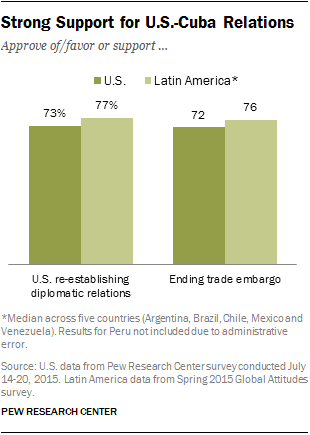
A new Pew poll shows US support for ending the Cuban embargo has climbed to 77% and 76% of the Latin Americans polled agree.

Strong Support for U.S.-Cuba Relations

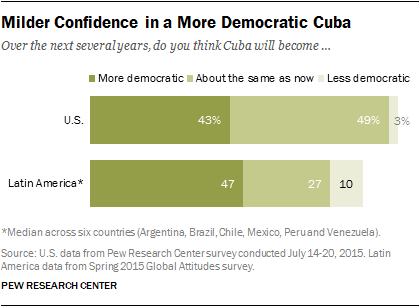
But, they are not certain that Cuba will become more democratic:

Milder Confidence in a More Democratic Cuba

-----
Update 10/21/2015

Nine US governors have called for an end to the embargo -- and two of them are Republicans. This seems to be the only issue with any bi-partisan support in the US congress. I guess these folks are thinking about both doing business with Cuba and public opinion (see poll results above).

-----
Update 1/13/2016

President Obama called for an end to the Cuban trade embargo in his State of the Union address. The American public also favors ending the embargo and this is one of the few (only?) issues with some bi-partisan support, so it is conceivable that he will get his wish.

Thursday, September 7, 2017

Fact checking the recent news about Google in Cuba

The Cuban Internet is constrained by the Cuban government and to a lesser extent the US government, not Google.

Google's Cuba project has been in the news lately. Mary Anastasia O’Grady wrote a Wall Street Journal article called "Google’s Broken Promise to Cubans," criticising Google for being "wholly uninterested in the Cuban struggle for free speech" and assisting the Castro government.

The article begins by taking a shot at President Obama who "raved" about an impending Google-Cuba deal “to start setting up more Wi-Fi access and broadband access on the island.”

(The use of the word "raved" nearly caused me to dismiss the article and stop reading, but I forced myself to continue).

The next paragraph tells us "Google has become a supplier of resources to the regime so that Raúl Castro can run internet (sic) at faster speeds for his own purposes."

The article goes on to tell us that Brett Perlmutter of Google "boasted" that Google was “thrilled to partner” with a regime-owned museum, featuring a Castro-approved artist.

(Like "raved," the use of the word "boasted" seemed Trump-worthy, but I kept reading).

O'Grady also referred to a July 2015 Miami Herald report that Perlmutter had pitched a proposal to build an island-wide digital infrastructure that the Cuban government rejected.

Next came the buried lead -- it turns out this article was precipitated by blocked Cuban access to the pro-democracy Web site Cubadecide.org.

Perlmutter tweeted that the site was blocked because of the US embargo on Cuba.

Well, that is enough. Let's do some fact checking.

President Obama's "raving:" It is true that President Obama made a number of (in retrospect) overly-optimistic predictions during his Cuba trip, but the use of the word "raving" and the obligatory shot at President Obama were clues that O'grady might not be impartial and objective.

Google as a supplier of resources: This presumably is a reference to Google's caching servers in Cuba. While these servers marginally speed access to Google applications like Gmail and YouTube, it is hard to see how that helps Raul Castro. It has been reported that Cuba agreed "not censor, surveil or interfere with the content stored" on Google's caching servers. Furthermore, Gmail is encrypted and YouTube is open to all comers -- for and against the Cuban government.

Brett Perlmutter's boasting:
about partnering with a Cuban artist's installation of a free WiFi hotspot. I agree that the WiFi hotspot at the studio of the Cuban artist Kcho is an over-publicized drop in the bucket -- much ado about not much.

Google's rejected offer of an island-wide digital infrastructure: I have seen many, many (now I'm channeling Trump) references to this "offer," but have no idea what was offered. Google won't tell me and I've seen no documentation on the offer.

Google's blocking of Cubadecide.org: It is true that Google blocks access to Cubadecide.org. Furthermore, they block access from Cuba to all sites that are hosted on their infrastructure. Microsoft also blocks Cuban access to sites they host; however, Amazon and Rackspace do not. Cubadecide.org could solve their problem by moving their site to Amazon, Rackspace or a different hosting service that does not block Cuban access.

Perlmutter blames the embargo: I don't want to give Google a pass on this. The next question is "why does Amazon allow Cuban access and Google does not?" They are both subject to the same US laws. IBM is a more interesting case -- they did not block access at first but changed their policy later.

There may be some reason for IBM and Google behaving differently than Amazon and Rackspace. I asked both IBM and Google for an explanation, but neither replied.

It should also be pointed out that the Cuban government also blocks access to some Web sites so they could counter a move by Cubadecide.org if they wished.

Before publishing this post, I wanted to confirm my understanding of the situation and I found something I cannot explain. It turns out that the Khan Academy, an educational site with both Spanish and English versions that I would love to see available in Cuba, uses both Amazon and Google as hosts.

When I accessed them from the US, I was directed to Amazon for the English site and Google for the Spanish site, but I got strange results from friends in Cuba. One told me he was unable to access either site from a government enterprise but was able to access both from a WiFi park. Another told me he was unable to access either from a university, the medical network, Mednet, or a WiFi park. I had them try the Amazon IP address I was directed to in the US (23.23.224.106), but that did not work in Cuba either.

Well, that remains a mystery, which maybe some reader in Cuba can clear up.

Well, those are the "facts" as I see them. The bottom line for me is that the Cuban government, not Google, is constraining the Cuban Internet. (I've talked about Cuban constraints in several earlier posts, for example, here and here). The US embargo and Trump's policy have also set the Cuban Internet back. That being said, I would like to know why Google feels compelled to block Cuban access when Amazon does not.

Friday, August 25, 2017

Cuba's Digital Revoluton -- a flawed documentary

Most of Cuba doesn't have the Internet.
The Bertelsmann Foundation has produced a 25-minute documentary on Cuba's Digital Revolution (below). The video is divided into four parts:
While I agree with the editorial point of view that US Cuba policy should remain open, as it was during the Obama administration, the video is flawed.

There is nothing novel about the basic content -- it has all been covered in other videos, articles, and blogs like the one you are reading now.

More important, the video overstates the impact of the opening of the US to Cuba, concluding that "In the two years since the Obama administration engaged with the country, Cuba has taken remarkable steps towards a digital revolution" or stating that "in 2014, after the Obama administration extended an olive branch, the Cuban government began relaxing restrictions on internet use -- the government opened a series of WiFi parks."

Correlation is not causation. The first WiFi parks opened in July 2015, several months after President Obama's policy change, but Cuba had begun opening public access facilities in June of 2013 and the WiFi hotspots were built by Huawei, a Chinese company with a long standing relationship with Cuba.

Carlos Gutierrez, who served as Secretary of Commerce under George W. Bush, went further saying "all the big telecomms -- AT&T, T-Mobile, Verizon have roaming agreements with the Cuban government and that's what's enabled all these people to get WiFi." He does not understand the difference between mobile roaming and WiFi or who the roaming users are and I can't understand why that clip was not cut.

But, it's not all bad. The presentation is often engaging. For example, we follow the narrator around Havana as he buys a phone (on Revolico) and gets online at a WiFi hotspot and there is a good interview with a distributor of El Paquete. My favorite part was a conversation in which Cardenas is trying to recruit a contributor for his blog. He takes a thinly veiled shot at the US and goes on to say that he wants to improve and refine Cuban socialism, not abandon it. He criticises the government in order to improve it.

If you still want to watch the video, focus on the vignettes, not the hyperbole. Here it is:

Tuesday, March 15, 2016

Alan Gross' talk at the National Press Club

Source: Local10.com

Alan Gross spoke at the National Press Club and answered questions about his years in prison in Cuba. Although I have been covering the technical and political aspects of his case for years, he said a number of things I had not heard before.

He spent the first year in prison confined to his cell and rarely saw daylight, but in subsequent years, after his "conviction," he had a number of visitors including his wife, Jimmy Carter, former president of the Dominican Republic, Leonel Fernandez and "numerous U.S. elected officials from both sides of Congress and both sides of the aisle."

Gross said that Carter attempted to persuade Cuban President Raul Castro to free the contractor.

"I was visited by former President Jimmy Carter and his wife Rosalynn, and President Carter told me that the night before our visit he had met with President Raúl Castro, who told him, 'Jimmy, I know that Alan is not a spy.' And President Carter said, 'Well Raúl, I have my plane with me (so) why don't you let me take him home?' And President Castro said, 'If I do that Jimmy, they'll run me out of town on a rail.' I don't think that sounds like a person who has total control over his government," Gross said.

When asked about the current situation, Gross replied that

"Normalization is not going to occur for many years, but all it took was a single step -- they say a journey of a thousand miles begins by the single step, and we've taken more than a single step -- not only in the United States, but in Cuba too. And to those members of Congress who said that Obama has been giving gifts to the Castro brothers, I would respond to that by saying the Castro brothers are totally irrelevant to Cuba's future."

You can download an audio recording of the talk here and read more quotes here.

-----
Update 3/29/2016

These photos underscore Alan Gross' contention that the Castro brothers are no longer relevant. Crowds watching Obama drive by while Venezuelan President Maduro visits Fidel Castro -- the past and the future.


Neither Castro nor Obama wished to meet each other and Fidel criticized President Obama after he had left Cuba.

-----
Update 5/17/2016

Alan Gross, who spent five years in prison in Cuba for bringing in portable satellite equipment, has given an interview in which he talks in some detail about what he did and did not do.

The video below shows a user setting up a portable satellite ground station like those Gross carried into Cuba. As you see, it is highly portable and is set up in about three minutes.


In the interview, Gross describes the moment at which you lock onto a satellite signal after adjusting the antenna alignment:
When you lock onto the satellite you've lit a candle. It's a feeling of elation. After I did it the first time, that's all I wanted to do. Go around the world lighting candles.
He's good man!

(For more on Alan Gross, what he did and the politics surrounding his eventual release, click here).

Tuesday, February 23, 2021

A simple suggestion for President Biden regarding the Cuban Internet

President Biden has a lot on his plate, but having someone pursue a Cuban undersea cable would be simple and benefit both Cuba and the US.

The Cuban backbone (source)
Last September I asked what had happened to the proposal for a branch connecting the ARCOS undersea cable, which has a landing point in North Miami Beach, to Cojimar, Cuba. The consortium that operates the cable had applied for permission to connect Cuba in July 2018 and the FCC granted a request for streamlined processing, which should have taken less than 45 days, but nothing happened until September 2020 when the application was referred to a Justice Department committee for the assessment of foreign participation in the telecommunication services sector, that Trump had established in an executive order on April 4, 2020.

On October 26, 2020 -- shortly before the election -- the application was withdrawn without explanation. I asked the FCC officials involved why the processing had taken so long and why the application was withdrawn, but received no answer. I also filed Freedom of Information Act Requests with the FCC and Justice Department, but my questions were not answered. (Justice did not even reply).

But that is history -- spilled milk. During the campaign, President Biden said he would "try to reverse the failed Trump policies that inflicted harm on Cubans and their families" and he has taken steps to liberalize travel and remittances. He has a lot on his plate beside Cuba, but having someone pursue a Cuban undersea cable would be simple and benefit both Cuba and the US.

The first step would be to contact the operators of the ARCOS cable to see if they are still interested in the Cuban branch. If not, other options should be pursued. Daniel Sepulveda, who was Deputy Assistant Secretary of State and U.S. Coordinator for International Communications and Information Policy, in the Obama administration said there were at least a half-dozen proposals — from US and non-US companies — to construct a north-south undersea cable between the US and Cuba. There had also been discussion of one day allowing Cuban access to the US cable at Guantanamo, GTMO-1.

An undersea cable to the US would be a boost to the Cuban Internet. Nearly all Cuban international traffic is carried over the ALBA-1 cable, which lands at the south-east end of the island so traffic from heavily populated areas like Havana must traverse the national backbone. An undersea cable from Cojimar, which is near Havana, would reduce latency, free backbone capacity, save capital investment and provide a backup path in case of an outage.

Note that even Trump would agree with this proposal. His policy was to "amplify efforts to support the Cuban people through the expansion of internet services" and he directed government departments and agencies "to examine the technological challenges and opportunities for expanding internet access in Cuba." He also established a task force "to examine technological challenges and opportunities for expanding internet access in Cuba" and did nothing to reverse any of President Obama's Cuba telecommunication policies.

President Biden might be concerned that such a move might be politically damaging since Cuban-American voters in Florida favored Trump in the last election, but that is not a sure thing. The 2020 Florida International University Cuba Poll showed that among south Florida Cubans, young people are most liberal on issues like the embargo and all except those over 75 consider Cuba policy less important than the economy, health care, race, immigration, and China policy. Demographics and Trump's impeachments may have shifted Cuban voting patterns by 2022 or 2024.

Supporting an undersea cable between the US and Cuba would also enhance our reputaion in the region and encroach upon China's near monopoly as a vendor of Cuban Internet infrastructure. It would also strengthen the US's strategic position vis-a-vis China's expansion in the region.

President Obama sought rapproachmont with Cuba and several Internet-related proposals followed, but the result was disappointing. Trump and Raúl Castro are now ex-presidents so the ARCOS cable may stand a chance. (It would not be unprecedented -- Cuba's first connection to the Internet was through the US National Science Foundation International Connections Program for research and university networks in developing nations).

Update 4/5/2021

In March 2019, Google and ETECSA signed a memorandum of understanding committing to cost-free interchange of traffic between their networks once Cuba was able to connect to a new undersea cable that would be laid, presumably to Miami "sometime in the future." That cable has not yet been laid and I got no answer when I asked Google what the project status was last week.

Google has persisted in an effort to improve Cuban Internet connectivity and access for years but the effort has yielded very little. They have installed Google Global Cache servers in Cuba, enabling ETECSA to serve some Google content from within its own network, and established one public WiFi hotspot.

There were hopes for progress when President Obama visited Cuba, but the Cuban government under Raúl Castro was unwilling and Díaz-Canel was met by Trump. President Biden has a lot on his mind these days, but I hope Google is hanging in.

Thursday, July 16, 2015

Does Cuba trust the US (and Google)?

Will mistrust stop Google and other US Internet companies in Cuba?

Trust?

I've written posts speculating on what Google might do in Cuba and on the possibility of their providing Internet access, but have received consistent "no comment" from Google, so a recent Havana Times report that Cuba had turned down an offer of WiFi connectivity from Google caught my eye.

The Havana Times post was based on an interview of the second secretary of the Cuban Communist Party, Jose Ramon Machado Ventura, but he does not mention Google or an offer of connectivity from them in the interview. He speaks instead of the intent of imperialists to use the Internet as a way to destroy the Revolution.

That has been the party line for years. Left trolls say the fear is realistic, citing the Helms-Burton Act, which has been used to justify various covert Internet initiatives to assist "the Cuban people in regaining their freedom." Right trolls answer that the Cuban government is only interested in enriching the Castros and their friends.

I've no idea what Google has offered Cuba, but it seems that trust is central to this discussion -- does the Cuban government trust Google or see them as a tool of the US government?

Google's advances toward Cuba have been made by their in-house "think/do tank" Google Ideas, which "builds products to support free expression and access to information for people who need it most — those facing violence and harassment."

Google Ideas is headed by Jared Cohen who, before coming to Google, was a member of the Secretary of State's Policy Planning Staff and served as an advisor to Condoleezza Rice and later Hillary Clinton. A couple years ago, Julian Assange of Wikileaks published documentation of Cohen's activity, branding him "Google’s director of regime change." A Cuban pro-government blog publicized Assange's work saying Google was doing what the CIA and NSA could not and channeling the State Department in Silicon Valley.

(Note the irony of the Cuban government pointing to documents uncovered by Wikileaks)!

Will mistrust stop Google and other US Internet companies in Cuba? Has the mistrust begun to thaw? Diplomatic relations are resuming and Raúl Castro, who opposed the Internet at its beginning, says Cuba and the United States are entering a new era.

Mr. Machado's remarks suggest that we may have to wait till regime change occurs (without Google's help) in 2018.

-----
Update 7/17/2015

President Obama has stated that "On Cuba, we are not in the business of regime change."

In spite of that, Gustavo Machin, deputy director for U.S. affairs in the Cuban Foreign Ministry, told reporters that he saw no evidence of practical change, citing the multimillion-dollar 2016 US budged request for Cuban democracy programs.

Tracey Eaton has analyzed the State Department request for Cuba funds for the 2016 fiscal year in a thorough blog post with links to the actual budget appendices. For example, he highlighted the following $20 million request for Cuba:


Regardless of one's opinion of the stated goals and the innefectiveness of such programs, the government of Cuba sees democracy promotion programs as regime change efforts. I don't know whether their expressed fear of such projects is genuine or propaganda, but either way, they undermine trust in US Internet companies.

-----
Update 7/27/2015

In a recent blog post, Circles Robinson askes whether the Cuban people (as oppossed to the government) trust the United States, condluding that "In asking around for opinions we found that in general there appears to be little mistrust of ulterior motives and most people are happy with the change. Likewise Obama seems quite popular."

This is of course annecdotal and probably limited to Havana, but it does not seem unreasonable.

-----
Update 3/25/2016

The Wall Street Journal has published an article surveying the collaboration between the Obama administration and Google on efforts to improve Cuban Internet access.
Real Time Analytics