|
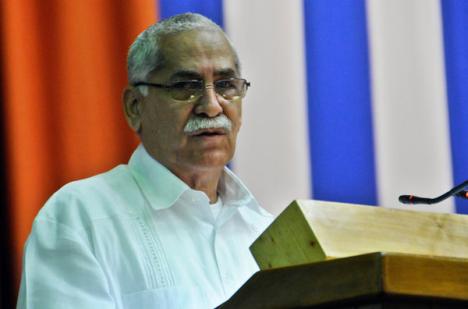
| Communication Minister Mesa Ramos |
- They are working on a new regulatory and legal framework. The International Telecommunication Union describes four generations of regulatory evolution. Cuba is one of the few nations remaining at level 1. Might they leapfrog a generation or more?
- They are assembling tablets and laptops running the Cuban operating system, Nova. We discussed this work here and it is my understanding that the laptops are being rolled out to university professors.
- A computer science professional society was created. We covered this topic here.
- In 2016, 3,330 new data links were established to national agencies and institutions and the bandwidth to these organizations increased by 72 percent. I can think of many follow-up questions to drill down on this one, but it is good to hear that domestic infrastructure is improving.
- There are now 879 mobile base stations in Cuba, 358 of which support third generation (3G) mobile service. The percent of the population with mobile coverage has not changed, so the main activity has been 3G upgrades. It would be interesting to know how many Cubans have 3G phones and if backhaul capacity has been added to 3G base stations. Also for context -- 5G networks are forecast to cover around a third of the global population by 2025. Is Cuba planning on leapfrogging to 5G mobile technology?
- There are over 630 public access navigation rooms and 370 WiFi access points. It is good that they are able to expand public access, but it is an interim, stopgap measure.
- There are 4.3 million mobile "lines.” I assume this means 4.3 million mobile accounts.
- Four million users have access to the “Internet,” roughly one million through permanent accounts. The four million figure must include those with access to the domestic Cuban intranet, but not the global Internet. Perhaps the one million permanent accounts belong to people who have accessed the global Internet. Regardless, the term "user" is not defined.
- Their home broadband service has about 600 subscribers and they realize that it is not the solution for mass access to the Internet. I've been following this home broadband project for some time and have consistently said it made no sense. It seems that the Cubans now agree, but it is hard to understand how such a bad idea was ever considered. I hope different people are making decisions today.
- Mass deployment will come from wireless services. I wonder what they mean by this. Today's 3G mobile, WiFi hotspots and unofficial streetnets are clearly interim stopgap measures. I hope he was referring to studies of forthcoming 5G wireless and high-speed point-point wireless links to leapfrog current wireless technology. While I am dreaming, I'd love to see Cuba talk with OneWeb and SpaceX about their forthcoming satellite networks. OneWeb is committed to first deploying over Alaska -- how about talking with SpaceX about first covering Cuba?
- International bandwidth doubled in 2016 from 4Gb/s to 8 Gb/s. That is good to hear -- they need to balance international bandwidth with domestic backbone and access networks, but it should also be kept in context. My small university has a symmetric 10 Gb/s to the Internet.
There was some discussion after the presentation, in which representatives encouraged the production of Cuban content and expressed concern about affordability, cyber crime, and the migration of computer scientists to the non-state sector.
Wilfredo González, vice minister of the Ministry of Communication, said their principle computerization asset was over 25 thousand professionals, trained by Cuban universities.
Miriam Nicado, Rector of the University of Computer Sciences, where the Nova operating system was developed, said its widespread use would allow Cubans to surf with security, independence and technological sovereignty. I wonder if Cubans who get those new Nova-based laptops are installing Windows on them. China, with a population of nearly 1.4 billion people, can support their own software, services, and standards, but not Cuba.
This talk was given shortly before Cuba released their 2016 ICT statistics report, which covers some of the same ground. Check this post for further discussion of that report.