Showing posts with label CITF. Show all posts

Friday, January 10, 2020

Cuban fake news about some fake news

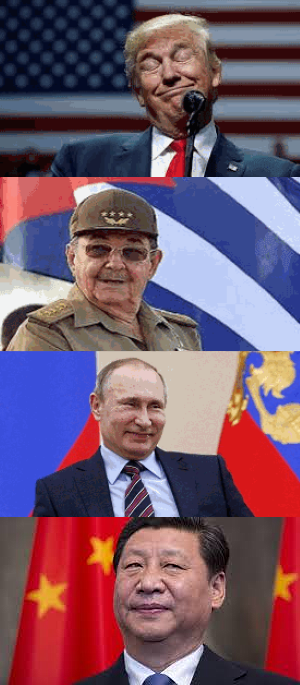
Four CITF winners (source)
When the Cuba Internet Task Force (CITF) was established, it was touted as being formed for the benefit of the Cuban people, but that was fake news.

Granma recently posted a Trump-worthy article charging that the U. S. finances mercenary groups and gives scholarships to train young Cubans as fake leaders in a dirty Internet war on Cuba. The article also alleges that activists who live in Florida, Texas, Tennessee and Georgia have tried to manipulate Cuban opinion on the constitutional referendum using the hashtag #YoVotoNo on Twitter and it claims we do similar things in Iran and Bolivia.

I am not sufficiently naive to think that the US has never meddled with the Internet in Cuba and have blogged extensively about the Alan Gross case, Zunzuneo and the attempted smuggling of satellite receivers disguised as surfing equipment, but the claims made in this article are bogus. It is telling that there there are no links in the story -- nothing to substantiate any of the claims -- and I have first-hand knowledge of the central claim that:
In February of 2018, the so-called Cuba Internet Task Force was created, following instructions outlined in a Presidential memorandum on national security, released June 16, 2017. The website Razones de Cuba has documented that the CIA’s Political Action Group and institutions on the task force have highly qualified specialists who, based on models previously developed through Big Data, sent sector-specific messages to Cubans.
The CITF established two subcommittees, one to explore and develop recommendations on the role of the media and the free, unregulated flow of information through independent media in Cuba and the other to explore and develop recommendations for expanding Internet access in Cuba. I attended the first meeting of the Internet-access subcommittee, participated in the online discussions of both and reviewed and commented on their draft recommendations.

The Task Force Final Report is short -- only 1,904 words on 6 double-spaced pages. (This post is 631 words). It consists of a summary of the state of the Cuban Internet and regulatory policy followed by nine fairly obvious, tersely stated recommendations. I am unaware of any impact it has had on U. S. or Cuban action or policy.

The CIA and its Political Action Group (PAG) are not mentioned in the report and were never mentioned during the discussion leading up to it. No form of cyberattack or propaganda was discussed by the Task Force or called for in the final report. In short, this was a bland report and the Task Force was a show for Florida voters.

The quote regarding the CIA and PAG are taken from the English language version of the story. It is noteworthy that it has been edited out of the Spanish, French, German, Italian, and Portuguese versions. Each version credits the same author and I reached out to him asking about this but did not receive a reply. Furthermore, the article credits the Razones de Cuba Web site with having documented this CIA PAG meddling. I searched their Web site for terms like Grupo de trabajo, grupo de tarea and and 1984, but got no hits.

You get the picture -- the CITF did not work with the CIA and this Granma article does not document any of the charges it makes. In fact, it includes no links or quotes -- just assertions. When the CITF was established, it was touted as being formed for the benefit of the Cuban people, but that was fake news. It was a political move, intended to give Trump a boost in Florida. It also provided Cuba with propaganda fodder for articles like this one and strengthened the economic and political ties between Cuba and Russia and China.

Sunday, February 11, 2018

Suggestions for the Cuba Internet Task Force

John S. Creamer
The Cuba Internet Task Force (CITF) held their inaugural meeting last week.

Deputy Assistant Secretary for Western Hemisphere Affairs John S. Creamer will chair the CITF and there are government representatives from the Department of State, Office of Cuba Broadcasting, Federal Communications Commission, National Telecommunications and Information Administration and Agency for International Development. Freedom House will represent NGOs and the Information Technology Industry Council will represent the IT industry.

They agreed to form two subcommittees -- one to explore the role of media and freedom of information in Cuba and one to explore Internet access. The subcommittees are to provide preliminary reports of recommendations within six months and the CITF will reconvene in October to review those preliminary reports and prepare a final report with recommendations for the Secretary of State and the President.

They are soliciting public comments, looking for volunteers for service on the subcommittees and have established a Web site.

I may be wrong, but it sounds like the subcommittees will be doing much of the actual work. The subcommittee on technological challenges to Internet access will include US technology firms and industry representatives and the subcommittee on media and freedom of information will include NGOs and program implementers with a focus on activities that encourage freedom of expression in Cuba through independent media and Internet freedom. They aim to maintain balance by including members from industry, academia and legal, labor, or other professionals.

I hope the Task Force resists proposals for clandestine programs. Those that have failed in the past have provided the Cuban government with an excuse for repression and cost the United States money and prestige. Both the Cuban and United States governments have overstated what their impact would have been had they succeeded.

Cuba's current Wi-Fi hotspots, navigation rooms, home DSL and 3G mobile are stopgap efforts based on obsolete technology and they provide inferior Internet access to a limited number of people. (El Paquete Semanal is the most important substitute for a modern Internet in Cuba today).

It would be difficult to devise plans or offer support for activities that the current Cuban government would allow and be able to afford; however, the situation may ease somewhat after Raúl Castro steps down in April. Are there short-run steps Cuba would be willing to take that we could assist them with?

For example, the next Cuban government might be willing to consider legitimizing and assisting some citizen-implemented stopgap measures like building street nets and rural community networks, selling geostationary satellite service and installing LANs in schools and other organizations.

They might also be willing to accept educational material and services like access to online material from Coursera or LAN-based courseware from MIT or The Khan Academy. (At the time of President Obama's visit, Cisco and the Universidad de las Ciencias Informaticas promised to cooperate in bringing the Cisco Network Academy to Cuba, but, as far as I know, that has not happened).

The US requires Coursera and other companies to block Cuban access to their services. We could reverse that policy unilaterally, without the permission of the Cuban government.

Google is the only US Internet company that has established a relationship with and been allowed to install infrastructure in Cuba. The next Cuban administration might be willing to trust them as partners in infrastructure projects like providing wholesale fiber service or establishing a YouTube production space in Havana. Cuba could also serve as a test population for Google services optimized for low-bandwidth networks.

These are short-term, stopgap measures. In the long run, Cuba should investigate opportunities for leapfrogging – planning for technology like 5G wireless and low-Earth orbit satellites that will be available in, say, five years. Our mobile phone companies and nascent satellite ISPs SpaceX and OneWeb may have significant offerings in five years -- might Cuba be willing to work with them?

Long-run steps like these would require Cuba's leapfrogging regulatory and infrastructure-ownership policy. The ITU defines four generations of regulation and Cuba is one of the few remaining first-generation nations -- might the Cuban government be willing to make policy changes in five years?


Sunday, January 28, 2018

The Cuba Internet Task Force -- a win for Trump, Castro, Putin and Xi

President Obama began working on Cuban rapprochement during his 2009 presidential campaign. After over five years of thought and negotiation, the Whitehouse announced a major shift in Cuba policy, which included allowing telecommunications providers "to establish the necessary mechanisms, including infrastructure, in Cuba to provide commercial telecommunications and Internet services, which will improve telecommunications between the United States and Cuba."

When President Obama's trip to Cuba was announced, I speculated on possible Internet-related advances but was disappointed by the results. While in Cuba, the President held optimistic public meetings and several Internet-related projects were announced, but, as far as I know, none of them materialized. Can we expect more from Trump?

Last summer, Trump said he would be changing our Cuba policy and I speculated on how it might affect the Internet, but could not think of anything reasonable. When he published his Cuba policy memorandum, one of its purposes was to restore Cuban's "right to speak freely, including through access to the Internet" and one of its goals was to "amplify efforts to support the Cuban people through the expansion of internet services."

Trump said he was "canceling the last administration’s completely one-sided deal with Cuba," but his Internet policy sounded a lot like Obama's. The only concrete difference I saw was that Trump had ordered the State Department to convene a task force "to examine the technological challenges and opportunities for expanding internet access in Cuba."

Last week, the State Department issued a public invitation to attend the first meeting of that Cuba Internet Task Force on February 7th.

I called the State Department to ask whether the meeting would be streamed or archived and was told that it would not. I asked if they had any information on the meeting agenda, the charge of the task force and who the members were. They referred my questions to the Press office, but they did not answer.

We will hopefully learn more after the meeting, but what might Trump do? Will we see the laissez-faire Trump who promised Saudi Arabia that "America will not seek to impose our way of life on others" or some sort of digital Bay of Pigs like the failed smuggling of satellite equipment into Cuba, Zunzuneo or the Alan Gross affair?

My guess is that not much will happen -- that this task force and the rest of Trump's Cuba policy is for domestic political consumption by anti-Castro politicians and voters. The Cuban government is also using the task force for domestic political consumption. Their reaction to its formation was predictable -- saying that Cuba is being attacked by a powerful, hostile nation. Within a few days of the formation of the task force, many articles like this one were published by the Cuban government and allied publications like China's Xinhua and Russia's RT. (Perhaps rekindling the Cold War is part of making America great again).

Ironically, this task force is a political win for both Castro and Trump -- autocracy thrives on fear and mistrust.

=====
Update 2/2/2018

Last night I saw The Final Year, a documentary on the final year of the Obama administration. In it, former Whitehouse staff member Ben Rhodes says it took them time to realize that Putin was not motivated by the interests of Russia, but by self-interest. That may be true to some extent for nearly all politicians, but it seems to fit Castro and Trump well in this case.

(As an aside -- Rhodes was one of the two White House staff members handling the negotiations leading up to our opening with Cuba).

=====
Update 2/3/2018

Following up on Ben Rhodes' comment on Putin -- establishing this task force or any other act that drives a wedge between Cuba and the US benefits Putin as well as Trump and Castro.

While Castro and Trump use the rift between their nations for domestic political advantage, Putin uses it for international political advantage and commerce.

The dissolution of the Soviet Union caused an economic crisis in Cuba, sharply cutting trade and cooperation with Russia and other Soviet republics, but in the last few years, trade and cooperation have picked up. In 2014, Russia forgave 90 percent of the $35 billion debt Cuba incurred during the economically difficult "special period" of the 1990s, with the remaining $3.5 billion to be settled by giving preferential treatment to Russian investments on the island.

Cuba and Russia are also cooperating on oil exploration, extraction and refining and Cuba is importing oil, cars, trucks, and railway infrastructure and equipment. Trade between Russia and Cuba rose 73 percent in the first half of 2017 to $176 million. There has even been talk of Russia reopening it's cold war Signals Intelligence base, which once had a staff of 1,500 in Cuba.

While Russia is building commercial and political ties with Cuba, China remains their largest trading partner and a major supplier of Internet and computer equipment. (For more on Cuba-China trades, click here). Even Iran is allying with Cuba.

Russia is also on the "right side" of public opinion of the Cuban embargo. The embargo is unpopular in Latin America and the rest of the world. (The US and Israel support the embargo in the UN and the remaining 191 UN member states oppose it).

Evidently making America great again entails having a hostile ally of Russia and China 90 miles from Florida -- sound familiar? Putin and Ji may be the biggest winners from our Cuban policy shift and the Cuban and American people the biggest losers.

Castro and Putin meeting at the UN (source)

=====
Update 2/7/2018

Reuters reports that Cuban independent media outlets oppose Trump's Cuba Internet policy.

Elaine Diaz, founder of Periodismo de Barrio, José Jasán Nieves, director of El Toque and Miguel Alejandro Hayes who writes for La Joven Cuba are all quoted as opposing the Trump initiative.

Nieves said civil society initiatives had "flourished" after the Obama-Castro detente and Diaz said she would refuse any money the Trump program might award and stressed that they are independent media "independent of Cuban authorities as well as any other government." Hayes does not agree with Trump's goal of toppling the Cuban government.

Of course, these are only three of many independent journalists in Cuba and they are not extremists.

I suspect that this Task Force will be given a budget and, if independent journalists are not interested in assistance from the US, they may end up funding secret projects like those mentioned above. That will allow Trump to claim to be tougher than Obama and the Cubans will discover the projects and overstate their significance -- propaganda wins for Trump and Castro while Putin and Ji smile quietly.
Real Time Analytics