Showing posts with label US policy. Show all posts

Thursday, March 28, 2019

Google and ETECSA will agree to exchange Internet traffic without charge

This agreement telegraphs a change in Cuban policy -- now we need the cable.

Google and ETECSA have signed a memorandum of understanding agreeing to negotiate a peering agreement that would allow cost-free data exchange between their networks once an undersea cable physically connects them.

Google has worked hard to establish a relationship with ETECSA and the Cuban government. In recent years, Cuba, not the US, has limited the Cuban Internet. This agreement telegraphs a change in Cuban policy.

Today, nearly all of Cuba's Internet traffic is carried over an undersea cable at the south end of the island. A cable from the Havana area to Florida would reduce the load on their inter-city "backbone" network that today carries Internet traffic to the cable landing in the south. That would result in a faster Internet and save ETECSA money. The next generation of low-earth and medium-earth orbit satellite connectivity can have a similar effect.

ETECSA could use the savings from an undersea cable or next-generation satellites to cut prices, increase investment in infrastructure or increase profit. That would depend upon who is actually calling the shots at ETECSA.

Over three years ago, Daniel Sepulveda, Deputy Assistant Secretary of State and U.S. Coordinator for International Communications and Information Policy, said he knew of at least a half dozen proposals — from US and non-US companies — to construct a north-south undersea cable between the US and Cuba.

The cable has been stopped by politics, not economics or technical difficulty. It looks like Cuba is willing to relent on the politics. Trump's fighting this cable would solidify Cuba's political and commercial ties with China and Russia.


Sunday, January 28, 2018

The Cuba Internet Task Force -- a win for Trump, Castro, Putin and Xi

President Obama began working on Cuban rapprochement during his 2009 presidential campaign. After over five years of thought and negotiation, the Whitehouse announced a major shift in Cuba policy, which included allowing telecommunications providers "to establish the necessary mechanisms, including infrastructure, in Cuba to provide commercial telecommunications and Internet services, which will improve telecommunications between the United States and Cuba."

When President Obama's trip to Cuba was announced, I speculated on possible Internet-related advances but was disappointed by the results. While in Cuba, the President held optimistic public meetings and several Internet-related projects were announced, but, as far as I know, none of them materialized. Can we expect more from Trump?

Last summer, Trump said he would be changing our Cuba policy and I speculated on how it might affect the Internet, but could not think of anything reasonable. When he published his Cuba policy memorandum, one of its purposes was to restore Cuban's "right to speak freely, including through access to the Internet" and one of its goals was to "amplify efforts to support the Cuban people through the expansion of internet services."

Trump said he was "canceling the last administration’s completely one-sided deal with Cuba," but his Internet policy sounded a lot like Obama's. The only concrete difference I saw was that Trump had ordered the State Department to convene a task force "to examine the technological challenges and opportunities for expanding internet access in Cuba."

Last week, the State Department issued a public invitation to attend the first meeting of that Cuba Internet Task Force on February 7th.

I called the State Department to ask whether the meeting would be streamed or archived and was told that it would not. I asked if they had any information on the meeting agenda, the charge of the task force and who the members were. They referred my questions to the Press office, but they did not answer.

We will hopefully learn more after the meeting, but what might Trump do? Will we see the laissez-faire Trump who promised Saudi Arabia that "America will not seek to impose our way of life on others" or some sort of digital Bay of Pigs like the failed smuggling of satellite equipment into Cuba, Zunzuneo or the Alan Gross affair?

My guess is that not much will happen -- that this task force and the rest of Trump's Cuba policy is for domestic political consumption by anti-Castro politicians and voters. The Cuban government is also using the task force for domestic political consumption. Their reaction to its formation was predictable -- saying that Cuba is being attacked by a powerful, hostile nation. Within a few days of the formation of the task force, many articles like this one were published by the Cuban government and allied publications like China's Xinhua and Russia's RT. (Perhaps rekindling the Cold War is part of making America great again).

Ironically, this task force is a political win for both Castro and Trump -- autocracy thrives on fear and mistrust.

=====
Update 2/2/2018

Last night I saw The Final Year, a documentary on the final year of the Obama administration. In it, former Whitehouse staff member Ben Rhodes says it took them time to realize that Putin was not motivated by the interests of Russia, but by self-interest. That may be true to some extent for nearly all politicians, but it seems to fit Castro and Trump well in this case.

(As an aside -- Rhodes was one of the two White House staff members handling the negotiations leading up to our opening with Cuba).

=====
Update 2/3/2018

Following up on Ben Rhodes' comment on Putin -- establishing this task force or any other act that drives a wedge between Cuba and the US benefits Putin as well as Trump and Castro.

While Castro and Trump use the rift between their nations for domestic political advantage, Putin uses it for international political advantage and commerce.

The dissolution of the Soviet Union caused an economic crisis in Cuba, sharply cutting trade and cooperation with Russia and other Soviet republics, but in the last few years, trade and cooperation have picked up. In 2014, Russia forgave 90 percent of the $35 billion debt Cuba incurred during the economically difficult "special period" of the 1990s, with the remaining $3.5 billion to be settled by giving preferential treatment to Russian investments on the island.

Cuba and Russia are also cooperating on oil exploration, extraction and refining and Cuba is importing oil, cars, trucks, and railway infrastructure and equipment. Trade between Russia and Cuba rose 73 percent in the first half of 2017 to $176 million. There has even been talk of Russia reopening it's cold war Signals Intelligence base, which once had a staff of 1,500 in Cuba.

While Russia is building commercial and political ties with Cuba, China remains their largest trading partner and a major supplier of Internet and computer equipment. (For more on Cuba-China trades, click here). Even Iran is allying with Cuba.

Russia is also on the "right side" of public opinion of the Cuban embargo. The embargo is unpopular in Latin America and the rest of the world. (The US and Israel support the embargo in the UN and the remaining 191 UN member states oppose it).

Evidently making America great again entails having a hostile ally of Russia and China 90 miles from Florida -- sound familiar? Putin and Ji may be the biggest winners from our Cuban policy shift and the Cuban and American people the biggest losers.

Castro and Putin meeting at the UN (source)

=====
Update 2/7/2018

Reuters reports that Cuban independent media outlets oppose Trump's Cuba Internet policy.

Elaine Diaz, founder of Periodismo de Barrio, José Jasán Nieves, director of El Toque and Miguel Alejandro Hayes who writes for La Joven Cuba are all quoted as opposing the Trump initiative.

Nieves said civil society initiatives had "flourished" after the Obama-Castro detente and Diaz said she would refuse any money the Trump program might award and stressed that they are independent media "independent of Cuban authorities as well as any other government." Hayes does not agree with Trump's goal of toppling the Cuban government.

Of course, these are only three of many independent journalists in Cuba and they are not extremists.

I suspect that this Task Force will be given a budget and, if independent journalists are not interested in assistance from the US, they may end up funding secret projects like those mentioned above. That will allow Trump to claim to be tougher than Obama and the Cubans will discover the projects and overstate their significance -- propaganda wins for Trump and Castro while Putin and Ji smile quietly.

Thursday, September 21, 2017

Google global cache servers are online in Cuba, but Google's App Engine is blocked

This is a belated update. I had hoped to get more information before posting it, but difficult Internet access in Cuba and now the hurricane got in the way -- better late than never.

Cuban requests for Google services are being routed to GCC servers in Cuba and all Google services that are available in Cuba are being cached -- not just YouTube. That will cut latency significantly, but Cuban data rates remain painfully slow. My guess is that Cubans will notice the improved performance in interactive applications, but maybe not perceive much of a change when watching a streaming video.

Note the italics in the above paragraph -- evidently, Google blocks access to their App Engine hosting and application development platform. Cuban developers cannot build App Engine applications and Cubans cannot access applications like the Khan Academy or Google's G-Suite.


The last time I checked, Rackspace and Amazon allowed access to their hosting platforms from Cuba, but IBM Softlayer and Google did not. President Obama clearly favored improved telecommunication for Cuba, stating that
I’ve authorized increased telecommunications connections between the United States and Cuba. Businesses will be able to sell goods that enable Cubans to communicate with the United States and other countries.
in his Cuba Policy Changes. While Trump claimed that he was "canceling the last administration’s completely one-sided deal with Cuba," he made few changes and has said nothing about restrictions on access to Internet services by Cubans.

I wonder why IBM and Google do not follow the lead of Amazon and Rackspace.

Saturday, July 1, 2017

What does Trump's Cuba policy memorandum say about the Internet?

Trump orders the Secretary of State to create a Cuban Internet task force.

Last week I reviewed Trump's Cuban policy speech and its implications for the Internet. The speech was accompanied by a national security memorandum on strengthening US Cuba policy, which was sent to the Vice President, Cabinet Secretaries, and heads of various departments.

The first thing that struck me about the memorandum was that it was a "national security" memorandum. Does Trump think Cuba poses a threat to our national security and how does his policy improve the situation? That is a topic for another discussion, but what does the memorandum say about the Internet?

The memorandum addresses the Internet in its purpose, policy and implementation sections.

The purpose section states that in Cuba "the right to speak freely, including through access to the internet, is denied, and there is no free press." One of the purposes of the memorandum is to restore the right to speak freely on the Internet. The Cuban government censors and sometimes punishes dissent and uses the Internet for propaganda, but it is not clear that Trump's policy and attitude will improve the situation. Furthermore, freedom of speech online is often abused and it is ironic that Trump should lecture anyone on this issue.

In the policy section, Trump says he will "amplify efforts to support the Cuban people through the expansion of Internet services, free press, free enterprise, free association, and lawful travel." This sounds good, but, at best, it is inconsistent with the policy he outlined last month in Saudi Arabia when he promised that "America will not seek to impose our way of life on others but to outstretch our hands in the spirit of cooperation and trust." At worst, he could be considering actions like the failed smuggling of satellite equipment into Cuba, Zunzuneo or the Alan Gross affair.

The implementation section says he will "support the expansion of direct telecommunications and Internet access for the Cuban people" by having the Secretary of State convene
a task force, composed of relevant departments and agencies, including the Office of Cuba Broadcasting, and appropriate non-governmental organizations and private-sector entities, to examine the technological challenges and opportunities for expanding internet access in Cuba, including through Federal Government support of programs and activities that encourage freedom of expression through independent media and internet freedom so that the Cuban people can enjoy the free and unregulated flow of information
I contacted the State Department to see if they could tell me more about the task force, but they offered no details at this time. I'll follow up on this.

I cannot end this post without commenting on the writing style of the memorandum. It is written in the first person, implying that Trump actually wrote it. I am sure it was drafted and revised by staff, but gratuitous adjectives as in "dissidents and peaceful protesters are arbitrarily detained and held in terrible prison conditions," sounded Trumpian to me and the call for the establishment of a task force, quoted above, reminded me of James Joyce. I also found the organization confusing in places. Some policies seemed more like goals and one of them is to "not reinstate the 'Wet Foot, Dry Foot' policy." One wonders why he did not also vow not to reinstate limits on the value of rum and cigars travelers are allowed to bring back from Cuba.


Monday, June 12, 2017

Speculation on Trump's forthcoming Cuba policy speech and its impact on the Cuban Internet

Trump has a dilemma. He has to take some executive action that will allow him to ridicule President Obama and show that he is punishing Cuba for its human rights violations and the confiscation of businesses and property after the revolution, but not harm US telephone companies, hotel chains, airlines and cruise lines.

Trump is expected to announce his Cuba policy next Friday in Miami. There can be little doubt that he will reverse some of President Obama's executive orders in order to brag to his base supporters and try to make the Cuban diaspora hardliners happy. He will say the President was weak and made a terrible "deal," which the world is ridiculing. He may even take yet another shot at Hillary Clinton.

Cuban people trust and like President Obama. He opened diplomatic relations between the US and Cuba and implemented a policy of reaching out to the Cuban people. He is shown here at a baseball game with the wife of Jackie Robinson.
Cubans do not see President Obama as
an "Evil Emperor."
There are some things that I bet he does not say. He will not compare Cuban human rights with those of his friends in Turkey, the Philippines, Saudi Arabia, Russia, et al. and he will not mention that he is lending credence to the tired claim that the US is the Evil Empire that is responsible for Cuban economic problems. He probably won't note the unpopularity of his action in Latin America and I don't expect him to say much about the security implications of alienating Cuba at a time when Russia, China, and Iran are moving closer either. (Someone should tell him about the Cuban missile crisis).

But, I can't imagine that he would do something major like break off diplomatic relations or do anything to harm the tourism and travel industries. That would hurt our economy, cost jobs and be unpopular with the general public which favors lifting the trade embargo.

What about the Internet?


By and large, the Cuban Internet is constrained by political/power considerations, tired political rhetoric and mistrust, the cost of infrastructure, the bureaucracy and economic interests of the ETECSA monopoly and Cuban government bureaucracy, not US policy.

But, what Internet-related changes might Trump reverse?

During his first hundred days, President Obama "reached out to the Cuban people" (emphasis added) by easing restrictions on remittances, family travel and gifts.¹ Increased remittances and gifts meant more Cuban people had laptops, tablets and smartphones to use in public access hotspots and access rooms as well as the money to pay for time online. Reversing these changes would deny ETECSA Interent-access revenue, but it would harm Cuban citizens with family abroad and give the government anti-US talking points. I will be surprised if Trump reverses these changes, but that does not mean he won't do it.

At the same time, the president eased restrictions on telecommunications allowing:
  • Phone companies to offer voice and data roaming
  • People in the US to pay for Internet-access and other telecommunication bills for Cubans
  • US Companies to establish fiber-optic cable and satellite links to Cuba
  • Satellite Internet and TV companies to serve Cuban companies
  • Companies to export personal communication equipment like mobile phones, computers and software and satellite receivers to Cuba
Cutting roaming would hurt US tourism and telephone companies -- it is hard to imagine Trump doing that. He might be willing prohibit Americans from buying phone and data minutes for Cubans -- that would only hurt Cuban people and payment services like Ding.com (an Irish company).

While US companies have permission to sell communication equipment and infrastructure to Cuba, I am not aware of any significant sales. Since China has dominated the Cuban Internet infrastructure market, stopping infrastructure sales would have little or no immediate impact, but it could become significant next year when Miguel Díaz-Canel, who seems to be pro-Internet, replaces Raúl Castro.

The FCC removed Cuba from their exclusion and reversing that might cause Google to remove their Cuban caching servers. If that were to happen, there would be little practical impact, but it would be symbolically significant.

President Obama also moved to allow US citizens and companies to pay self-employed Cuban entrepreneurs for software and services. I don't know the extent to which this occurs, but it is hard to see what would be gained by trying to stop the practice and who would be pleased to see it happen. I doubt that he will roll this one back.

A number of organizations and universities have sponsored conferences, training courses, hackathons, etc. in support of Cuban software entrepreneurs. I am not sure whether Trump could somehow block that sort of activity, but I cannot imagine why he would do so.

How about attacking President Obama's trip to Cuba? During that trip, he addressed Cuban entrepreneurs and announced a couple of concrete commitments, but they have all fizzled. Trump may point that out.

Trump has a dilemma. He has to take some executive action that will allow him to ridicule President Obama and show that he is punishing Cuba for its human rights violations and the confiscation of businesses and property after the revolution, but not harm US telephone companies, hotel chains, airlines and cruise lines. It does not seem that reversing any of President Obama's Internet-related changes will achieve that end.

Steve Bannon may be able to come up with some ideas, but, if he can't, I have a suggestion. One of the properties the Castro government seized after the revolution was the Riviera, a waterfront hotel and casino that is now run by the Cuban government. The hotel was built by the gangster Meyer Lansky and Lansky's grandson, Gary Rapoport, has claimed it. Perhaps he and Trump could work out a deal with the Cuban government, rebranding it the Trump Rivera.

-----
¹ The initial announcement of this was removed from the Whitehouse.gov Web site, but it was captured by the Internet Archive and is also on the Obamawhitehouse.gov Web site.


Thursday, May 25, 2017

Crooked media interviews on Cuba

"We were just trying to get Alan Gross out of prison at first" Ben Rhodes, Obama Administration Cuba negotiator

Crooked Media, which was created by three senior Obama White House staff members, produces several excellent (pro-Democratic) podcasts. One of those is PodSavetheWorld, hosted by Tommy Vietor, who spent nearly a decade as a spokesman for President Obama, specializing in foreign policy and national security issues.

Two episodes of PodSavetheWorld include interviews with high-level Obama staff members who were involved in forming our Cuba policy. The following describe and link to exceprts from those interviews.

The first excerpt is from an interview of Dan Restrepo, who served as a top Latin America advisor to President Obama. Restrepo had written a Cuban-rapprochement roadmap for candidate Obama during his first campaign and he returned to the topic in 2013. He says Obama was playing a "long game," knowing that his executive authority was limited and he could not move faster than US public opinion. Restrepo characterizes Obama's strategy as a bet that by creating a degree of freedom among the Cuban people, for example by expanding reparations and undermining Castro's excuse of blaming all problems on the Evil Empire, the Cuban government would be forced to change. He noted that the blame-US game was a hard sell after the Cuban people saw the Evil Emperor, who looked more like them than the current Cuban leaders, giving a speech on TV or at a baseball game with Raúl Castro.

The excerpt (14:20) is here and the full podcast (48:37) here.

The second excerpt is from an interview of Ben Rhodes, who served as a speechwriter and emissary for President Obama and was one of two White House staff members handling the negotiations leading up to our opening with Cuba. Rhodes and his colleague Ricardo Zuniga traveled to Canada for 12-15 secret meetings with Cuban representatives while working out the rapprochement details. At the start, they were only negotiating for the release of Alan Gross because Obama reasoned that rapprochement would be politically unacceptable if Gross remained in a Cuban prison. Early in the negotiation for Gross, they realized more was possible and the scope of the discussion broadened. Only a few people in the White House knew of these negotiations, but the Vatican was informed early and played a key role. (If you are unfamiliar with the Alan Gross case, click here).

The excerpt (11:30) is here and the full podcast (1:00:48) is here.

Thursday, September 15, 2016

US-Cuba diplomacy is picking up.

This is somewhat off the subject of this blog, but it seems that US-Cuba diplomacy might be picking up steam. It may be coincidence, but three meetings have been scheduled:
Perhaps the Obama administration is accelerating negotiations before they leave office.

Wednesday, September 7, 2016

Criticism is not subversive

"Write criticism, the party will support you."
Raúl Castro, addressing the union of Cuban journalists, March 1980.

Josefina Vidal, Director General of the Department of the United States at the Cuban Ministry of Foreign Affairs, tweeted that the Internet Freedom Conference next week is subversive -- "The illegal use of radio and television against Cuba is not enough for them, they insist on the use of the Internet as a weapon of subversion."

Her statement is based upon the fact that the conference is sponsored by the US government, but, if she would look beyond that, she would have a more nuanced view. (Note that I have been invited to participate in the conference and will have my travel expenses paid, but will not be compensated for the four days I spend).

For example, if she would read my blogs, reports and papers, she would see that I have been critical of the politics and Internet regulation and policies of both Cuba and the United States, but I am not trying to subvert either government. She would also see that I have recognized Cuban achievements and made many suggestions for improving Cuba's Internet infrastructure and policy. Whatever I have written or done has been pro-Internet, not anti-Cuban government.

As Cuban blogger Carlos Alberto Carlos Alberto Pérez said "I don't criticize to knock the system down. On the contrary, I criticize to perfect the system."

There are hard-liners in Cuba and the US, but after many years they seem to be following bureaucratic, party-line protocols, which call for rote repetition of tired sentences. I am confident that there are Cuban technicians and policy makers who realize the possibility of leapfrogging today's technology and policy just as there are many in the US who realize that our Cuba policy has been unproductive. It is time to look to the future.

Monday, January 25, 2016

A second high-level US delegation to Havana to discuss telecommunication and the Internet

Daniel Sepulveda speaking at the University of Information Science (UCI)

A short post on the Web site of Cuba's Ministry of Exterior Relations reports that a high-level US delegation went to Cuba to discuss telecommunication during January 20-22.

The US delegation was led by Daniel Sepulveda, Deputy Assistant Secretary of State and U.S. Coordinator for International Communications and Information Policy and FCC Chairman Thomas Wheeler. They were accompanied by officials from the Departments of State, Commerce and Treasury, and the FCC. The delegation also included representatives of US telecommunication companies.

Deputy Minister of Communications, Jorge Luis Perdomo Di-Lella met the delegation along with officials from other ministries and representatives from business and academia. They visited the Joven Clubs, Polytechnic José Antonio Echeverría and the University of Information Science.

The post gives no substantive details on the meetings, but says they discussed the effect of the trade embargo and blocking of access to US Internet sites that were key to Cuba's scientific, technical and economic development. They also talked of the scope and limitations of the new regulations adopted by the US government on Cuban telecommunication, which probably means that Chairman Wheeler clarified the implications of the recent removal of Cuba from the FCC "exclusion list" (which is now empty). That sounds like a quick summary of issues the diplomats and officials may have raised, but there was no mention of which US business leaders were in the delegation or what they may have said.

This was a follow-on to a similar meeting held last March. Based on the minimal reporting of the two meetings, the only difference would seem to be the participation of the FCC.

In addition to clarifying the implications of Cuba being removed from the exclusion list, the Cubans and FCC staff may have discussed alternative infrastructure ownership and regulation policies. Since Cuba is late to the Internet game, they are free to consider the wide variety of policy alternatives adopted by different nations. It may be unlikely, but it is possible that in doing so they could come up with a uniquely Cuban Internet.

-----
Update 1/26/2016

Daniel Sepulveda, who has led both US government delegations to Cuba, has given interviews on the trip to the Miami Herald and OnCuba magazine (in Spanish). You should read both interviews, but I will summarize some of the things that jumped out at me.

Sepulveda said there are at least a half-dozen proposals — from US and non-US companies — to construct a north-south undersea cable between the US and Cuba. An undersea cable connecting Havana and Florida would provide backup for the ALBA-1 Venezuelan cable, add capacity and reduce latency. Perhaps more important, it would reduce the load on Cuba's domestic backbone. This is something ETECSA can and should be negotiating on behalf of the Cuba people, even if it requires government subsidy to attract capital, and they have requested specific, written proposals.

Sepulveda also pointed out that such a cable would establish both a psychological and physical connection between the two countries -- a sign of healing.

The ball is now in Cuba's court. In the past, the embargo limited, but did not stop the Cuban Internet. Mexico's Grupo Domos and the Italian phone company STET were investors in ETECSA, US equipment was available through third parties and China has provided the undersea cable and much domestic infrastructure. Sepulveda pointed out that there are no longer restrictions on US telecom company dealings with ETECSA or other Cuban organizations. (private programmers can also work for US companies).

Sepulveda feels a sense of urgency -- neither he nor President Obama will be in the government next year, and, while he does not believe it will be possible for the next administration to reverse the advances that have been made, it will be possible to delay implementation and stop further progress. There is an issue of trust in both directions -- trust that the US and the Internet will not undermine the Cuban government and trust that the Cuban government will be open to foreign investment and will not constrain investors with overly burdensome regulation. US companies need positive signs from Cuba if they are going to invest.

The US delegation included Dean Garfield, president of the Information Technology Industry Council, and representatives from Cisco Systems, Comcast, the North American division of Ericsson, a Swedish communications company, and other government and industry officials. Google, which has expressed considerable interest in Cuba, was conspicuously absent -- perhaps due to the lack of trust Sepulveda referred to.

Cisco has proposed establishing a Cisco Academy training and certification program at the University of Information Science. That is the most concrete proposal I have heard of and, if it is approved, it would signal Cuba being open to competition for Huawei, which has a dominant position today. Opening a Cisco Academy at a major computer science university would both give Cisco a foothold in the Cuban infrastructure market and signal Cuban willingness to have infrastructure competition.

Sepulveda favors rapid rollout of fourth generation mobile connectivity, mentioning Vietnam, Myanmar, Ecuador, Bolivia and the Dominican Republic as examples. That must have brought a smile to the face of the representative from Ericsson. (Doug Madory has suggested Myanmar as a model).

Finally, the delegation met with independent bloggers -- I wonder which ones and what was said.

Those are a few highlights, but the interviews say more.

Here is a short video of Sepulveda speaking with the Miami Herald:


Daniel Sepulveda during his OnCuba interview

-----
Update 1/28/2016

I mentioned above that the US delegation met with several Cuban bloggers and entrepreneurs, and I wondered who they had met with and what was said. Two of the bloggers they met with were Norges Rodríguez and Taylor Torres and Norges has summarized the meeting in a blog post.

After summarizing the meeting, he inlcuded the full text of the interview of Sepulveda, which I highlighted above, and he promises to post more on their wide-ranging meeting.

I do not know which other bloggers and entrepreneurs the delegation met with, but the inclusion of Taylor and Norges is interesting because one blogs on art and culture, the other on telecommunication technology and policy. We tend to focus on topics like infrastructure, access to information, social networking, etc., but the Cuban creative community has the potential to become a rich source of Spanish language entertainment and art content. (Netflix came to Cuba less than two months after the December 17 opening of relations -- I suspect in search of potential content as well as subscribers).

It is also encouraging that high-level US officials and business people are meeting with bloggers and entrepreneurs as well as government officials and ETECSA executives. Perhaps we will see a uniquely Cuban approach to the Internet.

Norges Rodriguez, Taylor Torres, Tom Wheeler and Daniel Sepulveda

Image from Taylor Torres' art-focused blog
-----
Update 1/29/2016

FCC Chairman Thomas Wheeler has written a blog post on the trip to Cuba. I don't think he adds much of substance, but it is good to see Cuba on his mind and concludes that he came away from the trip with "a newfound understanding of both the opportunities and challenges facing Cuba in terms of communications technology and access."

Perhaps the most interesting aspect of his participation in the trip was that he met with students and bloggers as well as government officials and executives of state enterprises. Here he is shown with the Cuban bloggers shown above.

Wednesday, June 24, 2015

What is the effect U.S. trade restrictions on IT exports to Cuba?

The Senate Finance Committee is researching the economic impact of U.S. embargo on trade with Cuba and I was asked to testify before the US International Trade Commission on the effects of the U.S. restrictions on our exports of telecommunication equipment and services to Cuba. I have a chance to revise the testimony, and would appreciate feedback.

Click to download Word or PDF versions of the draft.

Here is the testimony introduction:

The Commission has asked for testimony on the effects of the U.S. trade restrictions on our telecommunication exports to Cuba. Since there is a great deal of uncertainty about the Cuban plans and policies and U.S. policy is also in a state of flux, I will lay out a framework for discussing the issue rather than attempting specific predictions. This framework can be modified and fleshed out by future research. I will focus on Internet-based telecommunications, which are subsuming traditional telephony.

Potential U.S. exports to Cuba include:
  • Personal Internet access devices
  • Internet services for fees or advertising
  • Internet infrastructure
  • Internet service provision
  • Digital entertainment and other content
  • Sensor-based Internet access devices – “the Internet of things.”

Some of these markets, for example, providing Internet infrastructure and service, are more severely impacted by U.S. restrictions than others.

U.S. restrictions are only one impediment to the sale of these goods and services – there are others that are out of our control:
  • Cuban government fear of free information exchange
  • The Cuban economy
  • The absence of domestic Internet infrastructure
  • Socialist values and practices
  • Foreign competition
  • Domestic competition from state monopolies

-----
Update 6/26/2015

An anonymous reader has the opinion that my testimony document underestimates the potential of the Cuban market. They listed the following examples:

Web hosting service -- the reader is "middle man" for ten Web sites hosted in Canada and knows of many others.

Specialized professional audio/video equipment that is only made in US, or were US products traditionally have much better quality. Examples include products from Avid, M-Audio and Alesis. Their products are sometimes bought by Cuban companies in third countries using a foreign nationals or foreign companies as middle man. Other times they have to settle for lower quality products from China or Europe.

Computer assisted Medical equipment -- this is a big opportunity because the Cuban government spends a lot on health care every year

Specialized Software -- for example Oracle databases, which are pervasive in Cuba.

The reader went on to say that some US companies refuse to sell their products to Cuban even in foreign countries. For example Dell dealers refuse to sell laptops to people with Cuban passports in Madrid and Barcelona.
Note that the specialized software is pirated, as is much of the software and content distributed in the weekly "paquete." Copyright infringement will be an issue in any discussion of liberalization of US trade policy. Also note that the medical and audio/video equipment is sold primarily to government enterprises, not private individuals or cooperatives.

-----
Update 1/16/2016

The FCC has removed Cuba from its exclusion list, opening the door for U.S. telecom carriers to provide facilities-based telephone and Internet service to Cuba without separate approval from the Commission. (Cuba was the last remaining country on the Commission’s
Exclusion List).

The ball is in Cuba's court, but I do not expect them to pick it up any time soon.

Dreaming -- this would be a good time for ETECSA to experiment with satellite Internet as an interim measure.

-----
Update 3/7/2016

The anti-Castro Internet advocacy group Foundation for Human Rights in Cuba has suggested that the choice of Huawei for the home-access pilot in Old Havana was motivated by Huawei's expertise in censorship and surveillance. (The Old Havana pilot deployment is quite limited, but Huawei is also the equipment vendor for forthcoming DSL home connectivity and Cuba's WiFi hotpots).

I mentioned the Foundation assertion to Doug Madory, Director of Internet Access at Dyn Research and he disagreed, saying:
No not really. There are plenty of companies that offer products that can be used for surveillance and censorship -- see the usage of Blue Coat of Canada in Syria. Huawei is both inexpensive and not western. Those are probably bigger reasons.

At The Economist event (last December) I spoke with the country manager (of a US firm) for Cuba and he said he was in the room for one of the main presentations from Huawei to ETECSA. He said Huawei had brought a dozen engineers and had put a lot of work into their proposal for a telecom build-out. Huawei wanted this deal very much.
Huawei opened a Cuban office and began replacing Cisco routers 16 years ago and they, and other Chinese companies, have established strong relationships with Cuba. The US may have been the dominant supplier of Internet infrastructure and other IT equipment and services at one time, but companies like Huawei are now effective competitors.

This was an unintended side-effect of the embargo, and it remains to be seen to what extent the US can recover.

-----
Update 4/22/2016

Last summer, I was invited by the US International Trade Commission (ITC) to testify on the likely impact of dropping US trade restrictions on the export of telecommunication equipment and services to Cuba. Others were invited to testify on other industries.

I was unable to make it on the day of the hearings, but submitted written testimony and met with the ITC staff a couple weeks later when I was in Washington.

The full ITC report has now been published. The report goes into considerable detail on a number of industries and their analysis suggests opportunities for increased U. S. exports of agricultural and manufactured goods:


They also looked at travel, financial and telecommunication services. The summary of their telecommunication services finding is:
Despite the underdeveloped nature of the Cuban telecommunication services market, and Cuba’s reported new receptiveness to investment in the sector, it is unlikely that U.S. carriers will enter the Cuban market for services beyond mobile roaming agreements and/or direct telephone services. The primary reasons for this reluctance include concerns that payments to the Cuban telecommunications provider (for connecting telephone calls in Cuba) will be garnished to satisfy judgments by winning plaintiffs in U.S. civil lawsuits against the Cuban government; Cuba’s longstanding ambivalence towards foreign investment in the telecom sector; and the small, low-income nature of the market.
The entire report is 437 pages, including the executive summary. The one-sentence takeaway is that "U. S. exports of agricultural, manufactured goods to Cuba could increase if U.S. trade restrictions were lifted, but significant Cuban barriers to foreign trade and investment would remain."

This rings true when we consider the minimal progress that has been made during the 16 months since the start of US-Cuba rapprochement and the recent Communist party congress.

Wednesday, May 27, 2015

Dueling Cuban Commerce Laws in the U. S. Senate

Believe it or not -- there is bipartisan support for bill in the U. S. Senate.


The dueling bills are:

The Cuban U.S. Claims Settlement Act:
U.S. Senators Marco Rubio (R-FL) and David Vitter (R-LA) have introduced legislation that would require Cuba to address unsettled and unpaid legal claims with the U.S. before easing restrictions on travel and trade with Cuba.

Versus

The Cuba Digital and Telecommunications Advancement Act (DATA):
U.S. Senators Tom Udall (D-N.M.), Jeff Flake (R-Ariz.), Dick Durbin (D-Ill.) and Mike Enzi (R-Wyo.) have introduced bipartisan legislation that would enable U.S. telecommunications and Internet companies to provide their services and devices in Cuba.

And

On December 17, 2014, the Whitehouse published a fact sheet called Charting a New Course on Cuba saying that "Telecommunications providers will be allowed to establish the necessary mechanisms, including infrastructure, in Cuba to provide commercial telecommunications and Internet services, which will improve telecommunications between the United States and Cuba."

I am no politician, but here are a couple observations.

  • DATA is a way better acronym than CUCSA
  • The DATA act sounds redundant, but the next president or the courts could reverse President Obama's Cuba policy.
  • The Helms-Burton act prohibits "the investment by any United States person in the domestic telecommunications network within Cuba."
  • Cuba is rolling out infrastructure now -- US companies will miss the boat unless the DATA act passes or the embargo is dropped.
  • I bet both acts sneak in more than their one-sentence summaries indicate.
  • The DATA act is bi-partisan -- when is the last time that happened?
  • Cuba also has claims against the U. S. for damage caused by the trade embargo.

-----
Update 6/3/2015

U.S. House panel seeks to ban funding for U.S. embassy in Cuba.
The appropriations bill released on Tuesday would restrict funds to facilitate the opening of a Cuban embassy in the United States, increase democracy assistance and international broadcasting to Cuba and provide direction to the State Department on denying visas to members of the Cuban military and Communist Party.

-----
Update 6/5/2015

The House of Representatives has passed a transportation funding bill that includes a provision to reverse the Obama administration's easing of restrictions on travel to Cuba -- travellers would again require a license from the Treasury Department as they had in the past.

The Republican rationale is that portions of the Havana airport were expropriated by Cuban government. The White House has threatened to veto the bill, in part because of the Cuba-related provision.

I don't know what all the transportation bill deals with, but it is surely a lot more than just this "poison pill" issue.

-----
Update 6/12/2015

U.S. Senators Jerry Moran (R-Kan.) and Angus King (I-Maine) have introduced legislation to restore trade with Cuba. The Cuba Trade Act of 2015 (S. 1543) would grant the private sector the freedom to export U.S. goods and services to Cuba while protecting U.S. taxpayers from any risk or exposure associated with such trade.

The senators seem to have different motivations for sponsoring the bill. Senator Moran is attracted to the bill by the possibility of exporting Kansas farm and ranch produce to Cuba and Senator King is worried about the growing influence of China in Cuba.

-----
Update 6/29/2015

Three more senators -- a Republican and two Democrats -- visit Cuba.
Three visiting U.S. senators said on Saturday they hoped Congress would support President Barack Obama's opening toward Cuba, including lifting a ban on U.S. citizens traveling to the Communist-run island.

Democratic Senators Patrick Leahy of Vermont and Ben Cardin of Maryland joined Republican Dean Heller of Nevada on a trip to Cuba where they met First Vice-President Miguel Diaz-Canel, Foreign Minister Bruno Rodriguez and ordinary Cubans.


-----
Update 7/20/2015

Rep. Kevin Cramer, R-N.D. and Rep. Peter Welch, D-Vt., on Monday announced they will introduce the Cuba DATA Act, a bill that would enable U.S. telecommunications and Internet firms to offer more services in Cuba. We now have versions of the Cuban DATA Act before both the House of Representatives and the Senate.

A bill with bi-partisan support is unusual, but this one is not surprising since 2/3 of the US public favors ending the embargo. (These bills stop short of repealing the embargo -- they seek to exempt a single industry).

Senate majority leader Mitch Mcconnel opposes President Obama's Cuban policy, but it seems the President has outflanked him on this issue.

-----
Update 7/24/2015

The Senate Appropriations Committee voted to allow Americans to travel to Cuba and to block enforcement of a law prohibiting banks and other U.S. businesses from financing sales of U.S. agricultural exports to Cuba. Four Republicans joined the 14 Committee Democrats in an 18-12 vote.

Democratic Senator Patrick Leahy said "This is a first step by the Senate to dismantle a failed, discredited and counterproductive policy that in 54 years has failed to achieve any of its objectives ... These votes were not about the repugnant policies of the Castro regime, but about doing away with unwarranted impediments to travel and commerce imposed on Americans by our own government."

-----
Update 8/3/2015

A New York Times editorial points out that there is Growing Momentum to Repeal Cuban Embargo:
A growing number of lawmakers from both parties have taken promising steps in that direction in recent weeks. Representatives Tom Emmer, Republican of Minnesota, and Kathy Castor, Democrat of Florida, introduced a bill in the House last week that would lift the embargo. Earlier last month, the Senate Appropriations Committee passed amendments that would allow American citizens to travel to Cuba freely and ease some commercial interactions.

A Pew Research Center poll released on July 21 showed that 72 percent of Americans support ending the embargo against Cuba, up from 66 percent in January.

-----
Update 8/12/2015

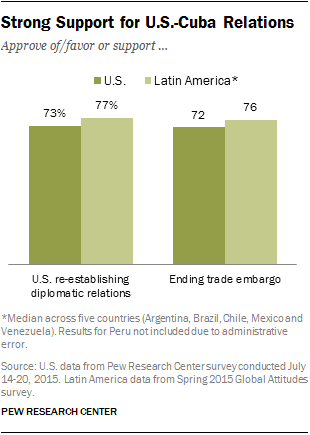
A new Pew poll shows US support for ending the Cuban embargo has climbed to 77% and 76% of the Latin Americans polled agree.

Strong Support for U.S.-Cuba Relations

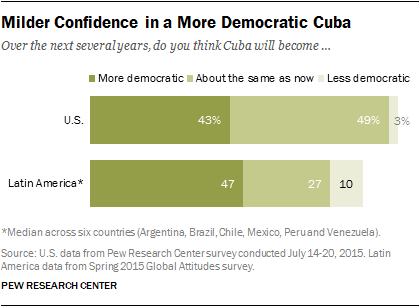
But, they are not certain that Cuba will become more democratic:

Milder Confidence in a More Democratic Cuba

-----
Update 10/21/2015

Nine US governors have called for an end to the embargo -- and two of them are Republicans. This seems to be the only issue with any bi-partisan support in the US congress. I guess these folks are thinking about both doing business with Cuba and public opinion (see poll results above).

-----
Update 1/13/2016

President Obama called for an end to the Cuban trade embargo in his State of the Union address. The American public also favors ending the embargo and this is one of the few (only?) issues with some bi-partisan support, so it is conceivable that he will get his wish.

Saturday, February 14, 2015

The US will allow imports from Cuba's nascent private sector -- will Cuba allow software exports?

Will Cuban programmers be allowed to sell software and do offshore programming and localization in the US and online?

Many people have asked me whether I expect the Cuban Internet to thrive after the rapprochement with the US, and I tell them that is up to the Cubans -- the ball is in their court.

President Obama passed them another ball yesterday -- Cubans can now be paid for many goods and services exported to the US.

My first reaction was a big grin -- I am more interested in what Cuba can sell in the US than I am in what US and other companies can sell in Cuba -- and I imagined Cuban companies and professionals offering high margin goods and services in the US.

But, Obama's offer is limited to "independent Cuban entrepreneurs" -- who are those entrepreneurs and what do they do? This report by Richard E. Feinberg lists the 201 self-employment job categories that were open to Cubans as of September 26, 2013 and it is a goofy list with jobs like three-wheeled pedal taxi driver (not to be confused with pedal taxi driver or horse-drawn cart operator). I'd advise you to check the list for laughs and also a glimpse into the Cuban bureaucratic mind.

Well, that was discouraging, but then I looked more closely at Feinberg's table grouping the 201 jobs into eight categories and one jumped off the page -- computer programmers were included in the "other" category along with clowns and magicians!


How did programmers get on this goofy list? Was it an oversight or an intended loophole for would-be app developers, Web site designers and developers, offshore programmers, software localizers, etc.?

There were 476,000 self-employed Cubans in December 2014 -- I wonder how many were computer programmers and how many more would apply for a self-employment license if software and software service export is actually allowed.

If any readers know any of these self-employed programmers, I would love to hear from them -- to hear what they are currently doing and what they would do if allowed to export to the US.

Programmers are close to my heart, but the Cuban economy can export much more than software. If Cuba is to take advantage of the offer President Obama has made, they must drop what Ted Hencken and Arch Ritter call the "internal Cuban embargo." The Cubans would be wise to adopt the economic and Internet reforms suggested by Hencken and Ritter if they hope to export more than artisan crafts, pottery and religious articles.

-----
Update 2/19/2015

Official daily Juventud Rebelde said participants in the forum stressed the need to "promote exports of computer services and products, establish business models among telecommunications operators and providers, and foment the creation and development of state companies in harmony with non-state forms of management."

-----
Update 2/20/2015

If Americans can now purchase goods and services from Cuba, can Cubans crowd-fund projects in the US? Cuban drummer YISSY raised €5,000 on Verkami, a Spanish crowd-funding site. Why not Cuban software projects (and everything else) on kickstarter?


_____
Update 2/25/2015

I've posted the complete list of jobs eligible for self-employment -- it is goofy and funny, but it also says something about Cuban micro-management and bureaucracy.


-----
Update 2/27/2015

Two excellent articles on the:


More examples here

-----
Update 4/29/2015

Cuban software exports will come from the nascent developer/startup community. I will have more to say on this in a future post, but for now, check out this Meetup group. The meetup is being organized by several former members of the Merchise software group and they are interested in software development, entrepreneurship, networking, venture capital, etc. etc. -- the sort of thing you would expect.

Latin American Freeware Festival 2015

Thursday, January 9, 2014

Un método Cubano para lograr conectividad a internet

(Versión Inglés)

La infraestructura doméstica de conexión a internet en Cuba es una de las peores del mundo, y sus posibilidades de mejoría son ínfimas a causa del embargo de E.U, las políticas de control de acceso y de limitaciones al acceso, el poder de ETECSA, la falta de una base de técnicos y usuarios entrenados y en alta demanda, y la falta de capital. ¿Podría eliminarse de alguna manera estos obstáculos?

El embargo va a ser derogado eventualmente, y hay signos de que podría ser relativamente pronto. Mientras tanto, China y otros países están dispuestos a vender y negociar con Cuba.

Las políticas de control gubernamentales podrían cambiar. Cuando Cuba se unió a internet por primera vez, hubo un debate de alto nivel sobre “el dilema del dictador” - la percepción de internet como una amenaza política y cultural contra su potencial de mejorar la vida de las personas y la economía. Se tomó entonces la decisión de controlar internet y el acceso al mismo - pero esta situación no está tallada en piedra, podría revertirse.

¿Y sobre ETECSA? ¿Existe acaso alguna nación en la que el proveedor de telecomunicaciones (sea propiedad del gobierno o privado) no actúe en interés propio a detrimento de la población y la economía? Sospecho que la respuesta es “no”. No conozco a la administración actual de ETECSA, pero me sorprendería que fuera diferente al resto.

ETECSA pertenece conjuntamente al Ministerio de Informática y Comunicaciones y a la empresa RAFIN, SA. El Ministerio lógicamente es parte del gobierno y se somete a su voluntad política -pero las políticas y los líderes pueden cambiar-.

RAFIN es un asunto diferente. No sé cuál es su rol en la administración de ETECSA. Ni siquiera comprendo el rol de una S.A en una nación socialista. ¿Dónde obtuvieron el capital para comprar la parte de ETECSA que pertenecía a Telecom Italia? ¿Quiénes son los accionistas e inversores? ¿Comparten ellos las ganancias y pérdidas de ETECSA? ¿Obtienen un puesto en el consejo de administración -una voz en las decisiones ejecutivas y de políticas a aplicar-? Necesito ayuda de un economista en esta parte.

Una base de técnicos y usuarios entrenados llegará una vez que la conectividad sea útil, globalmente disponible, y abordable -llegara como consecuencia, no como requerimiento, para una internet moderna-.

Nos queda entonces la falta de capital. China jugó un papel activo en el financiamiento e instalación del cable submarino ALBA-1, y en ese entonces especulé que a lo mejor harian una inversión en la infraestructura doméstica, pero esto hasta el momento no ha sucedido.

La sabiduría convencional del Banco Mundial o de la Unión Internacional de Telecomunicaciones es que el camino para lograr el capital necesario para la conectividad es privatizar la industria de las telecomunicaciones y de los proveedores de servicios de internet (ISP), e invitar entonces a inversores extranjeros a construir la infraestructura y competir hasta cierto nivel mientras son controlados por una agencia reguladora – Privatización, Regulación y Competencia (PCR).

Raúl Castro anunció que el gobierno está trabajando en una nueva política de inversión extranjera, lo cual es de singular importancia para estimular el desarrollo económico y social del país. La ley se espera que esté aprobada en Marzo próximo. Falta ver si la nueva ley y la supuesta demanda atraerá o no a inversionistas mayores, pero incluso si sucediera, hay un problema con la estrategia PCR – no funciona bien.

Muchas naciones en desarrollo optaron por la estrategia PCR entre 1991 y 2008:


En el año 2009, observé los datos y concluí que "PCR tuvo un impacto pequeño sobre Internet durante los últimos diez años en naciones desarrolladas o en desarrollo." No he actualizado el artículo con datos consecutivos, pero nuestra experiencia en E.U muestra que la propiedad privada sobre los servicios de telecomunicaciones no garantiza la competencia, la eficiencia y el buen servicio, a pesar de las buenas intenciones de los reguladores y del congreso.

Necesitamos una solución Cubana.

Seria genial si Cuba pudiera permitirse comprar una infraestructura moderna de telecomunicaciones, con fibra óptica hasta las edificaciones y retroalimentación (backhaul) para comunicaciones móviles LTE (siglas en inglés para “evolución a largo plazo”), pero no puede, por lo que tenemos que pensar en soluciones a corto plazo más baratas. El resto de este artículo lo dedicaremos a especular sobre una posibilidad, una política descentralizada multi-satelital.

Varios años atrás, escribí dos artículos (aquí y aquí) abordando las tecnologías inalámbricas para la conectividad en países en desarrollo: plataformas enlazadas y no enlazadas de altitud elevada (HAPs), redes inalámbricas terrestres (WiMAX era esperanzadora en aquel entonces), constelaciones de satélites de órbita baja (LEO) y terminales de satélite de apertura muy pequeña (VSATs).

Google experimenta actualmente con HAPs, pero sin ninguna utilización significativa. Hasta donde conozco, nadie está estudiando los satélites LEO y WiMAX no se desarrolló como se había previsto. En la época en que se escribieron esos artículos, VSAT era la única opción para conectar áreas rurales en naciones como la India, pero las estaciones terrestres VSAT eran grandes, caras y lentas.


Desde aquel entonces, la tecnología ha progresado, y el mercado de consumidores para la conexión por satélite ha crecido. Proveedores estadounidenses como HughesNet y Viasat tienen 1 398 000 suscriptores entre los dos. A pesar de los largos tiempos de respuesta, he tenido video-conferencias fluidas con amigos que usan platos satelitales en zonas rurales de Brasil y Chile. Las antenas son pequeñas, los costos bajan, y la velocidad crece.

¿Qué pasaría si el gobierno cubano fomentara el uso de los satélites en lugar de prohibirlos?

El gobierno de Cuba ha dicho que autorizará agentes para la venta de tiempo de teléfono e internet. ¿Que pasaria si expandieran el programa para permitir a esos agentes a poseer y vender tiempo y servicios usando enlaces de internet por satélite –- de la misma forma que las “damas de teléfonos Grameen” en Bangladesh compraban teléfonos celulares para revender el tiempo de llamada?


Hoy, hay algunos puntos de satélite instalados ilegalmente en Cuba. Imaginemos 1000 platos de satélite legales, dispersos por toda la isla, suministrando acceso a internet y a llamadas VOIP (las cuales son ilegales hoy).

Si esta idea se tomara en consideración, imagino que ETECSA querría poseer las estaciones terrestres y establecer los precios. Eso garantizaría las ganancias y el control gubernamental sobre el acceso a Internet, pero sería una estrategia de corta visión. Permitir a los operadores de satélites ser propietarios de su equipamiento, crearía un grupo descentralizado, auto-controlado, de empresarios que aportarían esfuerzo e innovaciones al proyecto.

La situación en Cuba hoy es un recuerdo de lo que era Internet al final de los años 1980 en E.U. Se inventó TCP/IP y mostraba ser efectivo en las redes APRANet y CSNET. El potencial de la red era obvio para aquellos que la habían utilizado, pero el acceso estaba restringido a unas pocas organizaciones y personas.

En aras de conectar a más personas, la Fundación Nacional de Ciencia (National Science Fundation) estableció NSFNet. Ellos contrataron una infraestructura de conexión nacional (blackbone network), y ofrecieron fondos a todos los colegas y universidades para cubrir los costos de un enrutador (router) y de la conexión a la infraestructura nacional. También ofrecieron conexión a redes de educación e investigación en países en desarrollo. Cuando fue desactivado en Abril de 1995, NSFNet era la infraestructura de conexión global, enlazando 28 470 redes domésticas y 22 296 foráneas. (Nótese que Spring, el proveedor de conectividad para naciones en desarrollo, también suministraba conectividad a Cuba, a pesar del embargo)

El proyecto NSFNet en su totalidad costó al contribuyente de E.U $94.5 millones – una inversión pequeña con un retorno inestimable. Cubrir a Cuba con una sábana da platos satelitales tendría resultados similares.

La inversión de NSFNet fue altamente balanceada. Mientras que las universidades obtenían conexión gratuita a la red nacional, se esperaba que ofrecieran acceso para las facultades y los estudiantes. Colectivamente, las universidades invirtieron mucho más en las redes locales de sus campus, en entrenamiento y en personal, que lo que invirtió NSF en NSFNet. El enfoque descentralizado y la arquitectura "end-end" de la red empujaron tanto la formación de capitales como innovaciones a el borde de la red donde hubieron inversionistas y empresarios listo para participar.

¿Cuál sería el rol del gobierno Cubano en un mundo de acceso satelital descentralizado? Su tarea más importante sería la planificación de la capacidad y la negociación con las compañías suministradoras de comunicación por satélite para el ancho de banda. Ellos tendrían además que especificar, evaluar y comprar equipamiento para estaciones terrestres (algunas de los cuales podrían fabricarse en la isla).

Ellos deberían también tomar la delantera en el desarrollo de software que opere eficientemente cuando no hay conexión, usando compresión automática de datos y trasfiriendo los mismos cuando el usuario se conecte. Este tipo de software sería útil en cualquier país con ancho de banda limitado, no solo en Cuba. Dado que la necesidad es la madre de la invención, podríamos incluso llegar a ver soluciones novedosas para ejecutivos ocupados viajando en “modo avión”.

El gobierno debería también apoyar a los operadores de satélite ofreciéndoles préstamos bancarios que ayuden con el costo inicial del equipamiento, facilitando entrenamiento y compartiendo experiencia y “mejores prácticas”. Uno puede imaginarse un banco de micro-finanzas controlado por el gobierno que ofrezca préstamos, y el gobierno pagando los costos de operación de una asociación de operadores de satélite. Como sucedió con NSFNet, el gobierno podría irse alejando de estas actividades una vez que la red sea estable y auto-sostenida.

Por supuesto el sistema de satélites es solo un paso intermedio, a largo plazo será desplazado en favor de una infraestructura de fibra óptica moderna. El sistema de satélites pavimentaría el camino hacia ese objetivo, al crear demanda y habilidades en los usuarios. Los enlaces de satélite servirían de guía al gobierno sobre como asignar sus escasos recursos de fibra óptica -regiones de alta demanda se conectarían primero que las demás-. (Google siguió una estrategia similar al priorizar barrios cuando instalaron su red Giga-bit en la ciudad de Kansas, - áreas con muchos suscriptores fueron las primeras en conectarse-).

Nótese que he sugerido que el gobierno sea responsable por la infraestructura de fibra óptica, pero no por proveer el servicio de internet. Deberían ver la infraestructura de conexión como si fueran carreteras – proveer una infraestructura para ser usada por tractores, autobuses y autos que tienen propietarios independientes. China siguió una estrategia de lanzamiento de internet similar, con organizaciones del gobierno construyendo las infraestructuras de red que para finales de 1999 estaban siendo usadas por más de 500 proveedores de servicio de internet.

Recordemos que las universidades de NSFNet aportaron sus propias redes locales. Uno puede entonces imaginarse redes locales a nivel de ciudad o de pueblos, enlazando estaciones terrestres en la ciudad. Como en el caso de NSF, el diseño y la inversión en tales redes deberían ser locales. En este caso, viene a mi recuerdo las redes de distribución de TV “hechas en casa”, en las que la gente usa su propio cable coaxial para conectar casas y otros locales a una estación central terrestre.


Al inicio de esta publicación, expuse una lista de barreras en el camino a la conectividad en Cuba. He presentado una propuesta de arrancada de bajo costo para una conectividad que no requiere inversión extranjera.

Esto deja entonces las barreras políticas. Tal vez hay esperanza. Como se menciona antes, E.U ha manifestado un deseo de cambio de política y Raúl Castro a llamado a los cubanos a adoptar las reformas económicas “sin prisa, pero sin pausa.”

Un estímulo más específico viene del primer Vice-Presidente Miguel Díaz-Canel, quien dijo: "Hoy, con el desarrollo de las tecnologías de la información, de las redes sociales, de la informática y la Internet, prohibir algo es casi una quimera imposible. No tiene sentido. (...) Por tanto, nosotros constantemente tenemos que estar dialogando."

Reconozco la ironía de proponer que el gobierno adopte una tecnología que llevó al encarcelamiento de Alan Gross y otros. Revertir la legislación sobre comunicación satelital requeriría coraje político, pero también brindaría al gobierno un argumento poderoso contra las acusaciones que pesan sobre él y estarían persiguiendo una solución cubana , una en la que Internet es operado como un servicio al pueblo y la sociedad, no al gobierno o a compañías de telecomunicaciones.

Traducción de un amigo de la Internet cubana.
-----

Actualización
1/10/2014

Una persona que respondió a mi post menciono que no es necesario que la política de los EE UU cambia para este propuesta tenga éxito. Afirma que en Abril 2009 el gobierno Americano aprobó la venta de satélites para servicios Internet.

Revise lo que la administración en "Reaching out to the Cuban People" especificaba y aprendí que autorizaba cable de fibra óptica y satélites de comunicación que conectaban Cuba con EE UU -- explícitamente para radio y televisión, pero no mencionaba la Internet.

Le pregunté al Departamento del Tesoro, si un proveedor de Internet por satélite podría obtener una licencia para servir a una cuenta de Cuba. Me contestaron que tendrían que revisar para darme una respuesta.
-----

Actualización
1/18/2014

Satélite ISP IPSTAR dice que han conectado más de 26.000 escuelas en Tailandia, lo que permite a más de 2.000.000 estudiantes el acceso a los materiales de aprendizaje en línea y aplicaciones basadas en IP. Se conectan a las LAN en las escuelas y el aprendizaje "cafés" y se centran en la entrega de matrial enseñanza. Este programa parece ser relativamente centralizado y muy específicas, sino que es un ejemplo de un proyecto de conectividad por satélite patrocinado por el gobierno.

Aquí está un breve vídeo IPSTAR en la educación y otras aplicaciones:

Real Time Analytics