Showing posts with label Cuban policy. Show all posts

Sunday, November 17, 2019

5G for fixed connectivity in Cuba

ETECSA reports that over 110,100 Cuban households have DSL connectivity using their Nauta Hogar service. There are also shared facilites -- 986 WiFi hotspots (127 in Havana) and 347 Navigation Rooms (44 in Havana) with 1,309 computers (304 in Havana).

These services are dead-ends on the road to hoped-for "computerization." The Cuban population is around 11 million so, after three years, roughly one person in 100 lives in a Nauta home and the services are limited geographically since DSL is only available in the vicinity of telephone central offices and WiFi hotspots and Navigation Rooms are at fixed locations. Furthermore, the connection speeds are low and the prices high.

When the U. S. began making fixed Internet connections to homes, schools, businesses, etc., we had an installed inventory of relatively new last-mile phone lines, television cables, and longer fiber links and we have been expanding that infrastructure for forty years. Cuba does not have those assets and, even if they were willing to invite foreign investment, the gap would continue to grow. (Furthermore, I wouldn't wish a foreign monopoly or duopoly on anyone).

Could 5G wireless help with Cuban fixed connectivity?

Medium-Earth orbit (MEO) satellite Internet service provider SES has been providing Cuban international transit for two years, so they have an established relationship with ETECSA. SES also provides 2, 3 and 4G mobile backhaul and managed mobile service in places like Chad, Pakistan and Papua New Guinea. (They also offer WiFi hotspots as a service).

SES is planning to offer the same services plus focused small-cell connectivity for 5G networks when their next-generation mPower satellites come online. SES has 20 MEO satellites in orbit today and in 2021 they will be adding seven next-generation mPower MEO satellites with over 4,000 shapeable and steerable beams that can be switched under program control, giving the constellation over 30,000 dynamically reconfigurable beams and over 10 Tbps capacity. The mPower satellites will work in conjunction with their current MEO satellites and their geostationary satellites.

Expected Starlink coverage, mid-2020
How about using low-Earth orbit (LEO) satellites for 5G backhaul? Several companies are developing LEO Internet-service constellations, but SpaceX's Starlink constellation has a clear lead. Simulation of their announced plans shows that they will have coverage over Cuba by around the middle of next year and after that capacity will grow steadily as they launch new satellites. SpaceX plans to focus on the US market at first, but Elon Musk is an iconoclast who refused to serve Trump and I would encourage ETECSA to at least reach out to SpaceX.

So much for backhaul and system integration, how about connectivity to the thousands of local small cells that would be required for fixed broadband? That would require a lot of local fiber, which could be planned and installed by local people. Decentralization of the design and installation of the edge of a fixed 5G network would require more than capital and new technology -- it would require a political shift to a telecommunication policy focused on economic and social goals. Unfortunately, that seems less likely today than it seemed before the confiscation of SNET and other community networks.

Cuba is emphasizing and investing in mobile connectivity today and phones and tablets are fine for applications like content consumption, online shopping, social interaction, and Twitter-style politics, but businesses, schools, content creators, software developers, etc. need larger computers with fast, fixed connectivity. If Karl Marx were alive today, he might say mobile phones were the opiate of the people.

Tuesday, July 30, 2019

Cuba claims new regulations expand Internet access to homes and businesses, but here's the downside

The new regulations establish constraints on private network transmission power and cabling that, if enforced, would put Cuba's cooperatively-owned community networks out of business.

New Cuban regulations regarding private WiFi networks went into effect yesterday, and the New York Times and others proclaimed that "Cuba expands Internet access to private homes and businesses." Yes, Cubans can legally import and install WiFi routers in their homes, small cafes, B&Bs, etc., but these regulations will make little difference in Internet access.

For a start, very few homes and small businesses in Cuba have links to the Internet. Furthermore, my guess is that most people in homes that are connected to the Internet have already installed registered or unregistered WiFi routers. (Resolution No. 65/2003 dated June 5, 2003, states the procedure for registering a private data network).

If that is the case, what do these new regulations change?

They establish constraints on private network transmission power and cabling that, if enforced, would put Cuba's cooperatively-owned community networks, the largest of which is SNET in Havana, out of business. Even if they are not enforced today, they will hang like the sword of Damocles over their heads.

That's the bad news. The good news is that the Ministry of Communication has postponed enforcement for 60 days while they negotiate with SNET.

SNET will remain up during 60 days of negotiation (source).

Why would the Cuban government want to eliminate community networks? Do they see them as economic competitors to the government Internet service provider, ETECSA? Is ETECSA embarrassed by the fact that community networks connect so many people at so little cost? Do they fear clandestine, anti-government communication? I really don't know.

Guifi.net
If Cuba aspires to what the International Telecommunication Union refers to as fourth generation policy, which they characterize as "Integrated regulation – led by economic and social policy goals," they should regard the community networks as collaborators, not competitors. They should legitimitize SNET and the others, subsidize and work with them and provide them with Internet connectivity. SNET is the world's largest community network that is not connected to the Internet. Cuba should follow the lead set by Spain, where they have provided Internet connectivity to Guifi.net, the world's largest Internet-connected community network. Looking to the future, community networkers could play a valuable role in the installation of Cuba's 5G wireless infrastructure.

Cuba proudly proclaims (Trumpets) that they working toward the computerization of society. The outcome of these negotiations with SNET will shed light on the veracity of that claim.

Update 8/10/2019

The Cuban Ministry of Communications has refused to make an exception to their restrictions on wireless power and cabling and says SNET (and presumably other Cuban community networks) must shut down. Over one hundred people have gathered to protest the decision, allegedly without any call to do so.


This goes beyond the loss of a large community network -- it signifies Cuban government intransigence and belies the claim that they seek "computerization" of the society and a modern Internet.

I asked earlier, why they might want to eliminate rather than collaborate with community networks and suggested three possibilities:
  1. They see community networks as economic competitors to ETECSA, the state-monopoly ISP.
  2. They are embarrassed by the community networks' ability to connect so many people at so little cost.
  3. They fear anti-government communication.
Since they control the Internet and have seen the example of countries like China which use a ubiquitous Internet as a tool of control, I lean toward answers 1 and 2.

Update 8/11/2019

Ernesto De Armas <@RealErnesto95>, tweeted this positive update on the negotiations with MINCOM:
Hola a todos. Por esta vía transmito las buenas nuevas respecto a SNET, hoy en la tarde el grupo de trabajo SNET-MINCOM llegaron a favorables acuerdos mediante los cuales se determinó que Snet va a pasar todos sus servicios a través de los JCC, los JCC a su vez estarán conectados por fibra óptica entre ellos y los servidores que contienen nuestros servicios se montarán en ETECSA.

También se autorizó a que los nodos se conecten a los JCC utilizando equipos de alta potencia que son los necesarios para poder hacer esto, entre estos equipos se incluyen los equipos de Ubikiti, Nanostation, etc de alta potencia, no pondrán trabas para estas conexiones hacia los JCC. También hay otra buena noticia, los servicios de SNET pronto estarán disponibles ¡Para todo el país!

También advirtió el grupo de trabajo respetar estos acuerdos y no realizar nada que pueda atentar contra los mismos, nada de manifestarse públicamente (que a mí entender no hace ya ninguna falta, ya hemos logrado lo que queríamos) ni hacer declaraciones ofensivas contra MINCOM. En mi opinión hemos ganado está batalla por la subsistencia de #Snet, ahora debemos cooperar entre todos para hacer de este proyecto algo mejor, incluso, a lo que teníamos anteriormente. Estoy sumamente contento, alegre y agradecido de que nuestras instituciones estatales no hayan hecho oídos sordos a nuestra causa. Hoy comienza una nueva era en la Informatización de la sociedad cubana

TheCubanJedi <@darthdancuba> asked "Podrán abrir algo de sNet a internet??" and Ernesto replied "No. De momento nada de internet a través de Snet como siempre ha sido."

This is unofficial, but if it is accurate, SNET will be more widely available and faster, but not yet on the Internet.

Update 8/12/2019

Sad to say, the August 10th update was accurate. Ernesto De Armas <@RealErnesto95> has learned that MINCOM has ruled against SNET and the restrictions on transmission power and cabling will be upheld.

Needless to say, this is disappointing to the users of Cuban community networks and to the general population since it is an indication that ETECSA is determined to remain a monopoly.

A demonstration protesting the decision will be held next Saturday. Here is the announcement:


Here is Ernesto's English translation:

As we have the conviction that Revolution is to change everything that needs to be changed, on Saturday, August 17th, from 9am in the park located in front of the MINCOM, behind the bus station terminal, we make a call to all persons filiated to Snet from all the provinces of the country.

SNET, a community created more than 15 years ago, is being affected by the resolutions 98 and 99, we fight and demand to have an autonomous SNET that keeps the social project that we have had during all these years and that reaches so many homes and Cuban families.

To everyone who has the feeling for Snet, which has been created by everyone, this is the time to fight against resolutions 98 and 99 that are attacking the correct functioning of our community, created with everyone's sacrifice and with more than a decade of existence and acceptance by thousands of Cubans.

This is the time to make MINCOM understand that true democracy is conceived and defined by the people and that we must be heard because we are the youth of this country, the new generation and as the future that we are we demand to be considered.

We urge and summon every teenager, young, adult or old person, without any difference who feels identified with our cause, either has enjoyed or not with our network and our services to support us from every place and every spot because WE ALL MATTER, WE ARE ALL SNET. On this depends the end of the beginning of a new dream, a new path that we want to follow, so we can accomplish our acknowledgment before the authorities and a happy ending to keep ourselves being what we are. Snet...


Thursday, June 13, 2019

Cuba's new WiFi regulations -- a step forward, backward or sideways?

Cuba has legalized WiFi access to public Internet hotspots from nearby homes and small businesses, but SNET and other community networks remain illegal under the new regulations. Does this signify a significant policy change?

Soon after Cuba's state monopoly telecommunication company ETECSA began rolling out WiFi hotspots for Internet access, people began linking to them from homes and community street nets. These connections and importing the WiFi equipment they used were illegal, but generally tolerated as long as they remained apolitical and avoided pornography. Regulations passed last month legalized some of this activity in a bid to boost connectivity by allowing Internet access from homes and small private businesses like restaurants and vacation rentals that are located close enough to a hotspot to establish a WiFi connection.

The added convenience may generate more revenue for ETECSA and it will give the Ministry of Communication (MINCOM) some small fees and, more important, registration data on the local-area network operators. (If you license a connection, you have the power to rescind the license). It will also generate some additional network traffic, which may strain network capacity. There are two WiFi frequency bands -- 2.4 and 5 Ghz -- and a friend told me that currently only the 2.4 Ghz band is being used. The new regulations allow use of the 5 Ghz band as well, which will add capacity from homes and businesses to the hotspots, but backhaul capacity from the hotspots to the Internet may become more of a bottleneck and exacerbate quality of service problems.

So much for small networks, but what, if anything, will be the impact of these regulations and their enforcement be on larger, community networks, the largest of which is Havana's SNET? The new regulations bar cables that cross streets and radio transmitter power over 100 mW. SNET uses cables and higher-powered transmitters, so, if these regulations were enforced, they would put SNET and smaller community networks out of business.

However, community networks have been illegal and tolerated since their inception, so it may be that they will continue to be ignored. If that is the case, the new regulations don't really change the status quo, but what if these new regulations foreshadow a policy change? What if ETECSA were willing to collaborate with community networks following the example of Guifi.net in Spain?

SNET topology. Red dots are pillars;
others are second-level nodes (source).
If that were the case, ETECSA could take steps like providing high-speed wireless or fiber Internet connections at the locations of the central SNET backbone "pillars" and allowing cables and faster wireless links to and within second-level networks that serve up to 200 users. They could also cooperate with SNET administrators in purchasing supplies and equipment and network management and they could do the same for smaller community networks outside of Havana.

So, which is it -- a step backward with cracking down on SNET and other community networks, a slightly positive step adding locations from which one can access a WiFi hotspot, or a positive indication of a policy change and a step toward incorporating community networks into the recognized and supported Cuban Internet infrastructure?

We will know the answer after the new rules go into effect on July 29, but my guess is that it will be the middle choice, a slightly positive step. Cracking down on SNET would be disruptive -- eliminating jobs and depriving thousands of users of services they value and I don't think the government would want those problems. At the other extreme, full cooperation with community networks would mean ETECSA giving up control and the dilution of their bureaucratic and financial monopoly, which seems unlikely.

But, to end on a more upbeat note -- a friend tells me that he has heard that SNET community representatives are talking with the government. Could ETECSA and MINCOM have different views and, if so, who is in charge?

Update 6/15/2019

Two things. First, the friend I mentioned above commented on my speculation that MINCOM and ETECSA might have different views, saying "ETECSA and MINCOM are so tight together that is hard to say where one starts and the other one begins."

He also pointed out that the administrators of four of the SNET sub-nets posted a statement telling users to remain respectful and calm while they negotiate with MINCOM to protect the interest of SNET and other community networks. They have had one meeting in which they talked about spectrum and the statement refers to the "regulatory framework," suggesting that MINCOM is open to high-speed wireless links. They say the first meeting was productive and they will have future meetings.

This increases my confidence that SNET will survive under these new regulations and, if MINCOM allows high-speed links between the sub-nets, SNET performance will improve. It would be even better if the talks go beyond SNET's survival and move on to ways they can collaborate with ETECSA.

You can follow the negotiation progress on the SNET Facebook page.

Thursday, March 28, 2019

Google and ETECSA will agree to exchange Internet traffic without charge

This agreement telegraphs a change in Cuban policy -- now we need the cable.

Google and ETECSA have signed a memorandum of understanding agreeing to negotiate a peering agreement that would allow cost-free data exchange between their networks once an undersea cable physically connects them.

Google has worked hard to establish a relationship with ETECSA and the Cuban government. In recent years, Cuba, not the US, has limited the Cuban Internet. This agreement telegraphs a change in Cuban policy.

Today, nearly all of Cuba's Internet traffic is carried over an undersea cable at the south end of the island. A cable from the Havana area to Florida would reduce the load on their inter-city "backbone" network that today carries Internet traffic to the cable landing in the south. That would result in a faster Internet and save ETECSA money. The next generation of low-earth and medium-earth orbit satellite connectivity can have a similar effect.

ETECSA could use the savings from an undersea cable or next-generation satellites to cut prices, increase investment in infrastructure or increase profit. That would depend upon who is actually calling the shots at ETECSA.

Over three years ago, Daniel Sepulveda, Deputy Assistant Secretary of State and U.S. Coordinator for International Communications and Information Policy, said he knew of at least a half dozen proposals — from US and non-US companies — to construct a north-south undersea cable between the US and Cuba.

The cable has been stopped by politics, not economics or technical difficulty. It looks like Cuba is willing to relent on the politics. Trump's fighting this cable would solidify Cuba's political and commercial ties with China and Russia.


Friday, June 1, 2018

Update on Cuban advances in the "computerization of society"

A recent televised roundtable enumerated advances in the computerization of Cuban society, including:
  • Telephone density is 58% with 6.5 million accounts, 5.2 million of which are cell phones.
  • 1.5 million people access Nauta mail with cell phones.
  • Over 1.7 million have permanent accounts.
  • There are 1,713 public-access spots: 709 WiFi locations, over 700 at ETECSA premises and the same number in third-party locations (but 709+1400 is 2109, not 1,713).
  • There are over 37,000 Nauta Hogar accounts, 22,000 of which were installed this year, and they hope to install another 30,000 by the end of the year.
  • Nauta Hogar is available in 136 municipalities and 22 percent of the Popular Councils.
  • They have installed a lot of fiber.
  • There are over 1,400 cellular base stations and over 520 of them are 3G compatible.
  • There are 935 ATMs, serving all provinces, but only 69 municipalities.
  • There are currently 11,500 point-of-sale terminals, mainly in retail stores.
  • UCI is working on "RED Cuba" a search service for all national intranet content.
  • UCI has a service for monitoring over 1,500 national intranet Web sites -- presumably monitoring traffic, not content.
  • Apklis, the online application center for Android devices, will serve as an alternative to the Google Play store for Cuban applications.
  • An e-government application for the collection and management of fines has been installed in 198 offices.
A few tentative observations come to mind. They are continuing to stress the national Cuban intranet with applications like Apkis and RED Cuba. Nauta Hogar is attractive to a subset of people and small businesses who can afford it and are located in served areas, but it will not reach the mass population -- for that, they are counting on 3G cellular and public-access spots.

Here is the roundtable video:


Friday, June 9, 2017

Questions about Cuba's 3G mobile expansion

I hope ETECSA is planning for the future and views this 3G rollout as an interim stopgap.

ETECSA is rolling out 3G mobile service in Havana and elsewhere in Cuba and Telegeography reports that there are now 229 3G base stations in Cuba.

Where and how extensive is the coverage?

ETECSA says 3G coverage is available in all of Havana, provincial capitals and tourist resorts. AT&T says there is GSM/GPRS coverage for 85% of national territory.

Here is a crowdsourced 3G coverage map of Cuba as of February 17, 2017:


Strong signal: received signal strength indicator (RSSI) > -85dB, Weak: RSSI < -99dB

Again, this is a crowd-sourced map, so it represents a lower bound on coverage, but it paints an unsurprising picture of 3G deployment -- near a backbone and strongest in cities.

Who has access to the 3G network and what can they access?

Google Fi service was
available earlier this year.
Tourists and foreign business travelers have had expensive Internet access while roaming in Cuba for some time. For example, AT&T and T-Mobile charge $2 per megabyte. Recently Digicel recently announced much lower cost roaming on a "dedicated tourist-only 3G mobile network," which sounds like the network described by ETECSA above. They charge between 17 and 25 cents per megabyte, depending on the size of the prepaid order.

The best deal of all was fleetingly offered by Google on their Fi mobile service. Earlier this year, users reported that Google was treating roaming data the same as domestic data -- $10 per gigabyte. Unfortunately, that capability has been turned off, but it may be a hint of things to come.

But which Cubans -- other than Raúl Castro -- have 3G access? I have been told that some people have 3G access because of their work, but have no confirmation of that. I've also been told that some hackers have been able to get 3G access, but, again, have no confirmation.

Assuming that some Cubans have access to the 3G network, are they able to see the global Internet or are they restricted to services offered on the national network? (I bet Raúl has international access).

(source)
How about speed?

Armando Camacho ran a number of 3G speed tests in Havana (near the corner of Patrocinio and 10 de Octubre) and observed ping time to a server in Miami as ranging from 91 to 127 milliseconds, upload speed from .48 to 1.58 Mbps and download speed from .85 to 10.42 Mbps. He observed considerable speed variance, suggesting that others were sharing the same radio or backhaul resources.

What is the interim plan for 3G access?

Today the 3G network serves tourists, foreign business people, and perhaps some Cubans at work or in government. ETECSA may be planning to extend the service to subscribers as a much-needed supplement to their current public-access centers. I don't know what their plans are, but more 3G will require more fiber and microwave connectivity for backhaul. Only ETECSA knows what they are installing today.

They may also be planning to extend 3G mobile to rural areas. In April, the Ministry of Agriculture announced plans to bring Internet connectivity and other computer services to rural areas beginning in Granma, Ciego de Ávila and Isla de la Juventud. Will 3G be part of this promised rural coverage? Again, backhaul would have to be provided.

What is the long-run mobile plan?

Regardless of the short-run, 3G technology is only an interim step. Since Cuba has so little legacy infrastructure, they are in a position to leapfrog today's 4G technology and plan for 5G mobile connectivity. If that is the case, they should be investing in fiber for backhaul in places that microwave can serve today -- long, microwave "daisy chains" will not have the speed or capacity for a modern Internet in five or ten years. They should also be planning on fiber to the curb, building, and home in order to support the myriad devices expected to comprise the Internet of things as well as fixed connectivity.

Fifth generation standards are not yet set, but the migration of base-station function to the "cloud" will occur as the number of base stations and backhaul speed increase. That implies the need for datacenter planning and investment for the future. (See this Stragey& analysis for more on the 5G architecture).

As usual, I have more questions than answers, but I hope ETECSA is planning for the future and views this 3G rollout as an interim stopgap.

-----
6/12/2017

Tu Android, the Cuba Android community blog, has a post on determining whether your smartphone is compatible with Cuban 3G. The post begins with an overview of the requirements and lists compatible phones sold by ETECSA and the Blu phones that are compatible. Evidently, that was not enough, because there are currently 316 comments in which users are helping each other out.

The comments are reminiscent of the early PC hobby days in the US -- questions and answers are coming from uncertain users and expert hackers. As the Tu Android tagline reads -- "this is a family, not a blog." (I am naively hopeful that Cuban culture may produce a unique Internet from which we can all learn).

If you are a Cuban and not sure whether your phone can or can be altered to use the 3G network or are not sure why you cannot connect (evidently ETECSA is rolling out activations over time) check out the post and the comments -- ask the family.

-----
Update 6/22/2017

We now have a couple of answers to our 3G mobile questions. Hilda María Arias Pérez, Central Director of ETECSA’s Mobile Services Division, says there are 4,220,000 mobile accounts and 856 2G locations, covering 75% of Cuban territory and 85% of the population. They began the 3G rollout in April and now have 343 3G locations covering 13 % of the territory and 47% of the population. (For more on mobile coverage, see this post).

Engineer Arias Pérez discusses ETECSA's mobile coverage in this interview:


Monday, June 5, 2017

Cuban tech entrepreneurs -- new values?

Might Cuban entrepreneurs develop uniquely Cuban enterprises?

A while ago, I pointed out that offical Cuban attitudes toward self-employed developers and privately owned Internet service companies are improving -- government software companies say they want to cooperate with private developers and Cuban Internet services that were once attacked are now praised in government publications.

This week three positive articles on NinjaCuba, a startup service for Cuban professionals seeking freelance work, were published: here, here and here.

Two things caught my eye.

First -- the latter two articles quote the company founders, Víctor Manuel Moratón and Fabián Ruiz, as saying they would like to have Cuban state companies as clients. That would have been unimaginable in the past, but the government sponsored TICS 2017 workshop held in March, called for collaboration between state and private companies and it now seems likely. These articles support my speculation that Cuban government attitudes toward tech entrepreneurs have changed.

Second -- Moratón and Ruiz say they are not preoccupied with becoming a startup "unicorn" (a billion dollar company) -- they want to find a way to sustain the company. That may say something about Cuban culture and values since it contradicts the widely-held (false) assumption that US corporations have a fiduciary duty to maximize profit and increase investor wealth, requiring constant growth and leading to tying executive compensation to stock price.

Andy Puzder, Trump's first (unconfirmed) nominee for Secretary of Labor, is a prominent supporter of the investor-return assumption. Puzder, who recently resigned as CEO of CKE Enterprises, a company that operates international fast-food chains, opposes government regulation of terms of employment or food health -- his job is to increase shareholder return and give people what they want. (I wonder how he feels about heroin).

Unfortunately, maximizing investor return ignores the interests of employees, the society, and the environment. Chobani Yogurt CEO Hamdi Ulukaya, a competitive capitalist, offers a counter example -- his company is successful and he gives back to his employees and has benefited his community. (The "alt-right" has attacked Ulukaya).

Last summer, a Copenhagen taxi driver told me he was about to leave on a three-week camping trip with his wife and children. US taxi drivers don't take three-week vacations with their families. The US is looking like a "canary in the coal mine" -- suffering the unintended side-effects of Puzder's grow-or-die strategy.

Perhaps young Cuban entrepreneurs like Moratón and Ruiz, who have been raised with communal values (regardless of what you think of the current government) and a Latin culture, will provide an example we can all learn from.

Fabián Ruiz and Víctor Manuel Moratón

Freelance ad for a developer who charges $US 3.00 per hour.


Thursday, May 11, 2017

Why not connect the Gaspar Social streetnet to the Internet?

Grupo creativo Gaspar Social (source)
I've been covering Cuban streetnets (local area networks with independent users that are not connected to the Internet) for some time. Reader Doug Madory told me about Gaspar Social, a new streetnet in Gaspar, a small town in central Cuba. Gaspar Social opened to the public last October and has grown quickly -- about 500 of Gaspar's 7,500 residents are now users.

Streetnets are illegal in Cuba and the government has ignored some and cracked down on others, but they seem to be tolerating them now as long as they remain apolitical and avoid pornography and other controversial material. Last month, Communist Party officials noticed Gaspar Social but did not shut it down. Yoandi Alvarez, one of the network creators, said "they made it clear our network was illegal but they wouldn't be taking our antennas down" and they were given instructions for applying for a permit.

So, residents of Gaspar can play games, download software, share files, socialize, etc., but they can not access the global Internet. Why not connect Gaspar Social to the Internet?

Gaspar is in the province of Ciego de Ávila and the capital city is Ciego de Ávila. ETECSA has six WiFi hotspots and three navigation rooms in Ciego de Ávila and, as a provincial capital, the city must have many government, medical and educational users. In other words, there must be relatively fast backhaul to the Internet in Ciego de Ávila.

Connecting Gaspar to Ciego de Ávila seems like it would be cheap and easy. As you see below, they are only 28.2 kilometers apart on the road (25 kilometers as the crow flies) and the terrain is flat. (Gaspar's elevation is 5.1 meters and Ciego de Ávila's 49 meters).


They could be connected with a high-speed wireless link or fiber. The flat terrain favors a wireless link and the road could provide a right-of-way for fiber. Installing 28 kilometers of fiber would be expensive in the US, but Cuba is not the US. One can imagine a community project using International Telecommunication Union (ITU) L.1700 cable. (For an example of a community fiber project, in Bhutan, click here).

ETECSA is the elephant in this hypothetical room. The ITU tracks regulatory evolution and, as of 2013, Cuba was one of the few remaining first-generation (regulated public monopoly) nations.


I suggested earlier that ETECSA consider streetnets as complementary collaborators rather than competitors or outlaws and last year they allowed a small streetnet to connect to a WiFi hotspot.

Cuba has a well-deserved reputation for improvisation and appropriate-technology innovation. I am not suggesting that they jump suddenly to fourth-generation regulation (regulation led by economic and social policy goals), but that they run a pilot test, connecting Gaspar Social to the Internet.

Here is a short video (1:56) on Gaspar Social:


And here is a longer video (13:48) with interviews of the network creators:


Tuesday, May 9, 2017

Trying to predict Miguel Díaz-Canel's Internet policy

Glasnost which undermined the USSR and other socialist countries consisted in handing over the mass media, one by one, to the enemies of socialism.
Raúl Castro, October 1997

The State will work to make [the Internet] available, accessible, affordable for all.
Miguel Díaz-Canel, February 2015

I recently gave a short talk that concluded with some speculation on the attitude of Miguel Díaz-Canel, who is expected to replace Raúl Castro next year, toward the Internet. I searched online and came up with three clues -- two talks he has given and one act.

In May 2013, Díaz-Canel gave a speech at an educator's conference in which he anticipated today's preoccupation with fake news. He acknowledged the futility of trying to control information:
Today, news from all sources -- good ones, bad ones, those that are manipulated, and those that are true, and those that are half-truths, all circulate on the web and reach people and those people are aware of them.
He said the worst response to this would be silence and called upon schools to teach kids to spot fake news. The following is news coverage of his talk (2:57).


The second talk I found was the closing address to the First National Workshop on Informatization and Cybersecurity in February 2015. The three-day workshop was streamed to over 11,500 professionals in 21 auditoriums throughout the country and Díaz-Canel mentioned online discussion by over 73,000 users. (This "national workshop" sounds like a unique mass-collaboration event and I would like to hear more about the format from those who participated).

Díaz-Canel said the Cuban State would work to make (safe and comprehensive Internet) available, accessible and affordable for everyone and that the Internet should be a tool for the sustainable human development in Cuba and its effective integration into the community of nations. He recognized the Internet as a tool benefiting the economy, science, and the culture.

This positive message was dampened somewhat by his recitation of the threats posed by the US and the responsibility of the citizens to use the Internet legally. Reading between the lines, it may be that he envisions a China-like policy of reaping the benefits of the Internet by expanding it while using it as a political tool by restricting access to controversial content, surveilling users and spreading propaganda. (Freedom House considers the Cuban Internet unfree today and the only nations they consider less free are Uzbekistan, Ethiopia, Iran, Syria and China).

The following video shows news coverage of Díaz-Canel's talk (3:26) and you can read the transcript here.


The third and perhaps most encouraging clue I found regarding Díaz-Canel's view of the Internet was not a speech, but his support of freedom of expression on the La Joven Cuba Web site.

La Joven Cuba, which refers to itself as a "socialist project of political debate speech on the web," was created at the University of Matanzas in April 2010. It was named after a political and revolutionary organization created by Antonio Guiteras in mid-1934. The original tagline was "A blog of university students that speaks of the Cuban reality" and today it is "Socialism and revolution."

Díaz-Canel and the founders of La Joven Cuba
This does not sound like a pro-US blog, but in November 2012, it was blocked.

That's the bad news. The good news is that it was restored in April 2013. The better news is that Díaz-Canel met with and endorsed the founders of La Joven Cuba.

I started this post thinking I would at least come to a tentative conclusion as to the likely Internet policy of Díaz-Canel and the next generation of Cuban leaders, but I am still up in the air.

-----
Update 5/25/2017

Antonio Moltó, UPEC president, Miguel
Díaz Canel and Miriam Nicado, UCI Rector
Díaz-Canel gave a speech at the 2017 Cuba Network workshop convened by the Union of Cuban Journalists (UPEC) and the University of Information Science (UCI).

It is dangerous to reach conclusions based on press coverage of a speech, but this report left me with the impression that while calling for increased Internet access, he is focused on Cuba's national network. He praised ETECSA for lowering rates for access to the national network and said it was necessary to develop government and e-commerce websites, and infrastructure that facilitates navigation in the national network. The report says he also addressed content citing the need to monitor the press (censorship?) prioritize Cuban press reports (trolling?), confront subversive projects (from the US?) and, above all, generate Cuban content.

Lest this sound negative, let me reiterate that it was based on a second-hand report of the speech and my Spanish is rudimentary.

Better yet, I'll end on a positive note. In March, the Cubans held a Workshop on Informatics and Communication for the Society in which self-employed programmers and representatives of state software companies met and were encouraged to collaborate. This month it is Journalists talking about the Internet. Are we seeing slow thawing?

=====
3/17/2018

The Cuban Ministry of Communication recently re-posted a long article on the 2015 speech by Díaz-Canel at the Workshop on Informatization and Cybersecurity mentioned above. Are they trying to tell us something as the election draws near? Are the times a changin'?

You can read the transcript of Díaz-Canel's February 2015 talk here.


Saturday, April 15, 2017

Cuba's self-employed computer programmers

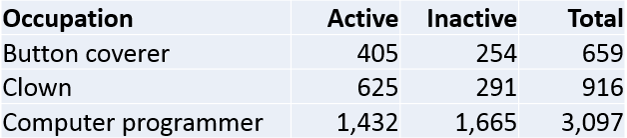
The Cuban government has licensed more self-employed computer programmers than clowns and button coverers combined.

The other day I wrote a somewhat optimistic post pointing out that the Cuban government and government software companies are reaching out to self-employed programmers. One of the reasons for my optimism was a recent informatics and communication workshop, TICS 2017, billed as an exchange between state and non-state sectors working together for the society.

Cubadebate covered the workshop and wrote that about 5% of the roughly 900 self-employed programmers in Havana attended. An anonymous source told me there are 904 licensed programmers in Havana and provided the following license counts for three of the 201 occupations eligible for private employment.

Number of Cuban self-employment licenses

It is encouraging to see that the number of licensed programmers exceeds the number of clowns and button coverers combined. That being said, licensed programmers are more likely to be inactive and the opposite holds true for both clowns and button coverers.

Joking aside, we see another positive trend -- the number of active, self-employed programmers has grown steadily and the growth rate has increased every year:

Number of active programmer licenses each year

A couple of years ago, I wrote a post asking whether Cuba would allow software exports -- it seems the answer may be "yes."

=====
In August 2017, The Cuban government stopped issuing new self-employment licenses. Last July they said they would begin issuing new licenses -- with added restrictions. People complained and the restrictions were reduced somewhat before the government began issuing new licenses.

An anonymous source has told me that, as of this month, the number of self-employed programmer licenses is down to 1,137. That is a step in the wrong direction.

Wednesday, April 12, 2017

Exporting Cuban software and programming -- the times they are a changin'

TICS 2017 taglines: Intercambio entre los sectores estatal y no estatal and Juntos por la sociedad

I've been tracking the nascent Cuban software industry for some time and, after the US decided to allow the import of services provided by independent Cuban entrepreneurs, I wondered if the Cuban government would allow software exports.

I've been away for the last few weeks and, upon my return, discovered some positive signs. Foremost was the first Workshop on Informatics and Communication for the Society (TICS 2017), held in Havana on March 29-30. Fifteen projects were presented and the attendees "succeeded in identifying business opportunities in a collaborative and supportive environment." The workshop was notable because it brought together representatives of the government, state software companies, academia and the private sector and it included discussion of legal matters hindering the development of relations between the private and government sectors. About five percent of Cuba's self-employed programmers attended.

There is also indirect evidence that the outlook is improving. Consider the evolution of the government attitude toward Revolico, a Cuban version of Craigslist classified ads. The Cuban government blocked access to Revolico three months after it was founded at the end of 2007. Co-founder Hiram Centelles countered by frequently changing the IP address, but the site was illegal, and, fearing the authorities, Centelles left Cuba for Spain, where Revolico co-founder Carlos Peña lived.

They began distributing Revolico on El Paquete Semanal and it took off. Today, Centelles has traveled to Cuba, speaks publically of the history of Revolico and the site is posting over 10,000 ads per day. More important, Revolico has three competitors. (More on the history of Revolico here).

Revolico and its competitors

I also see that while I was away, Granma published a positive article on the popular restaurant-directory app AlaMesa, calling it "the first and most comprehensive directory of restaurants in the Greater Antilles."
607
I suspect these examples are the tip of an iceberg. I've been told that there are 607 registered, self-employed programmers in Cuba. It is an open secret that Cuban programmers are doing off-shore work and services like Cubaoutsource and Ninjacuba are facilitating freelance engagement. The wheels of government turn slowly -- slower than most in Cuba -- but it does seem that the times may be a changin'.

-----

Update 4/14/2017

In the first version of this post, I understated the number of Cuban computer programmers with self-employment licenses. My source corrected me, saying there are currently 3,097 licensed programmers, 1,432 of whom are active. That's more than clowns and button coverers combined.

Number of Cuban self-employment licenses

Wednesday, February 22, 2017

There is no Cuban home Internet plan -- and that's good news.

I've followed Cuba's home-connectivity "plan" from the time it was leaked in 2015 until the recent Havana home Internet trial. I thought the plan was a bad idea when it was leaked -- it calls for installation of obsolete DSL (digital subscriber line) technology -- and now that the Havana trial is complete, I question whether the plan was real.

ETECSA denied the validity of the leaked presentation at the time and their definition of "broadband" was "at least 256 kb/s." Furthermore, the goal was stated as "Alcanzar para el 2020 que no menos del 50% de los hogares disponga de acceso de Banda Ancha a Internet." My Spanish is not very good, so I am not sure whether the plan was for connectivity in 50% of homes or connectivity being available to 50% of homes. Either way, slow DSL will be a joke in 2020.

But, the free home-connectivity trial in Havana used the DSL technology described in the leaked plan -- might it be for real? I don't think so.

During the free trial, 858 of the 2,000 of eligible Havana homes tested the service and as of April 14, there were 358 paid subscribers. I've also heard that around 12 homes have been connected in Bayamo and the same was going to happen in Santa Clara and Las Tunas. If this home connectivity roll-out has been planned since 2015, why is it going so slowly? Why aren't other parts of Havana open? Why aren't they doing large-scale trials in Bayamo, Santa Clara and Las Tunas?

The quality of a DSL connection is a function of the length and condition of the telephone wire running between a home and the central office serving it. If ETECSA had really planned to bring DSL to many Cuban homes, they would have understood the necessity of investing heavily in wiring as well as central office equipment.

My guess is that the Havana trial and the installations in Bayamo, Santa Clara and Las Tunas are not part of a national home-connectivity plan, but ends in themselves -- interim measures aimed at bringing slow DSL connectivity to small businesses and self-employed people in the most affluent parts of selected cities. That makes more sense to me than a plan to spend a lot of money upgrading copper telephone wires and central office equipment in order to be able to offer obsolete connectivity to 50% of Cuban homes by 2020. (I've always hoped Cuba would leapfrog today's technology, opting for that of the next generation).

If the DSL "plan" was never a plan, what might we expect? (The following is highly speculative).

My hope is that Cuba regards efforts like home DSL, WiFi hotspots, Street Nets and El Paquete as temporary stopgap measures while waiting for next-generation technology. If that is the case, we might see progress when Raúl Castro steps down next year.

Miguel Díaz-Canel Bermúdez, who is expected by many to succeed Castro, acknowledged the inevitability of the Internet in a 2013 talk, saying "today, news from all sides, good and bad, manipulated and true, or half-true, circulates on networks, reaches people — people hear it. The worst thing, then, is silence." (I think Donald Trump may have been in the audience :-).

In a later speech, Díaz-Canel recognized that the Internet is a social and economic necessity, therefore the government has the responsibility of providing affordable connectivity to every citizen, but there is a caveat -- the government must be vigilant in assuring that the citizens use the Internet legally. Here is a clip from that speech:


In 1997, the Cuban government decided that the political risk posed by the Internet outweighed its potential benefit and decided to suppress it. At the same time, China opted for a ubiquitous, modern Internet -- understanding they could use it as a tool for propaganda and surveillance. It sounds to me like Díaz-Canel has endorsed the Chinese model and will push for next-generation technology with propaganda and surveillance.

(Again, my Spanish is not so great and I may have mischaracterized Díaz-Canel's statements. I would welcome other's reactions to the clip shown above or other statements he has made).

If Cuba does decide to install next-generation technology, can they afford it?

I can't be certain, but I doubt that they have the expertise or the money to quickly deploy a next-generation Internet.

Cuba has many information technologists who have become proficient at improvisation and working with outdated technology. I expect that they can quickly learn to work with modern technology if it is available.

Funding is tougher. Cuba is a "green field" and a timely move to modern infrastructure will require their being open to foreign investment and partnership, which may be a hard sell for Díaz-Canel or whoever replaces Castro. They need to adopt next-generation regulation and infrastructure ownership policy if they are to obtain next-generation technology. That will not be easy, but there are cultural and historical reasons to believe that Cuba may be able to do so. (If they succeed, we can all learn from them).

Who might Cuba partner with?

As a customer of an Internet service provider (ISP) that has a monopoly in my neighborhood, I fully understand the pitfalls of the wrong partner and would be cautious in dealing with large ISPs. I don't know who the likely vendors will be, but Google has the inside track. (Huawei is well established in Cuba, but is more narrowly focused than Google).

Google Executive Chairman Eric Schmidt traveled to Cuba in June 2014, accompanied by Brett Perlmutter, who is now their Head of Cuba Strategy & Operations. Google's progress has been slow, but they seem to be patiently investing in relationships for the long haul. Their most technically significant achievement has been securing permission to install servers that cache their content on the Island, but their production of a tribute to Cuban arts and culture on their online Cultural Institute, including the following VR video on Jose Marti, may be more important for its political and cultural significance:


Google has much to offer Cuba -- experience with fiber infrastructure in developed and developing nations, content development and future technologies. Perhaps more important, they can profit by simply having more users in Cuba without having to sell them service or equipment -- they can profit by collaborating with ETECSA rather than competing with them.

Cuba should consider other partners, but Google seems to be in a strong position. As Perlmutter said when asked about home connectivity in a recent intverview, “We’d love to do that. We’ve put everything on the table and I’m really optimistic about this because everything is still on the table. We’re holding talks and discussing all these matters.” (For a Spanish version of the interview, click here).

Perlmutter also said that "ETECSA has a plan and our goal is to work hand in hand with them and assist them with the vast experience we have piled up around the globe doing this same thing.” It doesn't sound like the plan is to bring 256 kb/s DSL to Cuban homes.

Thursday, September 15, 2016

US-Cuba diplomacy is picking up.

This is somewhat off the subject of this blog, but it seems that US-Cuba diplomacy might be picking up steam. It may be coincidence, but three meetings have been scheduled:
Perhaps the Obama administration is accelerating negotiations before they leave office.

Wednesday, September 7, 2016

Criticism is not subversive

"Write criticism, the party will support you."
Raúl Castro, addressing the union of Cuban journalists, March 1980.

Josefina Vidal, Director General of the Department of the United States at the Cuban Ministry of Foreign Affairs, tweeted that the Internet Freedom Conference next week is subversive -- "The illegal use of radio and television against Cuba is not enough for them, they insist on the use of the Internet as a weapon of subversion."

Her statement is based upon the fact that the conference is sponsored by the US government, but, if she would look beyond that, she would have a more nuanced view. (Note that I have been invited to participate in the conference and will have my travel expenses paid, but will not be compensated for the four days I spend).

For example, if she would read my blogs, reports and papers, she would see that I have been critical of the politics and Internet regulation and policies of both Cuba and the United States, but I am not trying to subvert either government. She would also see that I have recognized Cuban achievements and made many suggestions for improving Cuba's Internet infrastructure and policy. Whatever I have written or done has been pro-Internet, not anti-Cuban government.

As Cuban blogger Carlos Alberto Carlos Alberto Pérez said "I don't criticize to knock the system down. On the contrary, I criticize to perfect the system."

There are hard-liners in Cuba and the US, but after many years they seem to be following bureaucratic, party-line protocols, which call for rote repetition of tired sentences. I am confident that there are Cuban technicians and policy makers who realize the possibility of leapfrogging today's technology and policy just as there are many in the US who realize that our Cuba policy has been unproductive. It is time to look to the future.

Tuesday, July 5, 2016

The possibility of leapfrogging telecommunication regulation

I put Cuban telecommunication regulation in context in a previous post. The International Telecommunication Union defines four general generations of regulation and Cuba is stuck at the first generation. But going forward, Cuban regulation does not have to recapitulate the evolution of the last twenty years -- it is possible to leapfrog to fourth or fifth generation regulation.

At the recent Global Symposium for Regulators, Sofie Maddens presented a paper on fifth generation regulation (slides). The goal of fifth generation regulation is collaborative telecommunication regulation with other sectors to help achieve the United Nations Sustainable Development Goals." She defined the role of fifth generation regulation as follows:
The interconnected nature of digital societies across the sectors means that there is a need for collaboration between government and industry operators, as well as between regulators across the sectors to provide effective responses to issues arising in networked communication flow. Today, regulators and policy makers are starting to define the foundation as well as the platforms and mechanisms for collaborative regulation with other sectors such as health, finance, education, energy.
She recognizes what Ithiel de Sola Pool told us twenty years ago -- telecommunication infrastructure planning is implicit social planning.

I am not optimistic that Cuba will skip to this enlightened position -- the entrenched bureaucracy and the power ETECSA are formidable barriers -- but Cuba does have a few things going for it.

For one thing, the party line for over 50 years has lauded equity and sharing and those values must have gained some traction in Cuban society and culture. Cubans have been sharing by nature and of necessity for some time -- before Airbnb there were casas particulares, paladares, carros particulares and el Paquete Semanal.

The historic emphasis on education and health care also bodes well for an Internet focused on sustainable development goals. About twenty years ago, my colleagues and I developed a six-dimension framework for characterizing the diffusion of the Internet in a nation, and we used our framework to study many nations, including Cuba. As shown below, one of our dimensions was the absorption of Internet technology in education, healthcare, government and business.

Summary of the state of the Cuban Internet in 1997

Although they are minimal by today's standards, Cuba now has a transportation network, a national university network, a health network, a national school network, etc. These reflect the values and priorities of the society and, along with ETECSA, could form the basis for the sort of collaboration and coordination Maddens envisions.

-----
Update 7/10/2016

A Spanish translation and discussion of this post and another on Cuban regulation in context can be found here.

Thursday, June 30, 2016

Cuban telecommunication regulation in context

The International Telecommunication Union (ITU) publishes an annual report on "Trends in Telecommunication Reform" and in the 2015 edition, they defined four generations of telecommunicationi regulation as follows:

  • G1: Regulated public monopolies – command and control approach
  • G2: Basic reform – partial liberalization and privatization across the layers
  • G3: Enabling investment, innovation and access – dual focus on stimulating competition in service and content delivery, and consumer protection
  • G4: Integrated regulation – led by economic and social policy goals

They determine the generation of a nation's regulation as a function of 50 indicators in their database. The following figure shows the evolution of regulation over time:


As of 2013 fewer than ten percent of the nations on which they had data were stuck in the first generation and about 20% were fourth generation regulators.

It is not surprising that regulation has an impact on performance. For example, mobile broadband penetration is consistently highest and growing fastest in nations with fourth generation regulation.


Cuba was not included in the analysis shown here because of insufficient data, but, if they had been, they would have clearly been a first-generation nation. There cannot be many nations left in the world in which a single state-run monopoly is responsible for wholesale and retail fixed and mobile telephony and Internet access. North Korea may be in the same boat. (The US is rated as a third generation nation).

One can quibble with the methodology used in constructing this (or any) index -- the indicators and the way they are weighted are selected intelligently, but arbitrarily, and the data is self-reported, but there is no denying that it has some merit and Cuba is at or near the bottom of the list.

That is the bad news.

The good news is that just as Cuba could leapfrog technology generations, they could theoretically leapfrog regulatory generations -- they do not have to evolve over time, but could adopt global best practices. Cuba could opt for wholesale and retail competition and the pursuit of economic and social policy goals. (I am not optimistic, but it is conceivable).

I have advocated that Cuba should leapfrog current technology -- plan for future technology and take stopgap measures in the interim -- but that is less important than setting effective policies on Internet infrastructure ownership and regulation.

-----
Update 7/10/2016

A Spanish translation and discussion of this post and another on the possibility of Cuba leapfrogging regulation generations can be found here.


Real Time Analytics