This week three positive articles on NinjaCuba, a startup service for Cuban professionals seeking freelance work, were published: here, here and here.
Two things caught my eye.
First -- the latter two articles quote the company founders, Víctor Manuel Moratón and Fabián Ruiz, as saying they would like to have Cuban state companies as clients. That would have been unimaginable in the past, but the government sponsored TICS 2017 workshop held in March, called for collaboration between state and private companies and it now seems likely. These articles support my speculation that Cuban government attitudes toward tech entrepreneurs have changed.
Second -- Moratón and Ruiz say they are not preoccupied with becoming a startup "unicorn" (a billion dollar company) -- they want to find a way to sustain the company. That may say something about Cuban culture and values since it contradicts the widely-held (false) assumption that US corporations have a fiduciary duty to maximize profit and increase investor wealth, requiring constant growth and leading to tying executive compensation to stock price.
Andy Puzder, Trump's first (unconfirmed) nominee for Secretary of Labor, is a prominent supporter of the investor-return assumption. Puzder, who recently resigned as CEO of CKE Enterprises, a company that operates international fast-food chains, opposes government regulation of terms of employment or food health -- his job is to increase shareholder return and give people what they want. (I wonder how he feels about heroin).
Unfortunately, maximizing investor return ignores the interests of employees, the society, and the environment. Chobani Yogurt CEO Hamdi Ulukaya, a competitive capitalist, offers a counter example -- his company is successfuland he gives back to his employees and has benefited his community. (The "alt-right" has attacked Ulukaya).
Last summer, a Copenhagen taxi driver told me he was about to leave on a three-week camping trip with his wife and children. US taxi drivers don't take three-week vacations with their families. The US is looking like a "canary in the coal mine" -- suffering the unintended side-effects of Puzder's grow-or-die strategy.
Perhaps young Cuban entrepreneurs like Moratón and Ruiz, who have been raised with communal values (regardless of what you think of the current government) and a Latin culture, will provide an example we can all learn from.
Fabián Ruiz and Víctor Manuel Moratón
Freelance ad for a developer who charges $US 3.00 per hour.
The BBC reported (English, Spanish) on a panel featuring three Cuban software entrepreneurs at the recent TechCrunch conference in New York. The three companies were Cubazon, Knales and Kewalta.
The name "Cubazon" connotes that "It's like Amazon for Cuba, but with a difference." Looking at their Web site, it seems that the idea is for people in the Cuban diaspora in the US, Spain, etc to purchase gifts for friends and family in Cuba. The gifts are things like cakes and flowers sold by Cuban vendors.
Knales looks like an information-retrieval system in which the user can request information in over forty topic areas -- from sports scores to horoscopes -- by sending a 1 Cuba peso SMS message.
Kewalta ad categories
Kewelta (Cuban slang for "what's up?") began as an email list announcing cultural events, evolved into printing flyers and is now inviting potential advertisers to participate in a by-invitation beta of a Web site for ads. They say the ads will be free and promise to disrupt the current Web advertising model, but I was left wondering what their revenue model is.
Cuba has a history of necessity leading to invention. I hope I am misunderstanding and underestimating the Kewalta business model and they really have hit on a way to disrupt the current Web advertising model -- that would be a gift for us all -- with the exception of Facebook and Google stockholders.
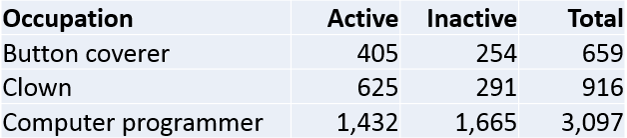
The Cuban government has licensed more self-employed computer programmers than clowns and button coverers combined.
The other day I wrote a somewhat optimistic post pointing out that the Cuban government and government software companies are reaching out to self-employed programmers. One of the reasons for my optimism was a recent informatics and communication workshop, TICS 2017, billed as an exchange between state and non-state sectors working together for the society.
It is encouraging to see that the number of licensed programmers exceeds the number of clowns and button coverers combined. That being said, licensed programmers are more likely to be inactive and the opposite holds true for both clowns and button coverers.
Joking aside, we see another positive trend -- the number of active, self-employed programmers has grown steadily and the growth rate has increased every year:
Number of active programmer licenses each year
A couple of years ago, I wrote a post asking whether Cuba would allow software exports -- it seems the answer may be "yes."
An anonymous source has told me that, as of this month, the number of self-employed programmer licenses is down to 1,137. That is a step in the wrong direction.
It would be great if Cuba could find a sustainable middle ground between the economy and culture of the early hobby and academic days and the dominance of money and advertising we have today in the US.
The meetup was organized by the people who contribute to the TuAndroid blog, which they insist is not a blog, but a family.
The meetup tagline was "For a technological culture accessible to all."
Ailyn Febles, president of the Unión de Informáticos de Cuba, a State professional society with 8,000 members, called for an exchange between academia, state professionals and the non-state tech community.
One of the speakers was Phillip Oertel, a Google engineer who worked on the Play Store. I was hoping he would say something about mirroring the Play Store on SNET or somewhere else in Cuba via, say, weekly batch updates, but evidently he did not. (It seems he is now working on a different project, Android Instant Aps, which, when launched, would be useful in a low-bandwidth nation like Cuba.
The meeting was held at the studio of the artist Kcho, which has a hands-on space with Google Chromebooks, Cardboard and phones, sponsored in part by Google. Kcho said his was a "space of sovereignty and freedom, which shows the daily struggle against the blockade" -- perhaps a necessary dollop of political correctness.
People helping each other after the formal talks
When the talks finished, there was an open session during which people helped each other -- answering questions, installing apps, upgrading Android, jailbreaking phones, etc. This sharing and assistance was done without charge and with a spirit of community building. It sounds like the days of the hobby computer clubs in the US. People helped each other freely and openly -- even the early businesses like Apple. The early academic and research days of the Internet felt the same.
It would be great if Cuba could find a sustainable middle ground between the economy and culture of the early hobby and academic days and the dominance of money and advertising we have today in the US.
Members of the independent Android community toured the headquarters of State-owned DESOFT and heard a talk sponsored by the Union of Information of Cuba. This might be further indication of progress toward cooperation and collaboration between independent and state software developers. I am far removed from Cuba to know, but, offhand, it seems like a step in the right direction.
Manuel Alejandro Gil Martín, a Cuban developer who lives in Chile, hopes that his new site, Cubaoutsource, will further community building. His goal is to help developers find and collaborate with each other and to offer outsource service. The site has just launched with profiles of fourteen registered members. They have between 6 and 30 years experience and have used various languages and tools. For example, two of the registrants have Python experience -- they can get to know each other now.
Cubaoutsource is light-weight social media, following the principle "do what you do best and link to the rest." User profiles include fields for links to LinkedIn and StackOverflow profiles for career and project details. (Perhaps version 2 should add a link to a Makerbase profile).
I've been talking about community building, but, as the name implies, the site is also aimed at facilitating employment and outsourcing. President Obama has loosened regulations, allowing US organizations to outsource the development of mobile apps to Cubans. That is a (vaguely worded) start, but there will no doubt be more.
My guess is that in five years, Cubans will be doing a lot of off-shore programming and application development -- especially for Spanish language clients -- and a lot of that will be for the US, where there are over 37 million Spanish-speaking people aged 5 and up.
If I were a Cuban programmer, I would take a few minutes to register with Cubaoutsource. Like any social media, Cubasoutsource needs scale, and, if it catches on, it will contribute to the Cuban tech ecosystem.
-----
Update 1/29/2016
You can see a Spanish translation of the text of this post (without the pictures and links) here. Thanks to Armando Camacho, who blogs at Carpe Diem.
Friday evening people will present short proposals for startups and those voted best will be worked on during the weekend. Teams will be formed around the chosen ideas so people will collaborate and learn from each other.
Saturday, the teams will meet at 9 AM and work on their proposed projects with the assistance of technical and business mentors. There will be food and the teams can work late into the night if they want to.
Sunday will be for demos and judging. The winners will advance to compete in the regional event of the Global Startup Battle..
They've had some trouble with the online registration system -- if you have trouble send an email to habana@startupweekend.org giving your name and a brief description of your background, like "Programmer/freelancer/ruby & prolog" or "graphic designer/etc").
Forty eight people took part in the weekend and 27 projects were proposed. The group voted on the proposals and selected eight to be worked on by teams during the rest of the weekend.
At the end of the weekend, the jury awarded first place to My Storefront, an app to enable people to exchange used clothing; second place went to the team working on Help Yourself, an app that matches recipes to the ingredients in your refrigerator, and third place went to Up Up, an app for creating off line posts on social networks. Sport City, a community of sports fans in the city, received an honorable mention.
Here is a five minute video giving a quick recap of the Startup Weekend and the projects people worked on:
My guess is that the exchange of ideas and energy and new connections among people was the most important result of the meeting -- what next?
-----
Update 11/14/2015
Third place in the Startup Weekend went to an app for creating off-line posts to social networks -- an app well suited to a place with Cuba's minimal connectivity. If I had been there, I would have proposed an app that went in the other direction.
I would like a program or an Internet service that would take a blog like this one, and convert it to a single file in a common format like Word or PDF. That would allow me to create a snapshopt of the entire history of the blog -- including links, images and comments -- and share it with people in Cuba who do not have fast, online access to it.
The blog is on Google's Blogger site, so I would have to supply the template and current XML file with the contents. If it was being read off-line, the posts would be readily available and, since most of the links are internal to the blog, they would work also. External links would require a live Internet connection.
If someone built such an app for Blogger and for Wordpress, most blogs could be read off-line in Cuba.
-----
Update 11/17/2015
More Startup Weekend video -- a lot of energy and enthusiasm!
The first meetup of the Merchise Startup Circle will be held in Havana on May 23. The event is being organized by a couple of Cubans who have worked abroad and hope this is the first of many meetings for people interested in startups, tech and entrepreneurship.
Can Cuba develop a vibrant tech startup community? Cuba may be short on financial capital, but that be raised fairly quickly -- Cuba's human capital has taken years to develop.
A successful software industry requires trained, demanding users and skilled technicians and Cuba's long-standing emphasis on education leaves them with both. As an indication of their commitment to education, Cuba spends 12.8% of its GDP on education -- the highest rate in the world -- and the Cuban literacy rate is 100%.
The United Nations Development Program reports a human development index (HDI) for every nation annually. The HDI includes components for health, economy and education and the only nation in Latin America and the Caribbean to out rank Cuba on the overall HDI and the education index is Chile. (Chile and Cuba rank 43rd and 44th on the HDI and 49th and 50th on the education index).
Cubans are generally well educated, but are they "trained, demanding users of technology?" Internet connectivity is nearly non-existent in Cuba and relatively few have sporadic, slow access to the Cuban intranet, but there a long history of promoting computer use and literacy among the youth. In 1987, Fidel Castro agreed to create 32 Youth Clubs of Computing and Electronics (YCCs) for promoting and teaching computer technology. As shown below, he expressed his envy of the young people at the dedication the YCC headquarters, which occupied the ex-Sears store in Havana (prime real estate) and his support has continued.
Fidel at the opening of the YCCs
Today there are 611 YCCs and over 2.25 million adults and kids have completed their courses. The YCCs are distributed throughout the island, not concentrated in one or a few large cities -- a common pattern in developing nations.
Of course, Cubans have some Internet and intranet experience. Most is at work or school, but there are also paid Internet access "CyberPoints." It is noteworthy that ETECSA (Cuba's single provider of Internet and telephone access) plans to increase the number of Cyber Points from 155 to over 300 by late this year -- evidently there is demand for slow Internet connectivity even if it costs as much as a week's salary per hour. (I would be curious to know who the users are and how they are using it. That would be an interesting survey).
In my 2011 report, I compared the UCI curriculum with the computer science curriculum at Carnegie Mellon University and found that
The work-study balance – ten semesters of professional practice and three studying business topics – differentiates UCI from U. S. universities. Students are expected to work on useful applications in education, health, sport, and online government -- writing software, building Web portals and developing multimedia products.
While they may not have experience with the latest technology, Cuban graduates should be ready to do practical work and good students may gravitate toward startups since state enterprises are the only alternative source of employment.
Even without domestic users, outsourcing can help bootstrap a tech community and Cuba's outsourcing prospects look good. Cuba is close to the large U. S. market, is in the Eastern time zone and there are many Cuban expats in the U. S. and elsewhere with professional and family ties to Cuba. Cuban developers have been doing small-scale, sub rosa work for U. S. firms for some time, but now that we have approved work by independent Cuban programmers (as opposed to state enterprises) that work can expand openly.
UNDP HDI and education ranks
I checked the 2014 A.T. Kearney Global Services Location Index™ and it turns out that the top ranked nation for outsourcing is India and Mexico (4th) and Chile (13th) are among the top 15. Given their UNDP Human Development and Education indices, Cuba looks like a formidable competitor to all three.
I've focused on tech and education to this point -- what about Cuban culture?
Of necessity, Cubans are resourceful. The old cars that Cubans have managed to keep running are as well-known as Cuban cigars. Homebrew computers are common. Before the government cracked down, homemade TV dishes were ubiquitous in Havana. There are even illegal satellite links in Cuba. These are a few examples of Cuban resourcefulness in the face of constraints. For more, watch this video:
The legacy of years of socialist rhetoric might also contribute to the success of a startup community. The early ARPA/Internet community or Silicon Valley in the 70s and 80s provide examples of success that was partially due to a somewhat idealistic, cooperative culture and a sense that the participants were doing something important.
When the PC revolution was just getting under way, computer clubs sprung up around the country. One, the Homebrew Computer Club (HCC) met in an auditorium at Stanford University in the heart of Silicon Valley. The meetings featured a "random access" session during which people stood up to ask for help or offer to share information. At one meeting I attended, Steve Wozniak offered schematics and a parts list for anyone who wanted to build a copy of the single-board computer he had designed, while his partner Steve Jobs stood at a table showing off wire-wrapped versions of the machine. After the meetings, "competitors" met at a hamburger place in Menlo Park (I forget its name) to talk about their latest S-100 but boards.
Random access session at the Homebrew Computer Club
Might the Merchise Meetup and the YCC Freeware Festivals turn out to be Cuba's HCC?
I've been painting a rosy picture -- talking more about what I would like to see happen than what I think will happen -- "Silicon Malecón" faces many obstacles.
Readers of this blog well know the sad state of Cuban Internet connectivity. As neuroscientist Frances Colón, acting science and technology adviser to Secretary of State Kerry says, "More than anything else, Cuban science and technology entrepreneurs need connectivity to finally move into the 21st century of scientific discoveries and technology development."
A lack of capital is another obvious problem, but Cuban entrepreneurs with good ideas and organizations will be able to attract capital if government polices encourage foreign investors. That being said, the Cuban economy is already looking up with easing of tension with the U. S. and Cuba may find it desirable to finance significant parts of its own Internet infrastructure.
A lack of business and marketing experience may also hinder Cuban entrepreneurs. That should be mitigated by close ties between Cubans and the expat community. Business schools are also eyeing Cuba. There is also Proyecto Cuba Emprende, which offers "training and advisory services to Cuban entrepreneurs who wish to start or improve a small business in order to contribute to the development of an entrepreneurial culture, social progress and to improve the quality of their lives."
The biggest problem for the startup community may be Cuban bureaucracy and the power of incumbent state software enterprises. Will the government stifle startups with micromanagement and regulation (as exemplified by their list of jobs eligible for self-employment) and taxes? Will politically entrenched state software enterprises like Albet and Desoft view startups as competitors to be beaten or will they be a training ground for future entrepreneurs? (This is similar to the question of the infrastructure policies of ETECSA).
I've mentioned some of the things the Cuban startup community has going for and against it. Let's hope it takes off.
-----
Update 5/26/2015
The Merchise Startup Circle meetup was held last Saturday. Over fifty people came -- there would have been more if they had had more space (and a larger pizza and beer budget :-).
An elegant meetup setting
Two of the organizers, Alex Medina and Medarado Rodriguez welcomed the attendees (the third, Rodney Hernandez was out of the country and could not attend).
They will now allow cooperatives a year to hire workers (it had been 3 months) and are studying 205 proposals to create new cooperatives.
Since 2012, 498 private non-agricultural cooperatives have been established (347 are still operating) and the authorities are presently studying 205 proposals to create new cooperatives.
Cooperatives are allowed to have Internet accounts, but do any readers know if any of these cooperatives -- existing or proposed -- involve technology or the Internet?
The Miami Herald has published an article profiling several Cuban software startups. It describes their applications and the difficulties they face. A "window" is starting to open for Cuban software startups -- how long until it is closed by established competitors -- from the US and other nations or Cuban state software enterprises?
-----
Update 8/4/2015
The second Merchise Meetup was held last Saturday. Read about the meetup here, see photos of the meetup here and check out all the tweets here.
It sounds like it was a great meeting with good speakers and a lot of enthusiasm. Here are a few quotes from folks who were there:
Cuba still lacks high-level Internet infrastructure, but it is full of programming talent.
I attended the event it was great. The technical knowledge is very strong.
Lots of smart people *already* doing lots of interesting things... instead of just waiting :-)
Bold prediction we will see better startups out of #habana than #miami in the coming years
It was great talking with so many engaged and interesting people. Thank you for your contribution and support!
Fantastic to hear investment topics described in an enlightening and entertaining way.
Awesome words of startup wisdom by @ubaldo, co-founder of http://fonoma.com. Many thanks!
Awesome ... Over 50 techies for 5 hours.
-----
Update 8/13/2015
The C.A.A. Foundation is sponsoring four Cuban student internships at a Manhattan tech incubator.
C.A.A. founder Miles Spencer, four Cuban interns and advisor John Caulfield, former
chief of mission at the US Interests Section in Havana.
They are the first interns in the C.A.A. Innovadores program, which seeks to provide opportunity, networking, mentoring and resources for promising innovators in Cuba.
C.A.A.'s first initiative is "to offer Cuban Innovators fully underwritten opportunities to intern and study with some of the best incubators and boarding schools in the Science and Technology space in the United States."
Nearshore America has published a market research report on Cuba's IT infrastructure, policy and software development community.
The report is written for those interested in outsourcing IT work to Cuba and it costs $749, but the atypically interesting executive summary is free.
The report includes results of a survey of Cuban IT professionals (half of whom report that they are already doing work for foreign clients). Here are a couple of figures summarizing characteristics of the developers who were surveyed:
You should check the post out, but a couple of things caught my eye. It says that El Paquete is paying taxes in Cuba. We've speculated on reasons for government tolerance of El Paquete -- reducing demand for Internet access and providing employment -- and it seems the government is also sharing in the revenue through taxes. (There has even been speculation that El Paquete is government run).
Revolico and CiberCuba pay taxes and employ people in Spain, where they were established. There was no mention of Vistar taxes, but it has 23 employees in Cuba. Revolico has 7 million page views per month, with 50% of the traffic from within Cuba. It has 25,000 ads daily and is profitable.
-----
Update 12/2/2015
There will be a meetup in Miami featuring the founders of five Cuban startups: Hiram Centelles - Co-founder, Fonoma, Revolico & Yagruma, Marta Deus - Founder, Deus Expertos Contables, Yondainer Gutierrez - Founder, Alamesa, Ubaldo Huerta - Co-founder, Fonoma & Yagruma, and Elio Hector Lopez (el Transportador) - Creator, El Paquete Semanal. Ted Henken will be the moderator.
You can read about the Connecting Cuba meetup featuring five Cuban Internet entrepreneurs here and here or watch the following archived live-stream video.
-----
Update 5/22/2016
Merchise has been organizing startup activities and meetups in Havana and is in a partnership with Stripe to help Cuban entrepreneurs export their goods and services -- commercial activity. But, they began as a programming research group and are now returning to their roots as organizers of MonadLibre V2016, a conference on functional programming, in August. I've not followed functional programming since playing a little with LISP as a student, but they seem to have invited a number of well known speakers from Haskell and related communities.
-----
Update 5/25/2016
Cuba is going to legalize small and medium sized businesses, but there are many open questions -- what is the difference between a small business and a cooperative or a self-employed person who hires others, what about taxes, can someone who is not a Cuban to make an equity investment in a small business, could a small business own an office space and hire Cubans directly, how small must a business be to qualify as "small or medium-sized," will they be allowed to compete with state-owned enterprises, etc.
For a tech-related example -- could a non-Cuban provide capital to establish an offshore programming business in Cuba? Cuba already allows self-employed computer programmers -- has this law changed anything for them?
The answer to such questions may become clearer when Cuba's National Assembly approves the proposed law.
Will Cuban programmers be allowed to sell software and do offshore programming and localization in the US and online?
Many people have asked me whether I expect the Cuban Internet to thrive after the rapprochement with the US, and I tell them that is up to the Cubans -- the ball is in their court.
My first reaction was a big grin -- I am more interested in what Cuba can sell in the US than I am in what US and other companies can sell in Cuba -- and I imagined Cuban companies and professionals offering high margin goods and services in the US.
But, Obama's offer is limited to "independent Cuban entrepreneurs" -- who are those entrepreneurs and what do they do? This report by Richard E. Feinberg lists the 201 self-employment job categories that were open to Cubans as of September 26, 2013 and it is a goofy list with jobs like three-wheeled pedal taxi driver (not to be confused with pedal taxi driver or horse-drawn cart operator). I'd advise you to check the list for laughs and also a glimpse into the Cuban bureaucratic mind.
Well, that was discouraging, but then I looked more closely at Feinberg's table grouping the 201 jobs into eight categories and one jumped off the page -- computer programmers were included in the "other" category along with clowns and magicians!
How did programmers get on this goofy list? Was it an oversight or an intended loophole for would-be app developers, Web site designers and developers, offshore programmers, software localizers, etc.?
There were 476,000 self-employed Cubans in December 2014 -- I wonder how many were computer programmers and how many more would apply for a self-employment license if software and software service export is actually allowed.
If any readers know any of these self-employed programmers, I would love to hear from them -- to hear what they are currently doing and what they would do if allowed to export to the US.
Programmers are close to my heart, but the Cuban economy can export much more than software. If Cuba is to take advantage of the offer President Obama has made, they must drop what Ted Hencken and Arch Ritter call the "internal Cuban embargo." The Cubans would be wise to adopt the economic and Internet reforms suggested by Hencken and Ritter if they hope to export more than artisan crafts, pottery and religious articles.
-----
Update 2/19/2015
Official daily Juventud Rebelde said participants in the forum stressed the need to "promote exports of computer services and products, establish business models among telecommunications operators and providers, and foment the creation and development of state companies in harmony with non-state forms of management."
-----
Update 2/20/2015
If Americans can now purchase goods and services from Cuba, can Cubans crowd-fund projects in the US? Cuban drummer YISSY raised €5,000 on Verkami, a Spanish crowd-funding site. Why not Cuban software projects (and everything else) on kickstarter?
Cuban software exports will come from the nascent developer/startup community. I will have more to say on this in a future post, but for now, check out this Meetup group. The meetup is being organized by several former members of the Merchise software group and they are interested in software development, entrepreneurship, networking, venture capital, etc. etc. -- the sort of thing you would expect.
This post is not about what I think will happen, but to begin discussion of what the Cuban government could do if the goal were to provide a modern, open Internet with affordable (free in some cases?) access.
The Cuban Internet is in a sorry state. Freedom House ranks Cuban Internet freedom 62nd among the 65 nations they survey and the UN International Telecommunications Union ranks Cuban information and communication technology development last among 32 nations in Latin America and the Caribbean.
Historically, there are three primary causes for the sad state of the Cuban Internet -- the US trade embargo, Cuban poverty at the time of their connection to the Internet and the government's fear of information. (We'll discuss a possible new constraint, ETECSA, later).
President Obama has lifted the first barrier and, when we look at other poor Latin America and Caribbean nations, we see that Cuba could afford a better Internet than it currently has.
That leaves fear of an open Internet. The government says the Internet is a priority and they want to expand access as quickly as financially feasible. I am skeptical, but let’s assume they are sincere – what might they do in the short term and the long term?
In the short term
Cuba cannot afford ubiquitous, modern Internet infrastructure today – they need low-cost interim action while planning for the long term. Here are some low-cost ways they could improve the Internet in the short run:
Run a pilot study using the same sort of satellite equipment that Alan Gross was arrested for bringing into the country and, If successful, follow with a national roll out – with access points marketed and supported by Cuba’s recently-legal small business people.
Equip central offices with equipment to upgrade dial-up to DSL accounts.
Use terrestrial wireless links to establish points of presence in rural locations.
Long range planning, addressing technology and, more important, infrastructure ownership and regulation policy, should begin immediately.
Cuba has little Internet infrastructure. There is an undersea cable to Venezuela, but little fiber on the island. (Eventually, Cuba might take control of the cable being installed between Guantánamo and Florida). Nearly all home connections are dial-up and the cell network is obsolete 2G technology. There are 573 public access computers in 155 locations, but they are slow and an hour online costs nearly a week’s pay for many workers.
Cuba should leapfrog today’s technology, looking toward developments that are five or more years out – 5G mobile communication, high frequency wireless by Google and others, the satellite constellation projects from SpaceX and OneWeb, connectivity using an undersea cable from Havana and perhaps the one at Guantánamo, etc. Routing traffic using version 6 of the Internet protocol will prepare them for the “Internet of things.”
The long range planning of technology is necessary, but formulating policies for ownership of infrastructure and regulation is more important -- not only for Cubans, but for the rest of the world as well if the Cuban experience leads to innovative policies.
The conventional wisdom is that Cuba should invite foreign companies to install infrastructure – a path many developing nations have followed with marginal success. It is not certain that Cuba, with its current government and weak economy, could attract foreign investment, but even if could, I would hate to see Cuba's Internet future in the hands of companies like AT&T or Orange.
If they do go with foreign investment, I would not be surprised to see them partnering with Google rather than a traditional ISP – Google executives have visited Cuba and Google is clearly interested in global connectivity. My experience in the US leads me to trust Google to do a better job than the incumbent ISPs, but, I would still have to ask -- in the long run, why should we expect Google to be better for the Cuban people than a traditional ISP? (I'd ask the same question of aspiring global satellite ISPs SpaceX and OneWeb).
Cuba should go slowly and consider a broad range of infrastructure ownership policies like municipal ownership in Stockholm, government as a venture capitalist in Singapore, government as rural wholesale backbone provider as in India, individual ownership of final links, etc. Cuban policy makers should consider a broad range of policy models -- Chile, Iceland, Vietnam, Estonia, etc. etc.
In 1997, fear of free speech led the government to squelch the Internet, but today there is another potential stumbling block – ETECSA, Cuba’s monopoly Internet service provider. ETECSA is usually described as a state-owned monopoly, but it’s privately owned by a murky collection of investors (rumored to include Fidel and Raúl Castro) and regulated by the Ministry of Communication.
The relationship between ETECSA and the Ministry is unclear – which organization makes investment decisions, sets prices, gets the profits or absorbs the losses, etc.?
Cynics predict the Cuban Internet will undergo a Soviet-style sell-off to foreign investors who will run it for their profit. But, if the Cuban government sincerely embraces its socialist goals, it has a chance to create a uniquely Cuban Internet with the goal of providing universal, affordable access to its citizens rather than making profit for private ISPs, ETECSA or the government. I’m skeptical, but hope I’m wrong.
-----
Update 3/18/2015
One of my long-term suggestions was that Cuba keep an eye on OneWeb, which hopes to provide global satellite connectivity. CEO Greg Wyler, speaking at the Satellite 2015 Conference yesterday, said they hope to be offering service by 2019 -- providing $250 ground stations that require no setup and establish a 50 mbps connection to the Internet and a WiFi, LTE, 3G and 2G local area network.
One of my short-term suggestions was that Cuba deploy geostationary satellite ground stations. They could do that today, but, if OneWeb is successful, their satellite links will be cheaper and superior to today's satellite offerings in every way.
Grag Wyler speaking:
A OneWeb ground station -- no setup required:
-----
Update 3/22/2015
It seems that Internet access at the University of Santiago de Cuba has been significantly improved. I am being a vague because the post I read has been translated into English and is hard to follow. It sounds like the university now has a fiber link and speed and data caps have improved significantly.
Can someone fill me in on the details of this upgrade and on the general state of connectivity at Cuban universities?
-----
Update 3/28/2015
Ricardo Alarcon, head of the Ministry of Higher Education announced a deal with ETECSA to substantially improve university Internet access. It sounds like every university will have both domestic and international links. The article is vague and inconsistent on technical details, but it also says students will have access to 40,000 digital magazines -- double the previous amount.
The article also refers to an upgrade to the university network, REDUNIV. The figure below was taken from a PowerPoint presentation last updated in 2005. I am saddened to see a frame relay backbone, but I am sure it has been upgraded since that time. Does anyone have information about the current network?
-----
Update 5/11/2015
I suggested that Cuba would be better off owning and controlling their telecommunication infrastructure rather than turning it over to foreign investors and they may be heading in that direction.
Pedraza also said the Cuban telecoms sector would be open to all foreign companies but also noted that the country wanted to avoid the "negative parts of the Internet."
One of my short-run suggestions was to legitimatize and support shared WiFi hotspots. Raymond J. Delgado Sutil has written a post that elaborates on that suggestion. He estimates that ETECSA's revenue from Internet access "navigation rooms" is around 907,000 CUC per year and the cost of installing WiFi access points at each navigation room and Youth Computer Club location would be about $200,000. Users would use their own computers and phones, eliminating the need for more computers in the navigation rooms. He says ETECSA should "just do it" rather than conducting a "study."
Unfortunately, Delgado does not mention backhaul speed at the navigation rooms or whether they connect to the undersea cable for international traffic. The backhaul speed is only 2 mb/s at the ballyhooed free hotspot of the artist Kcho. At that speed, performance would be very poor whether access was over WiFi or using one of the original hard-wired computers. Similarly, if international access were routed over satellite, response would be very slow.
-----
Update 7/16/2015
Raul Castro has reported that Cuba's economy is growing at a 4.7 percent annual rate (due to increased tourism?) and Cuba is "strictly meeting its debt obligations with foreign creditors and suppliers." A stronger economy will enable Cuba to pursue a relatively independent Internet strategy, without excessive reliance on foreign investment.
-----
Update 7/18/2015
Speaking at the 10th Congress of the Young Communist League of Cuba, Deputy Minister of Communications Jose Luis Perdomo said they were working on connectivity from homes, lower costs, access from educational, health, scientific, cultural and sport centers as well as industrial, business and service centers.
More concretely, he said they planned provide Internet service to 3G cellular users and deploy WiFi in Havana and provincial capitals. There is little 3G cellular today -- does that mean they plan to extend it? He also said they were deploying IPv6.
Deputy Minister of Communications Jose Luis Perdomo
-----
Update 11/19/2015
We suggested that Cuba shift to IPv6 and, as the following figure shows, they are routing IPv6 traffic over Tata and Newcomm (satellite) networks, but not Telefonica. I believe the "other" traffic is internal to Cuba -- peering with CENIAI Internet (AS10569).
-----
Update 1/17/2016
In considering future technology, infrastructure ownership and policy options, Cuba should look at the experience of others. Steve Song has just posted his annual Africa Telecoms Infrastructure review. The review might provide some insights for Cuban policy makers and they should be consulting with folks like Steve Song.
-----
Update 9/29/2016
Hybrid fiber-wireless is another future technology Cuba should track. Google, cell phone companies and others are experimenting with a number of options for "last kilometer" technology. One in particular, PCell wireless, might turn out to be appropriate in Cuba if it proves to be practical.
Demonstrations of PCells in labs are impressive, allowing full speed wireless connections to computers or mobile devices that are inches apart. One would expect closely situated radios operating in the same frequency band to interfere with each other, but PCells capitalize upon interference, analyzing it to create very small zones of clear reception.
It remains to be seen how this technology works on the street as opposed to the lab and Webpass, a boutique high speed Internet service provider that was recently acquired by Google, and Nokia are both evaluating PCell technology. If it turns out to be effective, PCell might be particularly appropriate in Cuba with its penchant for do-it yourself improvisation.
PCell access points are small and distributed compared to conventional cell towers and, if they turn out to be effective, they could be installed by the people -- like a "street net." They remind me of the home-made dishes people used to pirate TV signals broadcast from the Havana Libre hotel back in the day and the installation of local area network wiring in California schools by students and staff during "Net Days."
PCell access points
-----
Update 10/5/2016
In this post, I have suggested several short-run, interim steps Cuba could take while evaluating and planning for leapfrogging to next-generation infrastructure when they are financially and politically ready to create a modern Internet. I wrote the post about a year and a half ago, and started by saying that it was what I hoped would happen, not what I expected to happen.
There have been some short-run improvements during the last 18 months, but not all that I had hoped for. I have no idea what, if any, plans have been made for leapfrogging to next-generation infrastructure -- the planning process is not open or transparent.
One thing is for sure -- there will be no leapfrogging on infrastructure without leapfrogging to next-generation policy on infrastructure ownership and regulation. Next generation policy should be geared toward meeting economic and social goals, not to maintaining telecommunication bureaucracy and revenue or on politics. As we see below, the world is trending in that direction.