What if it were free?
After several months of trials, ETECSA announced the availablity of third-generation mobile access to their national intranet and the global Internet in a televised "round table."
As shown below, they have upgraded 789 mobile base stations to 3G reaching 66% of the population:
Pricing can be by the megabyte (1 CUC≈$1):
or in monthly packages:
The prices are quite steep for a typical Cuban and I suspect there would be relatively few subscribers among the 34% of the population that is not yet covered. Furthermore, many users will have to buy new phones to use the service. (There are still 1,084 second-generation mobile base stations in Cuba).
Network performance during the trials mentioned above was poor -- connections were unreliable and slow. Part of that may have been due to the fact that access was free, but it remains to be seen how fast and reliable the mobile access will be. That will be determined by demand and infrastructure -- the capacity of the base stations and backhaul.
Access to the national intranet costs less than access to the global Internet. While local access saves some congestion on Cuba's international links, it also encourages a Cuban "walled-garden." Cuba is developing local content and services, but they cannot compete with what is available globally. Cuba should open to the world and also aim to be a provider of Spanish-language content and services.
There is also a political dimension. Cuba's president, Miguel Díaz-Canel hinted at a walled-garden strategy when he addressed the Parliament saying "We need to be able to put the content of the revolution online," adding that Cubans could thus "counter the avalanche of pseudo-cultural, banal and vulgar content." I can't argue about banal and vulgar content (and worse), but the cure of a walled-garden in a nation with a government-monopoly Internet service provider is worse than the disease.
(Access to the national intranet portal has been blocked in the US -- I'd be curious to hear from others who can access it).
If performance is good enough, mobile access will be more convenient and comfortable than the current WiFi hotspots or navigation rooms so it will become the way most Cubans go online. That would be an improvement, but far from ideal. As I have said many times, 3G mobile, WiFi hotspots, home DSL, public navigation rooms, street nets, and El Paquete Semanal are stopgap measures and Cuba should be planning to leapfrog current technology in the future.
We should not forget that 3G mobile technology is around 15-years old. Another interim step could be to augment Cuba's current O3b satellite and terrestrial connectivity to significantly increase backhaul capacity and offer free 3G mobile access. Doing so would lead to a population of trained, demanding users and enable many innovative, practical applications. That may sound crazy at first, but we take free sidewalks, roads, firefighting, etc. for granted and a few cities offer free public transport -- why not ubiquitous, free 3G connectivity?
Coming back to Earth — ETECSA promised to make 3G mobile access widely available by the end of the year and they did it. You can watch the video of the televised announcement here:
=====
Update 1/10/2019
Oracle reported a significant increase in Cuban DNS queries immediately following the 3G rollout and, in spite of high prices, the increase persisted through mid-December. It would be interesting to know what portion of Cuban's new 3G access is paid for by ex-pat families and friends as opposed to Cuban nationals.
=====
Update 1/12/2019
The DNS query rate reported by Oracle continued through the end of the year. It dropped off on December 13th and again on Christmas day, but remained much higher than during the limited activation period which was double the pre-rollout rate. (What happened on Thursday, December 13th)?
Oracle reports DNS queries and other statistics here and you can view a plot for the previous week for a nation. (Click here for Cuba last week).
DNS queries last week in Cuba are shown here:
There was a dip last Thursday as well -- coincidence?
=====
Update 1/17/2019
There may be some confusion about 3G accounts -- ETECSA posted a tweet stressing the fact that charges are per amount of data rather than time online as at the WiFi hotspots and their Web site warns users that they need phones with 900 Mhz radios. I bet ETECSA is selling a lot of new phones, many of which are purchased with remittances from abroad.
Showing posts with label walled garden. Show all posts
Wednesday, December 5, 2018
Cuba rolls out 3G mobile access
Sunday, August 19, 2018
Cuba's 3G mobile access trial -- is the glass half full or half empty?
On August 14 at 11 AM ETECSA, Cuba's monopoly ISP, began a 9-hour, nationwide test of 3G mobile Internet access -- anyone near a 3G-equipped cell tower with a compatible phone and a prepaid mobile telephony account could get free access until 8 PM
As far as I know, the only notification was this post on the ETECSA Facebook page, but word of the test and instructions for getting online spread by word of mouth.
The word spread rapidly. Oracle-Dyn continuously monitors the Internet and Doug Madory, their director of Internet analysis, noted a two-peak spike in Cuban DNS server queries during the test period:
(Note that the service became unavailable for half an hour around 2:30).
Paul Calvano, a Web performance architect at Akamai, also observed a roughly 25% increase in their HTTP traffic to Cuba during the trial period:
The rapid spread of the news of this unannounced test and the existence of a Cuban hacker culture born of years of keeping old cars and everything else running in spite of poverty and the trade embargo attest to a pent-up demand for connectivity.
My friend Huxley enthusiastically noted that
Is the cup half full or half empty?
The signs are not promising. Tourists and some officials and journalists have had 3G Internet access for some time, but the speed and reliability have been underwhelming. Now ETECSA says they will provide nationwide service to anyone with a compatible phone by the end of the year. Have they the capacity to handle the volume?
They say the service will be available "nationwide," but mobile coverage is not available throughout the nation.
As of June 1, 2018, there were over 1,400 cellular base stations and over 520 of them were 3G compatible. For example, there are only 19 3G base stations in Las Tunas and 10 of those are in the capital.
Upgrading a base station from 2 to 3G requires both new equipment and a faster link between the base station and the Internet -- a large investment will be needed to upgrade all 1,400 base stations.
They say there are over 5 million mobile customers in Cuba, but how many of them have 3G-compatible phones? ETECSA will sell a lot of new phones when 3G service becomes available.
Okay -- enough with the half-empty news. Let's assume that ETECSA eventually installs the infrastructure to provide 3G mobile connectivity at an affordable price in the most populated areas in Cuba and they have the capacity to meet the 1-3 Mbps speed alluded to on their Web site.
Would that constitute a half-full glass?
Not really. Mobile connectivity at speeds of 1-3 Mbps is obsolete -- too slow for today's modern Web sites, which are designed with faster speeds in mind. The speed mismatch is exacerbated by the relatively low speed of the phones that are affordable in Cuba. A slow phone with a slow connection is useful for consuming and sharing content, but not for creating it.
I've discussed the possibility of differential pricing and government policy encouraging Cubans to use their national intranet rather than the global Internet in previous posts and that plus the inability to run modern Web applications will encourage the formation of a Cuban walled garden.
Before he became Cuba's president, Miguel Díaz-Canel hinted at a walled garden strategy when he addressed the Parliament saying "We need to be able to put the content of the revolution online," adding that Cubans could thus "counter the avalanche of pseudo-cultural, banal and vulgar content." I can't argue about banal and vulgar content (and worse), but the cure of a walled garden in a nation with a government-monopoly Internet service provider is worse than the disease.
I'm willing to credit the forthcoming 3G rollout as a half-full glass if the Cubans regard it as a temporary stopgap while they plan for a truly modern Internet with the goal of providing affordable, next-generation connectivity to the Global Internet. I'd call it 3/4-full if they'd commit to making 3G mobile connectivity free in the long run.
As far as I know, the only notification was this post on the ETECSA Facebook page, but word of the test and instructions for getting online spread by word of mouth.
![]() |
| Instructions for joining the free trial (source) |
The word spread rapidly. Oracle-Dyn continuously monitors the Internet and Doug Madory, their director of Internet analysis, noted a two-peak spike in Cuban DNS server queries during the test period:
![]() |
| Oracle DNS query rate |
(Note that the service became unavailable for half an hour around 2:30).
Paul Calvano, a Web performance architect at Akamai, also observed a roughly 25% increase in their HTTP traffic to Cuba during the trial period:
![]() |
| Source |
The rapid spread of the news of this unannounced test and the existence of a Cuban hacker culture born of years of keeping old cars and everything else running in spite of poverty and the trade embargo attest to a pent-up demand for connectivity.
My friend Huxley enthusiastically noted that
The news ran like incendiary gunpowder on the Island. Hundreds of thousands of ETECSA customers trying to get access to IMO, to Facebook to Google while walking down Calle 23, the Malecón or from P2.However, he went on to describe slow (.5 Mbps) unreliable service.
Is the cup half full or half empty?
The signs are not promising. Tourists and some officials and journalists have had 3G Internet access for some time, but the speed and reliability have been underwhelming. Now ETECSA says they will provide nationwide service to anyone with a compatible phone by the end of the year. Have they the capacity to handle the volume?
They say the service will be available "nationwide," but mobile coverage is not available throughout the nation.
![]() |
| Crowd-sourced 2-3G availability map, November 2017 (source) |
As of June 1, 2018, there were over 1,400 cellular base stations and over 520 of them were 3G compatible. For example, there are only 19 3G base stations in Las Tunas and 10 of those are in the capital.
Upgrading a base station from 2 to 3G requires both new equipment and a faster link between the base station and the Internet -- a large investment will be needed to upgrade all 1,400 base stations.
They say there are over 5 million mobile customers in Cuba, but how many of them have 3G-compatible phones? ETECSA will sell a lot of new phones when 3G service becomes available.
Okay -- enough with the half-empty news. Let's assume that ETECSA eventually installs the infrastructure to provide 3G mobile connectivity at an affordable price in the most populated areas in Cuba and they have the capacity to meet the 1-3 Mbps speed alluded to on their Web site.
Would that constitute a half-full glass?
Not really. Mobile connectivity at speeds of 1-3 Mbps is obsolete -- too slow for today's modern Web sites, which are designed with faster speeds in mind. The speed mismatch is exacerbated by the relatively low speed of the phones that are affordable in Cuba. A slow phone with a slow connection is useful for consuming and sharing content, but not for creating it.
I've discussed the possibility of differential pricing and government policy encouraging Cubans to use their national intranet rather than the global Internet in previous posts and that plus the inability to run modern Web applications will encourage the formation of a Cuban walled garden.
Before he became Cuba's president, Miguel Díaz-Canel hinted at a walled garden strategy when he addressed the Parliament saying "We need to be able to put the content of the revolution online," adding that Cubans could thus "counter the avalanche of pseudo-cultural, banal and vulgar content." I can't argue about banal and vulgar content (and worse), but the cure of a walled garden in a nation with a government-monopoly Internet service provider is worse than the disease.
I'm willing to credit the forthcoming 3G rollout as a half-full glass if the Cubans regard it as a temporary stopgap while they plan for a truly modern Internet with the goal of providing affordable, next-generation connectivity to the Global Internet. I'd call it 3/4-full if they'd commit to making 3G mobile connectivity free in the long run.
Wednesday, August 15, 2018
Cuba is testing 3G Internet access.
ETECSA, Cuba's monopoly ISP, has been running free tests of their forthcoming mobile access. It seems that the latest test is over for now, but Andy Garcia (@Dancuba96) ran a speed test before it ended:
ETECSA has not announced when commercial 3G service will commence, where it will be available at first and what it will cost, but the following image at the start of the @ETECSA_Cuba Twitter page suggests that service will begin soon and they are serious about mobile Internet access.
This history of Cuban mobile connectivity puts the current 3G expansion in context of earlier mobile offerings.
The following image from the ETECSA_Cuba Facebook page shows three speed tiers -- 1, 2 and 3 Mbps.
One to three Mbps connectivity using a mobile device is fine for consuming and sharing content, but not for content creation. I hope Cuba regards 3G as an interim, stopgap measure and they are planning to leapfrog over today's technology to roll out next-generation technology when it and they are ready. For example, one can imagine Cuba jumping from 3G to 5G community networks.
Cuban 3G access is a positive step -- it will scale better than their current WiFi hotspots and navigation rooms -- and be more convenient, but the prices may favor access to the Cuban national intranet over access to the global Internet, creating a "walled garden" with all of its shortcomings.
ETECSA has not announced when commercial 3G service will commence, where it will be available at first and what it will cost, but the following image at the start of the @ETECSA_Cuba Twitter page suggests that service will begin soon and they are serious about mobile Internet access.
This history of Cuban mobile connectivity puts the current 3G expansion in context of earlier mobile offerings.
The following image from the ETECSA_Cuba Facebook page shows three speed tiers -- 1, 2 and 3 Mbps.
One to three Mbps connectivity using a mobile device is fine for consuming and sharing content, but not for content creation. I hope Cuba regards 3G as an interim, stopgap measure and they are planning to leapfrog over today's technology to roll out next-generation technology when it and they are ready. For example, one can imagine Cuba jumping from 3G to 5G community networks.
Cuban 3G access is a positive step -- it will scale better than their current WiFi hotspots and navigation rooms -- and be more convenient, but the prices may favor access to the Cuban national intranet over access to the global Internet, creating a "walled garden" with all of its shortcomings.
Monday, July 2, 2018
Cuban "technological sovereignty" -- a walled garden strategy?
Cubans should focus on things in which they have a comparative advantage -- as the saying goes, "do what you do best and link to the rest."
ToDus, a messaging application described as a "Cuban WhatsApp" and Apklis, a distribution site for Android mobile apps, were featured at the First Computerization Workshop held recently at the Universidad de Ciencias Informáticas (UCI).
One might ask, why do we need a Cuban WhatsApp and Apklis when we already have WhatsApp itself and the Google Play Store?
ToDus seems to duplicate WhatsApp's features. Users can send messages, photos and other files to individuals or groups of up to 250 members and, like WhatsApp, it is secure -- messages are encrypted and stored on users phones, not toDus servers. (ToDus users cannot speak with each other using this version of the program, but that feature will be added). Since toDus is a free app, I believe it could be listed on the Google Play Store as well as on Apklis.
The key difference between toDus and Apkis and WhatsApp and the Play Store is that the former run on Cuba's national intranet, not the global Internet. One could argue that this duplication is done to lower operating costs or improve performance. I don't know how Cuba's international access is priced, but it seems that the marginal cost of international traffic for a chat app used by 11 million people would be very small and the latency difference imperceptible. (If Cuba is trying to save on communication cost or cut latency, they would be way better off pursuing an undersea cable between Havana and Florida).
Yadier Perdomo, Director of Networks at UCI, may have alluded to a more significant motivation when he stated that toDus "guarantees technological sovereignty, something that similar products, such as WhatsApp and Messenger (from Facebook), do not do." I am not sure what he means by "technological sovereignty," but it seems consistent with an overall effort to focus on domestic as opposed to global communication and services. Furthermore, ETECSA is rolling out 3G mobile connectivity (and experimenting with 4G) and evidently planning to charge less for access to the national intranet than the Global Internet.
Does this point to a strategy of encouraging a Cuban "walled garden" that favors intranet communication and services (and El Paquete Semanal) over Global Internet communication and services?
That policy would have two negative side effects. For one, it would create two classes of Cuban users -- the relatively poor, mass population that predominantly uses mobile phones on the intranet and elite users with access to the global Internet using computers as well as mobile phones. The Internet-enabled users would have access to more information and more powerful application and be better able to create content.
Second, while Cuba can create and support a simple application like toDus on its own, they lack the scale and resources to create complex and mass-data dependent applications -- Cuba's Ecured will never be as comprehensive as WikiPedia, their Mapa service will never be as useful as Google Maps, there can never be a Cuban equivalent of Google Translate, etc.
One might justify favoring the intranet over the Internet as an interim step to what the Cubans call "the computerization of society," but it is a drain of resources in the short run and a dead-end in the long run. Cubans should focus on things in which they have a comparative advantage -- as the saying goes, "do what you do best and link to the rest."
Well, that brings me to the end of this post, but I want to add two miscellaneous tidbits — kind of a PS:
1. If you go to the Internet portal of Cuba's intranet, you see links to toDus and Apklis. Both are broken from outside of Cuba, but the Apklis link is to https://www.apklis.cu/es/. It seems they are working on multi-language versions of the site.
2. The names and logos of Apklis and toDus are completely goofy. The toDus logo is evidently a reference to the Cuban tody bird and I cannot guess the rationale behind the Apklis butterfly. One thing is clear -- neither name or logo says anything about the corresponding service, though one might guess that Apklis has something to do with APKs.
![]() |
| ToDus can be downloaded at Apklis |
One might ask, why do we need a Cuban WhatsApp and Apklis when we already have WhatsApp itself and the Google Play Store?
ToDus seems to duplicate WhatsApp's features. Users can send messages, photos and other files to individuals or groups of up to 250 members and, like WhatsApp, it is secure -- messages are encrypted and stored on users phones, not toDus servers. (ToDus users cannot speak with each other using this version of the program, but that feature will be added). Since toDus is a free app, I believe it could be listed on the Google Play Store as well as on Apklis.
The key difference between toDus and Apkis and WhatsApp and the Play Store is that the former run on Cuba's national intranet, not the global Internet. One could argue that this duplication is done to lower operating costs or improve performance. I don't know how Cuba's international access is priced, but it seems that the marginal cost of international traffic for a chat app used by 11 million people would be very small and the latency difference imperceptible. (If Cuba is trying to save on communication cost or cut latency, they would be way better off pursuing an undersea cable between Havana and Florida).
Yadier Perdomo, Director of Networks at UCI, may have alluded to a more significant motivation when he stated that toDus "guarantees technological sovereignty, something that similar products, such as WhatsApp and Messenger (from Facebook), do not do." I am not sure what he means by "technological sovereignty," but it seems consistent with an overall effort to focus on domestic as opposed to global communication and services. Furthermore, ETECSA is rolling out 3G mobile connectivity (and experimenting with 4G) and evidently planning to charge less for access to the national intranet than the Global Internet.
Does this point to a strategy of encouraging a Cuban "walled garden" that favors intranet communication and services (and El Paquete Semanal) over Global Internet communication and services?
That policy would have two negative side effects. For one, it would create two classes of Cuban users -- the relatively poor, mass population that predominantly uses mobile phones on the intranet and elite users with access to the global Internet using computers as well as mobile phones. The Internet-enabled users would have access to more information and more powerful application and be better able to create content.
Second, while Cuba can create and support a simple application like toDus on its own, they lack the scale and resources to create complex and mass-data dependent applications -- Cuba's Ecured will never be as comprehensive as WikiPedia, their Mapa service will never be as useful as Google Maps, there can never be a Cuban equivalent of Google Translate, etc.
One might justify favoring the intranet over the Internet as an interim step to what the Cubans call "the computerization of society," but it is a drain of resources in the short run and a dead-end in the long run. Cubans should focus on things in which they have a comparative advantage -- as the saying goes, "do what you do best and link to the rest."
Well, that brings me to the end of this post, but I want to add two miscellaneous tidbits — kind of a PS:
1. If you go to the Internet portal of Cuba's intranet, you see links to toDus and Apklis. Both are broken from outside of Cuba, but the Apklis link is to https://www.apklis.cu/es/. It seems they are working on multi-language versions of the site.
2. The names and logos of Apklis and toDus are completely goofy. The toDus logo is evidently a reference to the Cuban tody bird and I cannot guess the rationale behind the Apklis butterfly. One thing is clear -- neither name or logo says anything about the corresponding service, though one might guess that Apklis has something to do with APKs.
Sunday, June 17, 2018
Cuba's forthcoming 3G pricing model -- protection and control
Zero-rating or other forms of subsidy are particularly problematic when the Internet service provider is a government-owned monopoly.
Jorge Luis Valdés Hernández, Director de Servicios Convergentes de la Vicepresidencia de Integración Comercial de ETECSA, described forthcoming changes to their mobile Internet service in a recent press conference. (He also has a very long job title).
To be honest, the press conference coverage left me a bit confused, but this is some of what he said as I understood it:
The press conference hailed the "launch" of the mobile Internet, but Cuban 3G mobile access began in 2015 when it was made available to tourists in limited locations and it has steadily expanded. Today there are over 520 3G-compatible base stations covering 47% of the population and all of Havana.
This press conference was not about new technology, but about new pricing, which favors government-approved political content and protects local content and services from global competition.
Subsidized content delivery is an attractive consumer marketing tool, but proponents of network neutrality argue that it gives the Internet service provider (ISP) the power to pick winners and losers. For example, AT&T could begin zero rating -- delivering content produced by its recently acquired Time-Warner subsidiary -- at no cost to the user.
Zero-rating or other forms of subsidy are even more problematical when the Internet service provider is a government-owned monopoly, as it is in Cuba. If you live in the US, depending upon your point of view, you probably consider Fox News or MSNBC politically biased, but your ISP does not give you a discount on either. Will Granma.cu be zero-rated?
Going beyond political information, the new pricing continues the Cuban policy of favoring content or service on the national intranet over that on the global Internet. Valdés asserted that in addition to increasing the consumption of national service, this policy would help offset the increased cost of delivering international content, but that increase is marginal and the national intranet discount amounts to a protectionist tariff on foreign content and services. (And, I bet ETECSA will make a handsome profit even with this national-intranet discount).
Mobile connectivity, not WiFi hotspots or home DSL, is the focus of Cuba's current "universal Internet access" campaign and the new pricing plans will serve to protect local content and service providers and control political information.
![]() |
| Jorge Luis Valdés Hernández |
To be honest, the press conference coverage left me a bit confused, but this is some of what he said as I understood it:
- There are 5.1 million active mobile accounts today and of those 35% use 2G phones, 45% 3G and 20% 4G. (ETECSA will be selling a lot of 3 and 4G phones).
- Fourth generation LTE service is being tested in Varadero and deployment will begin in 2019. (Armando Camacho has reported on the tests and found the preliminary speeds surprisingly slow).
- I believe that access to selected sites will be free or subsidized -- zero-rated -- and others will be capped by the amount of data transferred. My guess is that the majority of the free sites will be on the national intranet as opposed to the global Internet.
- He gave a hypothetical example in which a user on the 1 GB plan would receive .5 GB free access to sites on the national intranet, stating that international access was more expensive than domestic.
- While not defining plans or prices, he presented two hypothetical paid plans -- one for "moderate" users at 500 MB per month and a second for "intense" users at 2.5 GB per month -- and showed typical data utilization for various applications:
The press conference hailed the "launch" of the mobile Internet, but Cuban 3G mobile access began in 2015 when it was made available to tourists in limited locations and it has steadily expanded. Today there are over 520 3G-compatible base stations covering 47% of the population and all of Havana.
This press conference was not about new technology, but about new pricing, which favors government-approved political content and protects local content and services from global competition.
Subsidized content delivery is an attractive consumer marketing tool, but proponents of network neutrality argue that it gives the Internet service provider (ISP) the power to pick winners and losers. For example, AT&T could begin zero rating -- delivering content produced by its recently acquired Time-Warner subsidiary -- at no cost to the user.
Zero-rating or other forms of subsidy are even more problematical when the Internet service provider is a government-owned monopoly, as it is in Cuba. If you live in the US, depending upon your point of view, you probably consider Fox News or MSNBC politically biased, but your ISP does not give you a discount on either. Will Granma.cu be zero-rated?
Going beyond political information, the new pricing continues the Cuban policy of favoring content or service on the national intranet over that on the global Internet. Valdés asserted that in addition to increasing the consumption of national service, this policy would help offset the increased cost of delivering international content, but that increase is marginal and the national intranet discount amounts to a protectionist tariff on foreign content and services. (And, I bet ETECSA will make a handsome profit even with this national-intranet discount).
Mobile connectivity, not WiFi hotspots or home DSL, is the focus of Cuba's current "universal Internet access" campaign and the new pricing plans will serve to protect local content and service providers and control political information.
Tuesday, January 9, 2018
Cuba's year-end progress report -- emphasis on the national intranet
In 2014, Cuba embarked on a program for the "informatization" of society and "advances in the informatization of society" was the theme of the short videos by ETECSA president Mayra Arevich Marín and Vice Minister of Communications Wilfredo González, which are at the end of this post.
The following are some of the points they made:
The speakers mentioned Cuban services like the Ecured encyclopedia, Redcuba intranet portal and search engine, Reflejos blog site, CubaEduca teaching site and Andariego maps, which are somewhat like Cuban counterparts to Internet sites like Wikipedia, Google, Wordpress, the Khan Academy and Google Maps respectively. González even mentioned Mi Mochila, the state-sanctioned offline competitor to El Paquete, which is arguably the largest private employer and most pervasive source of digital information in Cuba.
I say these Cuban services are "somewhat like" corresponding Internet services because, given Cuba's population and resources, they can never hope to match the scope and functionality of their global counterparts. For example, Ecured is the closest of these services in design and function to its global counterpart, Wikipedia (both are based on the same software), but the number of Wikipedia articles and size and variety of its editor community are not comparable. Similarly, Redcuba is limited to the national intranet rather than the global Internet.
Copyright considerations also limit the eventual scope of the national intranet. For example, El Paquete distributes pirated Internet material. Some intranet services may also depend upon pirated software. For example, Andariego uses ESRI's ArcGIS geographic information system software -- do they pay for it?
Well, that is what jumped out at me -- you can watch the videos for yourself and see what strikes you.
President of ETECSA, Mayra Arevich Marín:
Vice Minister of Communications, Wilfredo González:
=====
Update 1/12/2018
Here are links to two more year-end summaries that are also based on the videos of Arevich and González and richly illustrated with images and charts:
The following are some of the points they made:
- Some e-government -- paying taxes, recording of births and marriages, court information, etc. is now online.
- Mobile banking and bill paying has been tested by 20,000 users and will be rolled out this year.
- Cuban content continues to be developed.
- There are now 11,980 home DSL subscribers. (This is a drop in the bucket, but more than I would have expected).
- Connectivity at hospitals and medical facilities have improved -- 200 clinics and 190 pharmacies now have connectivity.
- School connectivity at all levels has improved and all universities have fiber links.
- They will offer mobile phone access to the Internet this year.
![]() |
| Popular Cuban national intranet sites |
The speakers mentioned Cuban services like the Ecured encyclopedia, Redcuba intranet portal and search engine, Reflejos blog site, CubaEduca teaching site and Andariego maps, which are somewhat like Cuban counterparts to Internet sites like Wikipedia, Google, Wordpress, the Khan Academy and Google Maps respectively. González even mentioned Mi Mochila, the state-sanctioned offline competitor to El Paquete, which is arguably the largest private employer and most pervasive source of digital information in Cuba.
![]() |
| Comparison of Wikipedia and Ecured articles on José Martí, Cuba's national hero. |
Copyright considerations also limit the eventual scope of the national intranet. For example, El Paquete distributes pirated Internet material. Some intranet services may also depend upon pirated software. For example, Andariego uses ESRI's ArcGIS geographic information system software -- do they pay for it?
Well, that is what jumped out at me -- you can watch the videos for yourself and see what strikes you.
President of ETECSA, Mayra Arevich Marín:
Vice Minister of Communications, Wilfredo González:
=====
Update 1/12/2018
Here are links to two more year-end summaries that are also based on the videos of Arevich and González and richly illustrated with images and charts:
- Telefonía e Internet WiFi en Cuba… ETECSA en cifras
- Cuba: Computerization with an eye on the citizen
![]() |
| The big picture |
Labels:
Arevich,
ETECSA,
intranet,
walled garden,
year end review
Tuesday, July 26, 2016
Cuba's intranet portal is now on the Web
Cuba should stick to things where they have a comparative advantage -- as the saying goes, "do what you do best and link to the rest."
A year ago, a team of students and employees at the University of Information Science (UCI) launched a digital portal designed to unify all services and applications available on the Cuban intranet. Doug Madory discovered that it is now available on the international Web at Redcuba.cu, so I took a look at it.
As you see above, the portal links to various services -- Papeleta, a "billboard" to advertise cultural events, Reflejos, a blog hosting site, Ecured, Cuba's would-be version of Wikipedia, Andariego, a Cuban map site and Cubadebate, an extensive pro-government news site. There are also links to a selection of government, health and education-oriented material.
But the centerpiece is a search engine for the Cuban intranet, so I checked that out with a vanity search on my name "larry press." It returned seven hits, dated between 2003 and 2015. Two were copies of this article on different sites and one was to this article, but none of the others worked. Three were to a Reflejos blog that had been "archived or suspended" and one returned a database error.
Well, I am evidently not a rock star on the Cuban intranet, but my friend Jesús Martínez Alfonso, who led the team that first connected Cuba to the Internet, must be -- right? Wrong. Five of his eight links were to broken pages that seemed to be trying to list committee members for a session at the recent Informatica 2016 conference in Havana. One of the good links was to this article (in which I had also been mentioned), another to this article on the early Internet and a link to a link to the previous article.
You get the picture -- this search engine cannot be compared to a Web search engine in any way, but that is not surprising. China may be the only nation that can support a search engine in competition with giants like Google, Microsoft or Yahoo. The infrastructure to support such an effort is nearly unimaginable and there is no point in Cuba trying to build a search engine unless it is as a teaching exercise for students at UCI. Building a search engine rather than allowing Google or another service to index their material is goofy. (The same goes for Reflejos and Ecured).
I was not familiar with the Andariego map service, so I also checked it out. As you see below, it has a bug -- only displaying the southern half of the island when you zoom out:
But, if you zoom in, the entire screen fills, as shown here in a search for Playa Giron:
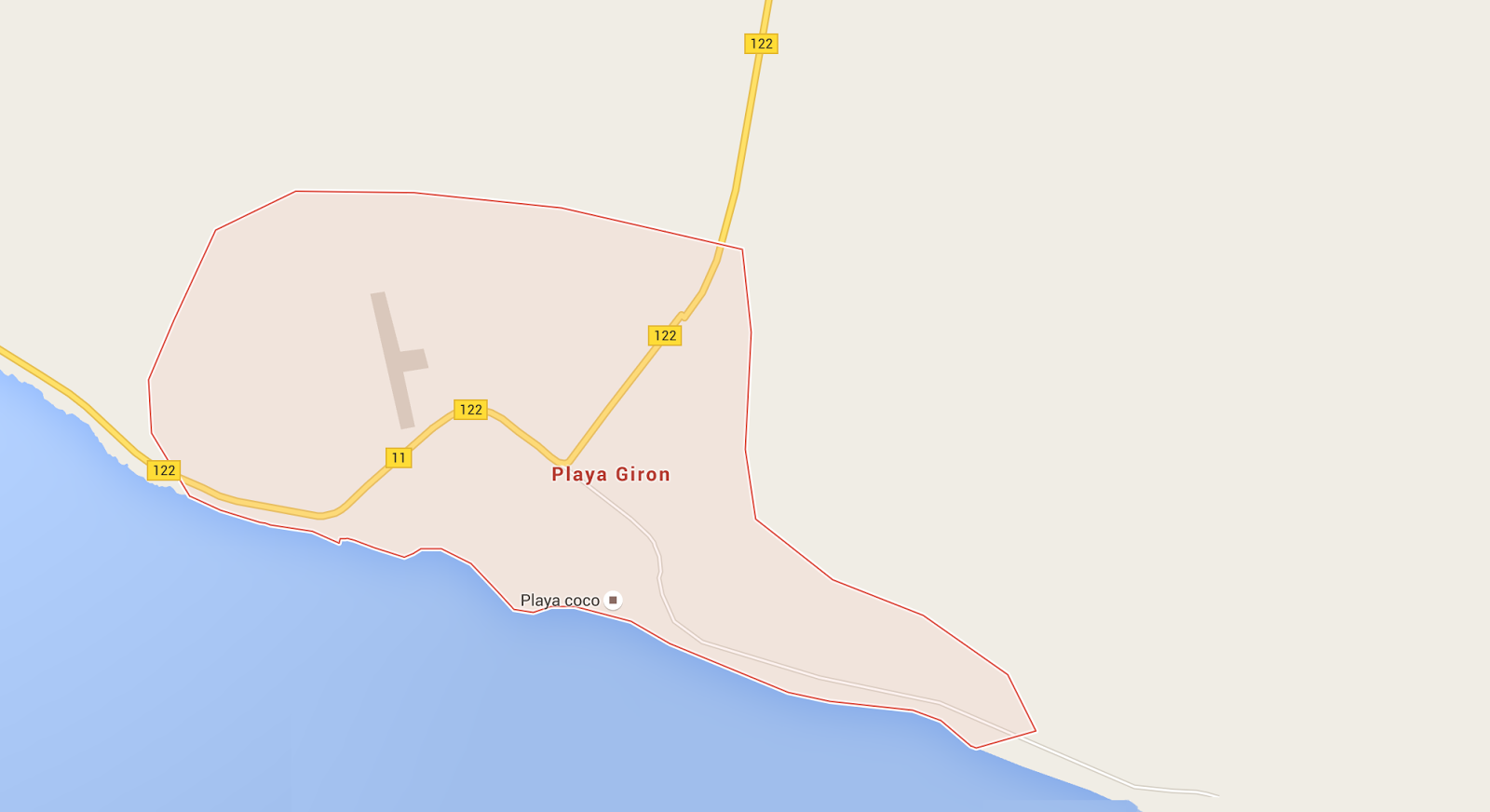
For comparison, I searched for Playa Giron using Google Maps and turned up this map:
In this case, the Cuban map shows more detail than Google's. While they cannot hope to compete with Google search, Wikipedia or a blogging service like Blogger or Wordpress, Cuba is in a position to develop better maps of Cuba than Google.
Cuba should stick to things in which they have a comparative advantage. Content like Spanish language entertainment and educational material and applications in areas where they have special needs and knowledge like appropriate-technology medicine. As the saying goes, "do what you do best and link to the rest."
-----
Update 8/11/2016
Cuba has unblocked access to the Revolico classified ad site in parts of their domestic intranet. Does that reflect a policy change? I wonder who made the decision and why they did it. I also wonder why it remains blocked in other internal networks. Uncoordinated bureaucrats?
-----
Update 7/2/2018
The original post announcing this portal has been deleted from the UCI Web site, but you can still see it at the Internet Archive. The portal has been redesigned and new links have been added since it was created.
A year ago, a team of students and employees at the University of Information Science (UCI) launched a digital portal designed to unify all services and applications available on the Cuban intranet. Doug Madory discovered that it is now available on the international Web at Redcuba.cu, so I took a look at it.
![]() |
| The front page of the Redcuba portal |
As you see above, the portal links to various services -- Papeleta, a "billboard" to advertise cultural events, Reflejos, a blog hosting site, Ecured, Cuba's would-be version of Wikipedia, Andariego, a Cuban map site and Cubadebate, an extensive pro-government news site. There are also links to a selection of government, health and education-oriented material.
But the centerpiece is a search engine for the Cuban intranet, so I checked that out with a vanity search on my name "larry press." It returned seven hits, dated between 2003 and 2015. Two were copies of this article on different sites and one was to this article, but none of the others worked. Three were to a Reflejos blog that had been "archived or suspended" and one returned a database error.
Well, I am evidently not a rock star on the Cuban intranet, but my friend Jesús Martínez Alfonso, who led the team that first connected Cuba to the Internet, must be -- right? Wrong. Five of his eight links were to broken pages that seemed to be trying to list committee members for a session at the recent Informatica 2016 conference in Havana. One of the good links was to this article (in which I had also been mentioned), another to this article on the early Internet and a link to a link to the previous article.
You get the picture -- this search engine cannot be compared to a Web search engine in any way, but that is not surprising. China may be the only nation that can support a search engine in competition with giants like Google, Microsoft or Yahoo. The infrastructure to support such an effort is nearly unimaginable and there is no point in Cuba trying to build a search engine unless it is as a teaching exercise for students at UCI. Building a search engine rather than allowing Google or another service to index their material is goofy. (The same goes for Reflejos and Ecured).
I was not familiar with the Andariego map service, so I also checked it out. As you see below, it has a bug -- only displaying the southern half of the island when you zoom out:
![]() |
| Andariego, the map service |
But, if you zoom in, the entire screen fills, as shown here in a search for Playa Giron:
![]() |
| Andariego map of Playa Giron |
For comparison, I searched for Playa Giron using Google Maps and turned up this map:
![]() |
| Google map of Playa Giron |
In this case, the Cuban map shows more detail than Google's. While they cannot hope to compete with Google search, Wikipedia or a blogging service like Blogger or Wordpress, Cuba is in a position to develop better maps of Cuba than Google.
Cuba should stick to things in which they have a comparative advantage. Content like Spanish language entertainment and educational material and applications in areas where they have special needs and knowledge like appropriate-technology medicine. As the saying goes, "do what you do best and link to the rest."
-----
Update 8/11/2016
Cuba has unblocked access to the Revolico classified ad site in parts of their domestic intranet. Does that reflect a policy change? I wonder who made the decision and why they did it. I also wonder why it remains blocked in other internal networks. Uncoordinated bureaucrats?
-----
Update 7/2/2018
The original post announcing this portal has been deleted from the UCI Web site, but you can still see it at the Internet Archive. The portal has been redesigned and new links have been added since it was created.
Subscribe to:
Posts (Atom)